

In Australian foreign policy, there has long been a tension between those who place preponderant weight on our alliance relationship with the United States and those who argue for drawing a greater sense of security from within the region.
For almost a generation, the former view has prevailed. We may now be witnessing some rebalancing towards the latter.
Stimulated by Chinese regional ambitions and the US administration’s erratic actions, our regional friends are increasingly exercising agency.
In the neighbourhood, concerns about China’s regional ambitions have run high for years, particularly in Japan and the Philippines. Vietnam is cautiously watchful.
China’s 6 July missile test directed towards the South Pacific is the sort of thing big powers do. But it did not win friends.
Self-evidently, the shift in US international conduct during President Donald Trump’s second term has severely affected the region. US tariffs have hit most of the region hard, and the war in Iran has inflated fuel costs.
The administration has left US alliance structures in East Asia alone. However, there are worries that Trump’s scorn for NATO could be replicated towards allies in this region, or that he could be attracted towards some form of power-sharing arrangement with China.
And such sense of US commitment as exists in East Asia is lacking elsewhere in the Indo-Pacific, namely in India and Southeast Asia.
First, on India.
From the early part of this century the US elevated its relationship with India to a genuine strategic partnership. A key component was a 2008 treaty allowing India to import nuclear fuel and technology for peaceful purposes. That treaty and the consequent bolstering of the US–India bilateral relationship were driven largely by mutual apprehension about the rise of China.
But since 2025, things have gone bad between the US and India. Two rounds of tariffs on India hurt. And after clashes between India and Pakistan in May 2025, India perceived a US tilt towards Pakistan.
The Quad – the grouping through which the US, India, Japan and Australia work together on common regional objectives – is still meeting at foreign minister level, but it has lost its mojo.
More recently, other doubts have arisen about the extent of US commitment to security in the Indian Ocean region.
Until the beginning of the 21st century, allied strategic focus was on East Asia and Southeast Asia. The area covered was called the Asia-Pacific, but there was ambiguity about whether India belonged in it.
In the event, the term ‘Indo-Pacific’ – a strategic construct designed to include South Asia and the Indian Ocean and first mooted by the late Japanese prime minister Shinzo Abe in New Delhi in 2007 – became increasingly common.
The term was adopted by the US during Trump’s first administration. In 2018, the US Pacific Command in Honolulu was renamed the Indo-Pacific Command.
But under Trump’s current administration, there have been scant references to the Indo-Pacific or indeed to the Indian Ocean. In June, the Pacific Command dropped its ‘Indo’ prefix.
This is not to suggest that the US will sail away from the Indian Ocean. It could argue that it is merely encouraging regional self-reliance. But nomenclature and symbols count, perhaps even more so when they are changed or removed.
Second, on Southeast Asia.
Historically, when the US has talked about East Asia, it has tended to mean Northeast Asia: China, Japan, the Koreas and Taiwan. The Vietnam War aside, it has never placed the same emphasis on Southeast Asia.
This remains the case today. US strategic focus is on the First Island Chain, which runs from Japan and South Korea through Taiwan and the Philippines, touching Vietnam.
But in most of Southeast Asia – including its engine room, Indonesia, and its intellectual hub, Singapore – the US is missing in action.
The plus is that the bigger regional countries, Japan and India, want to help fill the gap in South and Southeast Asia.
Japan has the best diplomatic system in the region. Surveys have shown it’s the country that’s most respected in Southeast Asia. In recent years, Japan has put its relationship with South Korea, sullied by Japan’s occupation of the latter between 1910 and 1945, into a better state of repair.
Japanese Prime Minister Sanae Takaichi’s July visit to India emphasised Japan’s intent to invest in the country and pursue defence and technology cooperation.
For its part, India has given more substance to its long-heralded push into Southeast Asia. It no longer talks of ‘looking east’ but of ‘acting east’. Indian Prime Minister Narendra Modi’s July visit to Indonesia, for example, resulted in an agreement to sell Indian missile systems.
And Australia is now looking more to the region for answers to our strategic quandaries. Takaichi’s visit here in May focused on defence issues, energy security and supply chain resilience. Political hooplah apart, outcomes of Modi’s visit to Australia in July included an agreement on the export of uranium to India and a joint declaration on defence and security.
There are other good stories:
Australia’s Keating-era treaty with Indonesia – the Agreement on Maintaining Security, abrogated during the 1999 East Timorese crisis – was in practice revived in February as the Australia–Indonesia Treaty on Common Security.
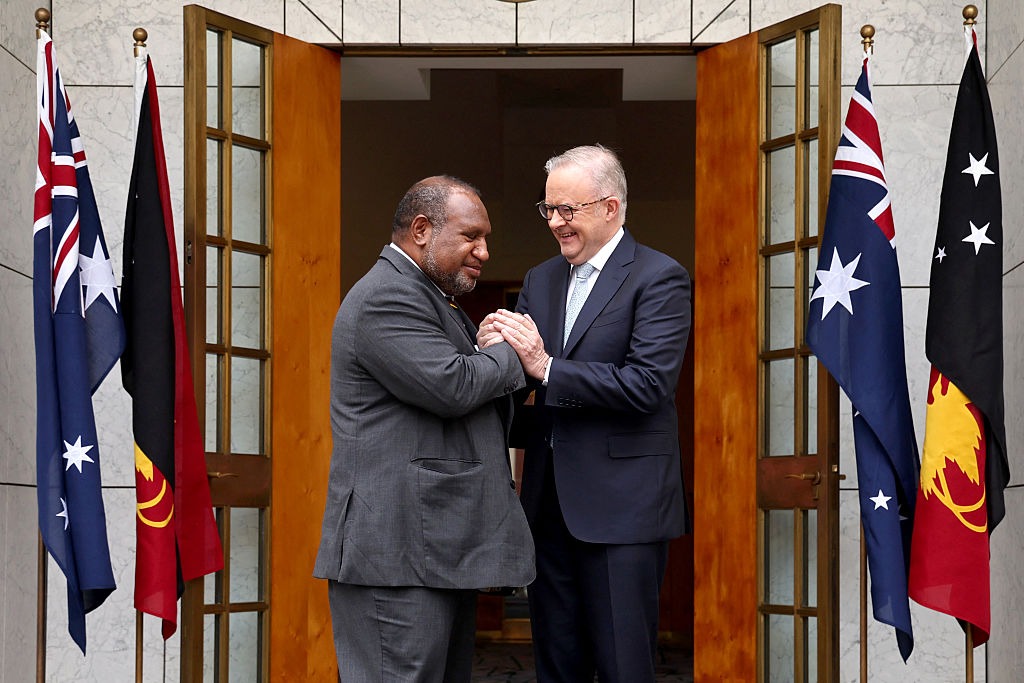
In October 2025, Australia and Papua New Guinea signed a mutual defence treaty. In the past month, Australia signed two treaties with Fiji and an agreement with Vanuatu.
These developments follow earlier agreements with Tuvalu and Nauru. Future arrangements are foreshadowed with the Solomons, Tonga and Samoa.
Adding all this up, regional countries are adopting double hedging strategies. They are hedging against the regional ambitions of China and against both the Trump administration’s perceived unreliability and an uncertainty about what comes after Trump. Australia is part of this process.
