

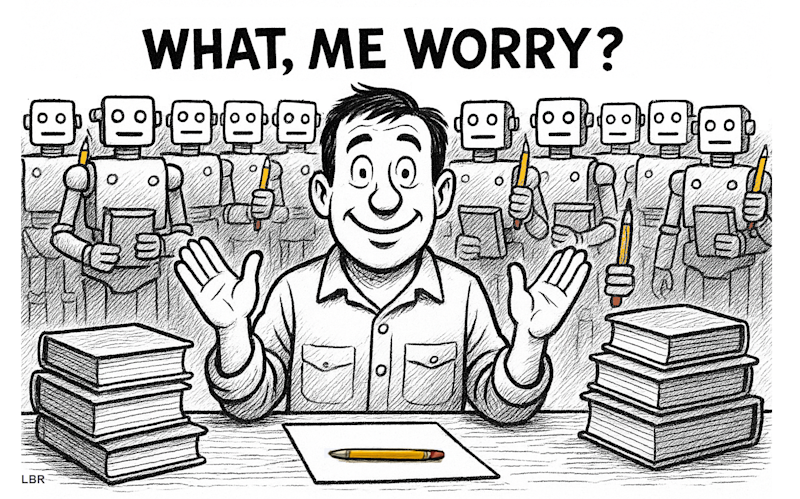
Three years ago, ChatGPT was born. It amazed the world and ignited unprecedented investment and excitement in AI. Today, ChatGPT is still a toddler, but public sentiment around the AI boom has turned sharply negative. The shift began when OpenAI released GPT-5 this summer to mixed reviews, mostly from casual users who, unsurprisingly, judged the system by its surface flaws rather than its underlying capabilities.
Since then, pundits and influencers have declared that AI progress is slowing, that scaling has “hit the wall,” and that the entire field is just another tech bubble inflated by blusterous hype. In fact, many influencers have latched onto the dismissive phrase “AI slop” to diminish the amazing images, documents, videos and code that frontier AI models generate on command.
This perspective is not just wrong, it is dangerous.
It makes me wonder, where were all these “experts” on irrational technology bubbles when electric scooter startups were touted as a transportation revolution and cartoon NFTs were being auctioned for millions? They were probably too busy buying worthless land in the metaverse or adding to their positions in GameStop. But when it comes to the AI boom, which is easily the most significant technological and economic transformation agent of the last 25 years, journalists and influencers can’t write the word “slop” enough times.
Doth we protest too much? After all, by any objective measure AI is wildly more capable than the vast majority of computer scientists predicted only five years ago and it is still improving at a surprising pace. The impressive leap demonstrated by Gemini 3 is only the latest example. At the same time, McKinsey recently reported that 20% of organizations already derive tangible value from genAI. Also, a recent survey by Deloitte indicates that 85% of organizations boosted their AI investment in 2025, and 91% plan to increase again in 2026.
This doesn’t fit the “bubble” narrative and the dismissive “slop” language. As a computer scientist and research engineer who began working with neural networks back in 1989 and tracked progress through cold winters and hot booms ever since, I find myself amazed almost every day by the rapidly increasing capabilities of frontier AI models. When I talk with other professionals in the field, I hear similar sentiments. If anything, the rate of AI advancement leaves many experts feeling overwhelmed and frankly somewhat scared.
The dangers of AI denial
So why is the public buying into the narrative that AI is faltering, that the output is “slop,” and that the AI boom lacks authentic use cases? Personally, I believe it’s because we’ve fallen into a collective state of AI denial, latching onto the narratives we want to hear in the face of strong evidence to the contrary. Denial is the first stage of grief and thus a reasonable reaction to the very disturbing prospect that we humans may soon lose cognitive supremacy here on planet earth. In other words, the overblown AI bubble narrative is a societal defense mechanism.
Believe me, I get it. I’ve been warning about the destabilizing risks and demoralizing impact of superintelligence for well over a decade, and I too feel AI is getting too smart too fast. The fact is, we are rapidly headed towards a future where widely available AI systems will be able to outperform most humans in most cognitive tasks, solving problems faster, more accurately and yes, more creatively than any individual can. I emphasize “creativity” because AI denialists often insist that certain human qualities (particularly creativity and emotional intelligence) will always be out of reach of AI systems. Unfortunately, there is little evidence supporting this perspective.
On the creativity front, today’s AI models can generate content faster and with more variation than any individual human. Critics argue that true creativity requires inner motivation. I resonate with that argument but find it circular — we’re defining creativity based on how we experience it rather than the quality, originality or usefulness of the output. Also, we just don’t know if AI systems will develop internal drives or a sense of agency. Either way, if AI can produce original work that rivals most human professionals, the impact on creative jobs will still be quite devastating.
The AI manipulation problem
Our human edge around emotional intelligence is even more precarious. It’s likely that AI will soon be able to read our emotions faster and more accurately than any human, tracking subtle cues in our micro-expressions, vocal patterns, posture, gaze and even breathing. And as we integrate AI assistants into our phones, glasses and other wearable devices, these systems will monitor our emotional reactions throughout our day, building predictive models of our behaviors. Without strict regulation, which is increasingly unlikely, these predictive models could be used to target us with individually optimized influence that maximizes persuasion.
This is called the AI manipulation problem and it suggests that emotional intelligence may not give humanity an advantage. In fact, it could be a significant weakness, fostering an asymmetric dynamic where AI systems can read us with superhuman accuracy, while we can’t read AI at all. When you talk with photorealistic AI agents (and you will) you’ll see a smiling façade designed to appear warm, empathic and trustworthy. It will look and feel human, but that’s just an illusion, and it could easily sway your perspectives. After all, our emotional reactions to faces are visceral reflexes shaped by millions of years of evolution on a planet where every interactive human face we encountered was actually human. Soon, that will no longer be true.
We are rapidly heading toward a world where many of the faces we encounter will belong to AI agents hiding behind digital facades. In fact, these “virtual spokespeople” could easily have appearances that are designed for each of us based on our prior reactions – whatever gets us to best let down our guard. And yet many insist that AI is just another tech cycle.
This is wishful thinking. The massive investment pouring into AI isn’t driven by hype — it’s driven by the expectation that AI will permeate every aspect of daily life, embodied as intelligent actors we engage throughout our day. These systems will assist us, teach us and influence us. They will reshape our lives, and it will happen faster than most people think.
To be clear, we are not witnessing an AI bubble filling with empty gas. We are watching a new planet form, a molten world rapidly taking shape, and it will solidify into a new AI-powered society. Denial will not stop this. It will only make us less prepared for the risks.
Louis Rosenberg is an early pioneer of augmented reality and a longtime AI researcher.
