


Capitalism requires strong competition to function properly, and because of that, I have always been enthusiastic about the clash of vendors and economic and technical substitution, which is not just a good idea but a law of economics.
I have watched the rise of GPU compute at Nvidia from the beginning, I have watched AMD fumble and stumble and eventually become credible in datacenter CPUs (for the second time) and in datacenter GPU accelerators (for the first time with the Instinct MI200 series).
But let’s be honest. AMD is hurting Intel, which has no datacenter GPU or indeed any AI accelerator to speak of, a hell of a lot more than it is hurting Nvidia. And that, I think, is mostly because AMD cannot make more Instinct GPUs because it cannot get more HBM allocations from Samsung, SK Hynix, and Micron. And to be perfectly frank, AMD is selling even fewer GPUs than it otherwise might because it is loading up the HBM memory on the Instinct MI400 series a lot more than is Nvidia with its “Blackwell” B200s and B300s and its “Rubin” R200s to get a more fair balance of compute and memory capacity.
I would argue that the Instinct MI500 series should have optical interposers and put disaggregated and composable HBM memory on trays adjacent to and interconnected with GPU accelerators, allowing for memory to be recycled and conserved as the GPU engines are swapped out with increasing capabilities, and that if AMD did this, it could have an intense architectural advantage over what Nvidia brings to market with static configurations that are intentionally under-memoried to ramp up GPU accelerator volumes. I doubt such a thing will happen, but it would be wonderful to see. Given the insane cost of DRAM in general, I wish the same thing for the future “Florence” Zen7 series of Epyc datacenter CPUs – trays of disaggregated and composable CPUs and DRAM banks so the DRAM can live on without having to throw it away as CPUs change.
No one is expecting such a thing as far as I know, and that is one reason why AMD is not really taking market share away from Nvidia in datacenter GPUs. And AMD is taking share from Intel in datacenter CPUs not only because it has designed a superior X86 product, but because it has taken care of its process nodes and supply chain of packaging and can actually grow its X86 shipments faster than Intel – and do so at a higher average selling price. We don’t have third quarter market share numbers as yet, but generally speaking, AMD has a little more than a third of X86 server CPU shipments and a little less than half of revenues for the first half of 2026.
The gap between Nvidia and AMD is growing, not shrinking, and is expected to get even wider. To keep the comparison simple, I am going to just use top line revenue across all products, which makes AMD look stronger than it is against Nvidia because of its very good client CPU and GPU businesses. But you will get the point.
In 2021, a year before the GenAI boom started with the emergence of a practical and usable ChatGPT chatbot API, Nvidia had $26.9 billion in sales and AMD had $16.4 billion, a gap of 1.64X in favor of Nvidia. GPU computing had been in the market for a decade and a half, so it was not like this was new. AMD was just finding its footing architecturally. In 2023, Nvidia started pulling even more ahead, with its nearly $60.9 billion in sales being 2.69X larger than the $22.7 billion that AMD took in, which was helped by the coronavirus pandemic PC buying boom. This year, thanks to the GenAI boom, even with all of its efforts and in part because AMD does not own the most lucrative parts of the networking for AI (scale across, scale out, and scale up networking), Nvidia is going to have somewhere on the order of $354 billion in sales, which will be 6.79X higher than the $52.2 billion that AMD might bring in. And three years hence, as Marvell was showing off in its charts justifying its $115 billion acquisition of optical component supplier Lumentum yesterday, one set of Wall Street consensus estimates has Nvidia raking in $1,091 billion in calendar 2029 compared to $164 billion for AMD – a gap of 6.65X, essentially unchanged from today.
Genetics is not destiny, and neither is forecasting, of course. But you can see that AMD cannot get enough HBM to make a dent in the Nvidia datacenter GPU business. So AMD will do what is sensible, and that is to make money on what it can manufacture, and that is just fine because the AI market is not really competitive as much as it is underserved, which always gives pricing power to the vendors. Which is why we see all of the hyperscalers and cloud builders, as well as some of the big AI model builders, designing and having manufactured their own compute engines, which are cheaper and more specialized.
With all that as a backdrop, let’s focus on AMD’s financial results for the third quarter of 2026, when its two variants of its “Helios” AI rackscale systems – one with CPUs for agentic AI sandboxes, and the other with a mix of Epyc CPUs and Instinct GPUs for AI training and inference – were ramping production.
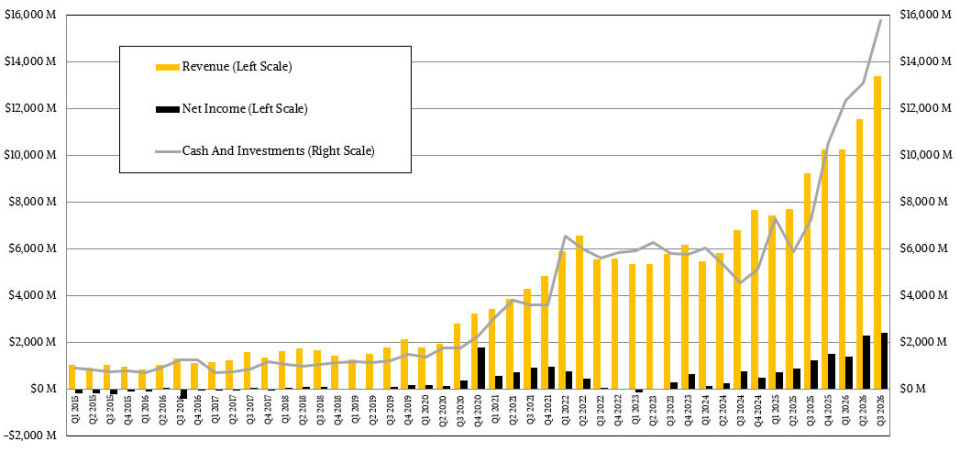
In Q3, AMD’s revenues were up 44.7 percent to $13.38 billion, and operating income was up by a factor of 2.2X to $2.83 billion as some of the costs for that Helion platform had been absorbed in prior quarters and as profits from the sales of components that go into these racks (which are made by OEMs and ODMs, not by AMD itself) started to rise. Net income was up 95.3 percent to $2.43 billion, which is 18.2 percent of revenues. AMD is inherently a lot less profitable than Nvidia, and sort of has to be, but these are nonetheless very good net margins for AMD.
The company’s cash hoard more than doubled year on year to $15.78 billion. It now has more than one quarter’s worth of revenue in the bank, which is a kind of security AMD has rarely experienced. This is a very healthy business in a cut-throat set of markets with very high production costs.
Two thirds of AMD’s revenues in the quarter came from datacenter products, which includes Epyc CPUs, Instinct GPUs, Pensando DPUs, and a few other things like Helios rack designs and ROCm software.
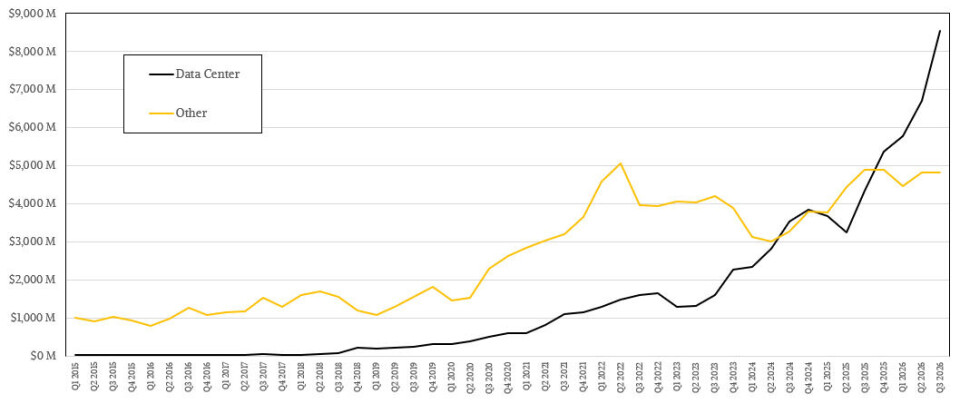
Data Center group revenues were $8.55 billion, up 96.9 percent and above the target growth rate of “more than 80 percent” that the company espoused a few months ago. Data Center group operating oncome was up by 2.7X to $2.88 billion, and comprising 33.7 percent of revenues.
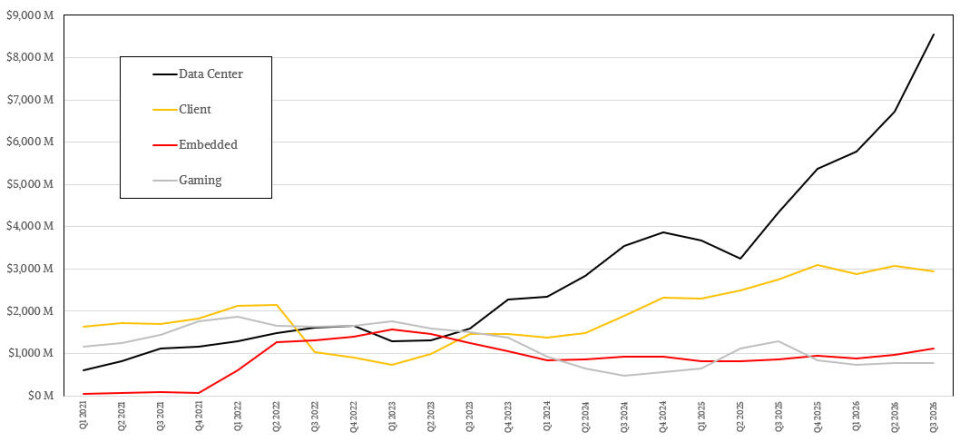
AMD’s Client group, which sells CPUs and GPUs for PCs, had $2.95 billion in sales, up a mere 7.2 percent, and in my model, operating income was down 18.8 percent to $401 million.
Gaming revenues – which means discrete Radeon GPUs aimed at gamers – brought in another $773 million, down 40.4 percent, which would be a crisis only a few years ago but it is now noise in AMD’s data. My best guess is that Gaming group operating income was $172 million, down 53.9 percent. (Why AMD consolidates profits for Client and Gaming but breaks out revenues for these two groups is beyond me. Why make us guess?)
Embedded revenues – meaning Xilinx FPGAs – drove $1.11 billion in sales, up 29.4 percent. Operating income here rose by 60.1 percent to $453 million. That is three times the profitability of the PC chip business for the company.
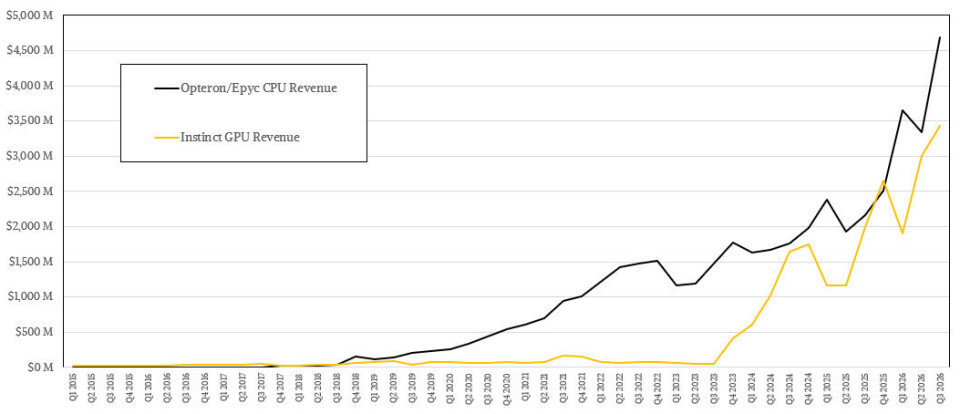
In the Data Center group, it was once again, for the third quarter in a row, the CPUs that drove the majority of revenues. We have to back into that to put some numbers on it.
On the call with Wall Street analysts, AMD chief executive officer Lisa Su said that sales of Epyc server CPUs to hyperscalers and cloud builders “more than doubled,” and so did sales of CPUs that would end up in servers aimed at enterprise, telco, service provider, government, and academic institutions. When I plug that into my model, taking a stab at what “more than doubled” might mean in each case, I think hyperscaler and cloud builder CPU sales were up 2.2X to $3.53 billion while the enterprise et al segment saw a 105 percent increase to $1.15 billion. That yields total Epyc CPU sales of $4.68 billion, up 116 percent year on year.
If you make some assumptions about how much AMD made selling Pensando DPUs and other NICs and datacenter-class FPGAs (very much noise in the data) plus components for CPU and GPU system boards, that means Instinct GPU sales came in at $3.43 billion, up 72.3 percent. If AMD had 5X times the memory allocations and could line up the packaging for more GPUs, do I think it could sell them? Abso-freaking-lutely. Could it sell 10X that amount? Quite possibly. The fact that AMD did not make that revenue tells you how the HBM allocations are shaking out.
In any event, the impending “Venice” Xen6 Epyc processors started shipping for revenue in Q3 2026, and Su said that the first OEM machines will be coming out before the end of the year. So far, OEMs and ODMs are making 240 different Venice platforms, a 20 percent increase over the design wins for the prior “Turin” Xen6 Epyc CPUs. Su also said that Helion racks stuffed with “Altair” MI455X GPUs had started shipping to Meta Platforms, Microsoft, OpenAI, and Oracle.
Looking ahead, Su said that AMD was raising its guidance for the datacenter business, saying it now expected 2026’s revenues to be more than double what it saw in 2025. And importantly, that the AI part of that business (meaning CPUs+GPUs+DPUs) would grow 50 percent sequentially in Q4 2026 and that means GPU sales will surpass CPU sales. Apparently, there is a bump of Helios iron coming out for production workloads.
“Our visibility into 2027 also continues to strengthen,” Su added. “Last quarter, we said we expected annual server revenue to grow more than 70 percent and datacenter segment revenue to more than double for the year. Since then, customers have expanded their EPYC and Instinct deployment plans, and we have secured more supply to support that growth. We now expect server revenue to double year-over-year in 2027 and datacenter AI revenue to grow even faster than we projected 90 days ago. As a result, we expect datacenter to be more than 80 percent of our total revenue in 2027 and to drive the majority of our revenue and earnings growth.”
