

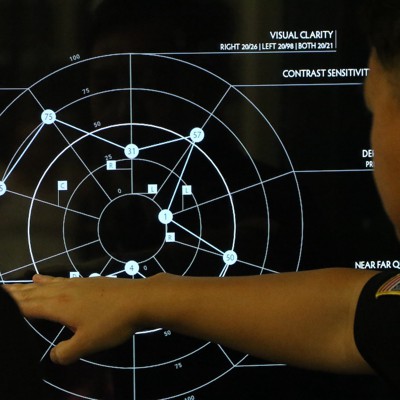
FORT BENNING, Georgia–U.S. military leaders at the forefront of troops’ training, health, and readiness are shifting their focus from creating “super-athletes” to building and maintaining the ability to wield the weapons and systems of an ever-more-robotified battlefield.
“We’re moving away from this kind of antiquated idea of very visceral combat experiences” that turn on “the ability to run and ruck,” said Drew Hammond, a human-performance specialist who has worked extensively with U.S. Special Operations Command. Combat effectiveness now requires building up “a lot of the intrinsic motivators that soldiers may not necessarily have prioritized years ago when all we focused on was PT scores,” Hammond said. “It’s the ability to be cognitively present in what you’re doing. And that’s a very different beast.”
Hammond spoke at Human Performance Symposium, which gathered human-performance leaders and experts at this Georgia base long known as the home of the infantry and more recently as the center of Army training for maneuver—the tactical movement of soldiers and equipment to gain an advantage over enemies. (The conference was organized by FBC, a corporate sister of Defense One.) Soldier performance, whether it’s taking physical territory or working cyber or drone piloting missions, is at the heart of that activity, said Maj. Gen. Colin Tuley, who leads the Maneuver Center of Excellence.
All future company and troop commanders, as well as about two-thirds of platoon leaders, come through Fort Benning for training. That’s one reason why the fort is also the home to the Army’s Holistic Health and Fitness Academy, which is to dramatically expand in the coming year.
“This is going to be that headquarters for the Army [holistic health and fitness training]. I want to have that flagpole planted here by early summer,” Tuley said. “The program will expand to a total of 111 brigades that include the additional human performance areas of support teams.”
Col. Jay Morgan, the holistic health and fitness director, laid out how individual soldier data on sleep and wellness will play a large role in that, in addition to traditional military fitness benchmarks. His team is working to incorporate soldier-borne devices into regular activity to provide a fuller data picture of how soldiers are actually feeling and performing, not just how well they’re meeting physical requirements.
“We’ll move into a prototype phase over the next 45 days, beginning at the end of the month,” Morgan said regarding a wearable device that meets security requirements. “Our goal is to get out to the 101st [Airborne Division] early third quarter and begin to pilot this. Really, our litmus test is: Are soldiers using it?”
‘Human weapon systems’
A spokesperson for Fort Benning emphasized that they don’t yet know exactly how they will implement changes to holistic health and fitness training.
However, new technologies like wearable biometric trackers and consumer-facing artificial intelligence are opening opportunities to understand how military operators will perform not just on physical tasks, but across the wide number of increasingly technological challenges that characterize modern warfare, said Hammond, who has worked with USSOCOM.
But it’s also a measurable beast, said Chris Myers, a researcher at the Air Force Research Lab who specializes in human performance. Much of Myers’ work hinges on a fundamental rethinking of what military activity is in an age dominated by rapid technological innovation cycles and faster, data-fueled operations. In this reality, military performance should be treated not like athletic training, but more like the buying and maintaining of a complex weapon.
“When you start looking at our human beings as a human weapon system, you can start looking at it through a lens of acquisitions, which really has three different proponents: procurement, fueling and sustainment, and disposition,” Myers said. “So basic training, feeding and nutrition, and actually monitoring the operator’s health and performance—not just yelling at them to do more.”
He described recent experimental efforts with the U.S. Space Force using Garmin biometric trackers and other pieces of equipment. Garmin, as a company, is well-positioned for this new era of military performance in large part because they’ve been cleared for use in the sorts of highly secured environments where operators find themselves.
Myers’ team had to build a holistic data architecture around what the Space Force guardians were telling them, wordlessly, through their data.
“One thing to understand about the guardians and the airmen involved with this study is that they spend most of their time in SCIFs, so they have to be able to work out in that secret environment,” he said.
Their findings showed how to increase performance across a range of physical tasks, like respiratory health and passing physical tests. But they were also able to make training less stressful for guardians by helping them avoid last-minute cramming for performance evaluations.
The next step, Myers said, is to expand the types of data that they will collect.
“We’re going to look at different metabolic markers, inflammation markers, and we’re also collecting preventative domain survey data and stress management data,” he said.
Hopefully, he said, that will enable them to better understand not just how well a given military operator is doing mentally and physically, but how well they will be able to perform key tasks and carry out specific missions.
“We’re really trying to get to that nitty-gritty: Does it move the operational needle?”
