


Human activity causes most of the wildfires breaking out across Europe, but their spread, speed and intensity are strongly affected by the warmer, drier conditions associated with climate change as well as with changing land use.
More than 600,000 hectares of land have burned within European Union countries in the first eight months of 2026, according to the European Forest Fire Information System.
That’s below the area recorded by the same date in 2025 (the worst year on record), but it far exceeds the 20-year average of around 280,000 hectares, and preparing for wildfires is key, UN agencies say.
Risks are growing
While most fires have occured in historically fire-prone countries such as France and Spain, extremely dry conditions are putting many areas in Western and Central Europe, including the UK and southern Scandinavia, at increased risk.
In the immediate future, wildfire risks may be compounded by the developing El Niño, a recurrent natural climate phenomenon, which can further influence temperatures and rainfall patterns and increase the likelihood of climate extremes.
Many countries with a history of wildfires are now experiencing more frequent and larger blazes, over longer periods. At the same time, other countries in traditionally cooler or wetter areas are also preparing for the prospect of dealing with more wildfires.
Scotland’s burning forests
A wildfire took hold in the Cairngorms mountains of Scotland in mid-July. The area has experienced wildfires before, but due to this year’s exceptionally dry conditions, the fire penetrated the dry peat layer, causing hotspots and flare-ups that resisted containment.
More than 500 firefighters fought the blazes, with aerial support to put out fires – while bulldozers were called in to dig firebreaks.
High winds pushed the unpredictable blaze towards the village of Nethy Bridge.
Evacuation orders
Nine days on from the outbreak, Police Scotland declared a major incident and many of Nethy Bridge’s 600 residents were evacuated, including James MacEwan, who described a worrying stretch of days without any rainfall amid the growing blaze.
“We were very fortunate that the wind remained from the west and took the fire towards the hills, otherwise we would have had a serious threat to property and possibly life,” he said. “The downside was that this took the fire into relatively inaccessible terrain and made containing it extremely difficult.”
It was over a month from the time that the fire started until the Scottish Fire and Rescue Service officially stood down firefighting crews.
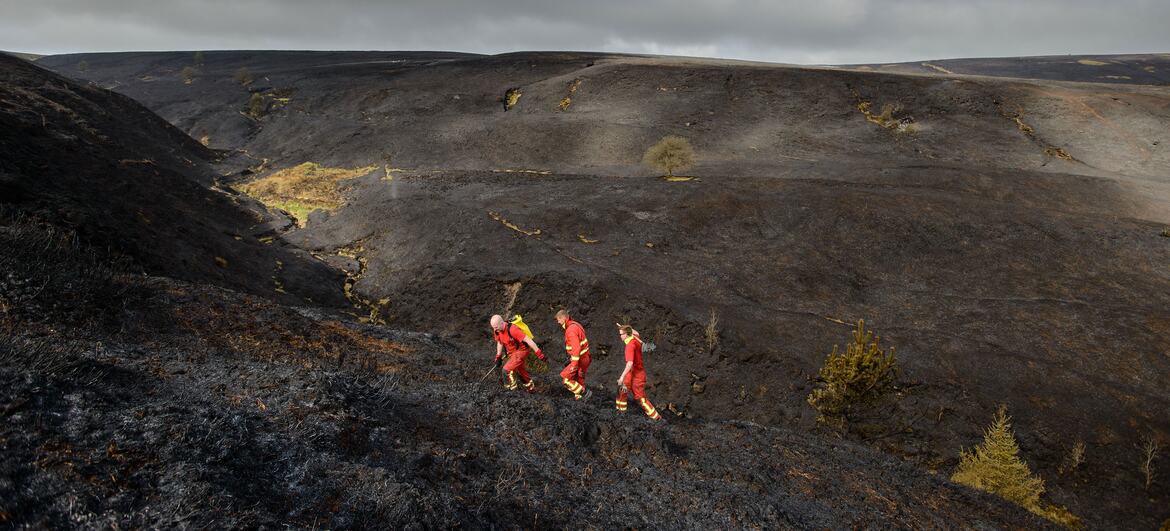
© Climate Visuals/Alastair
Firefighters in the scorched moorlands of the United Kingdom work to contain a wildfire. (file)
Preparing for the future
The risk is now extending far beyond the Mediterranean, said Will Hayes, a researcher with the UK’s Leverhulme Centre for Wildfires, Environment and Society.
Growing wildfire concerns have already emerged in the Atlantic uplands of Ireland and Scotland as well as other parts of Northern and Central Europe, he said.
“These areas are not becoming Mediterranean landscapes, but traditionally wetter, cooler regions are now experiencing more frequent windows where increasing amounts of vegetation is dry enough to burn and fires can spread,” Mr. Hayes warned.
“People should not assume that wet or green landscapes are immune to fire. During dry, warm and windy periods, vegetation can become highly flammable, even in upland and northern regions.”
He suggested avoiding campfires, barbecues and careless ignition sources – such as cigarette lighters – during high-risk weather, and following local fire warnings.
Assessing risks
Preparedness for wildfires is also important at the national level, Mr. Hayes said.
“Wildfire prevention is not just about fire services, it is about how landscapes are managed before they burn,” he explained. “Wildfire risk should be treated as a land-use, climate-adaptation and public-health issue, not just an emergency-response problem.”
The World Health Organization (WHO) Strategic Toolkit for Assessing Risks (STAR) methodology enables public health authorities to work alongside other sectors to rapidly conduct a strategic and evidence-based assessment of public health risks that includes the risk of heat and wildfires.
Smarter readiness
Countries such as Cyprus and Ireland have recently completed their first-ever assessment workshops, which used the STAR methodology to identify and prioritise pressing health hazards, from heatwaves to wildfires.
The workshops lay the groundwork for smarter, more strategic emergency preparedness and readiness investments.
WHO has run 38 national strategic risk assessment workshops in Europe since 2018, and its STAR is recognised as one of the core elements of international health regulations (IHR) and the Sendai Framework for Disaster Risk Reduction.
Growing public health threat
Tanja Schmidt, WHO Europe’s programme manager on preparedness in the health security division, said extreme heat and wildfires are no longer only environmental emergencies.
“They are growing public health threats that directly affect people’s health as well as health systems,” she said.
“Across the region, countries are increasingly using all-hazards national risk assessments to understand climate-driven risks, identify cascading impacts and prioritise preparedness actions. Ultimately, this helps protect communities, prioritising those most vulnerable and ensuring that health systems are ready to respond.”
Learn more about WHO’s risk assessment tool kit here.
