
LIVE NEWS
  • ShinyHunters Extorted Boeing Spin-off Prior to Arrests – Krebs on Security
  • Ukraine can help Europe counter Russia’s escalating shadow war
  • Why is Applied Optoelectronics stock surging today?
  • Zcash developers set January target for quantum-resistant payments after ‘bunker mode’ scare
  • To capture impact of abortion restrictions, researcher Betsy Pleasants studies Reddit
  • Hurricane Isaias live updates: Gulf coast braces for storm, Florida declares state of emergency
  • Claude can now build your dashboards
  • Trump administration investigates universities for J-1 visa fraud
Prime Reports
  • Home
  • Popular Now
  • Crypto
  • Cybersecurity
  • Economy
  • Geopolitics
  • Global Markets
  • Politics
  • See More
    • Artificial Intelligence
    • Climate Risks
    • Defense
    • Healthcare Innovation
    • Science
    • Technology
    • World
Prime Reports
  • Home
  • Popular Now
  • Crypto
  • Cybersecurity
  • Economy
  • Geopolitics
  • Global Markets
  • Politics
  • Artificial Intelligence
  • Climate Risks
  • Defense
  • Healthcare Innovation
  • Science
  • Technology
  • World
Home»Cybersecurity»Bots with good manners are better at fooling people on social media
Cybersecurity

Bots with good manners are better at fooling people on social media

primereportsBy primereportsSeptember 19, 2026No Comments3 Mins Read
Share Facebook Twitter Pinterest LinkedIn Tumblr Reddit Telegram Email
Bots with good manners are better at fooling people on social media
Share
Facebook Twitter LinkedIn Pinterest Email


Most people can’t tell a bot from a human online, and the bots most likely to fool them are the polite ones, according to a new Surfshark study.

The company analyzed 1,722 participants worldwide, testing their ability to separate human comments from AI-generated ones in a social media setting. Overall, people caught just 40% of the bots placed in front of them.
social media bot detection

(Source: Surfshark)

The bots that slipped by most often weren’t loud or aggressive. They were positive, friendly, and logical-sounding, the exact traits that make a stranger’s comment feel safe to trust.

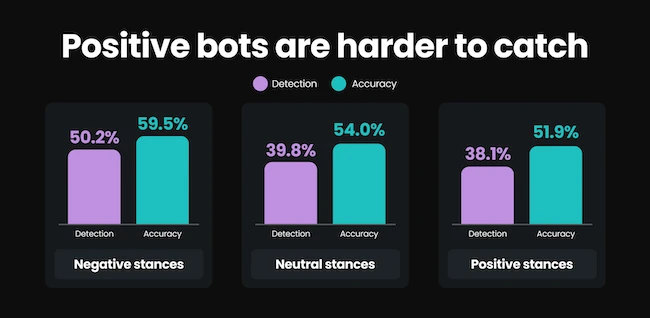
“On social media, everyone notices the angry trolls. That’s why the angry trolls are the ones who often get caught. In the simulated social media environment, participants flagged half (50.2%) of negative AI-generated bots,” said Luís Costa, Research and Insights Lead at Surfshark.

When a bot took on a positive, agreeable persona, detection dropped to 38%, a 12-point gap from the negative bots.

“Often, AI-powered accounts used in sophisticated manipulation campaigns are agreeable, logical, or simply unremarkable. They can support real users’ opinions and just inflate the number of comments in the discussion to make a minority view look like everyone feels the same way. Seldom do people report such accounts,” added Costa.

Serious topics make it worse

Participants spotted more bots on light topics, like pineapple on pizza, than on serious ones, like women’s rights. On the more serious topic, people weren’t only missing more bots. They were also wrongly accusing more real humans of being fake.

Neutral bots caused similar trouble, ranking near the bottom for detection across most topics. Immigration was the exception. Negative bots were still easiest to catch there, but positive bots were the hardest of all four topics to spot.

Bots that used emojis heavily were caught over 60% of the time, while bots that kept their language plain were detected only 35% of the time. An account that simply stops overusing emojis becomes twice as hard to identify.

Friendly bots do more damage than angry ones

Researchers argue that the agreeable, logical bot is a bigger privacy and security concern than the confrontational one, precisely because it doesn’t set off suspicion.

A bot that agrees with someone, sounds reasonable, and never picks a fight doesn’t register as a threat. People are more likely to move that conversation into private chat, hand over personal details, click a link, or accept a “logical” argument at face value, without knowing they’re talking to a machine.

Contact like that can shift someone’s political or social views before they ever suspect they’ve been talking to a bot.

Platform, age, and habits all play a role

Text-driven platforms performed better than visual ones. Threads users had the highest detection rate in the study, though Surfshark notes this is based on a small sample. X users followed close behind. TikTok and Facebook users trailed well behind both.

Detection peaked among the youngest players and declined steadily from there, bottoming out among people over 50, the lowest score of any group. Over-50s also had the weakest accuracy, meaning they were the most likely to wrongly flag a real person as a bot.

People on social media “almost all the time” caught close to half the bots they saw, while people who don’t use social media at all caught roughly a third.

Share. Facebook Twitter Pinterest LinkedIn Tumblr Email
Previous ArticleUkraine’s Companies, Soldiers Want Drones That Need Less Human Control
Next Article Scammers Drain $73,000 From Chase Account After Posing As Bank Fraud Investigators
primereports
  • Website

Related Posts

Cybersecurity

ShinyHunters Extorted Boeing Spin-off Prior to Arrests – Krebs on Security

October 9, 2026
Cybersecurity

Authorities seize sites selling hacked, stolen intimate images of 17,000 women and girls

October 8, 2026
Cybersecurity

SonicWall warns of max severity SSRF flaw in SMA1000 gateways

October 7, 2026
Add A Comment
Leave A Reply Cancel Reply

Top Posts

Threat of further violence looms after Mexican cartel rampage

February 25, 2026116 Views

‘Two-sided risk’ Medicare Advantage plans improve patient outcomes

February 24, 202673 Views

An $18bn settlement – and Zuckerberg barely blinked. The tech titans must be stripped of their power, and soon | Jonathan Freedland

August 28, 202626 Views
Stay In Touch
  • Facebook
  • YouTube
  • TikTok
  • WhatsApp
  • Twitter
  • Instagram
Latest Reviews

Subscribe to Updates

Get the latest tech news from FooBar about tech, design and biz.

PrimeReports.org
Independent global news, analysis & insights.

PrimeReports.org brings you in-depth coverage of geopolitics, markets, technology and risk – with context that helps you understand what really matters.

Editorially independent · Opinions are those of the authors and not investment advice.
Facebook X (Twitter) LinkedIn YouTube
Key Sections
  • World
  • Crypto
  • Cybersecurity
  • Geopolitics
  • Artificial Intelligence
  • Global Markets
All Categories
  • Artificial Intelligence
  • Climate Risks
  • Crypto
  • Cybersecurity
  • Defense
  • Economy
  • Geopolitics
  • Global Markets
  • Healthcare Innovation
  • Politics
  • Popular Now
  • Science
  • Technology
  • World
  • About Us
  • Contact Us
  • Privacy Policy
  • Terms & Conditions
  • Disclaimer
  • Cookie Policy
  • DMCA / Copyright Notice
  • Editorial Policy

Sign up for Prime Reports Briefing – essential stories and analysis in your inbox.

By subscribing you agree to our Privacy Policy. You can opt out anytime.
Latest Stories
  • ShinyHunters Extorted Boeing Spin-off Prior to Arrests – Krebs on Security
  • Ukraine can help Europe counter Russia’s escalating shadow war
  • Why is Applied Optoelectronics stock surging today?
© 2026 PrimeReports.org. All rights reserved.
Privacy Terms Contact

Type above and press Enter to search. Press Esc to cancel.