

Anthropic’s Claude Managed Agents are a suite of composable APIs for building and deploying cloud-hosted agents at scale, handling sandboxed code execution, checkpointing, credential management, scoped permissions, and end-to-end tracing for you.
Developers can define tasks, tools, and permissions within a managed environment, while the platform handles execution and state management. The product is currently available in public beta on the Claude Platform.
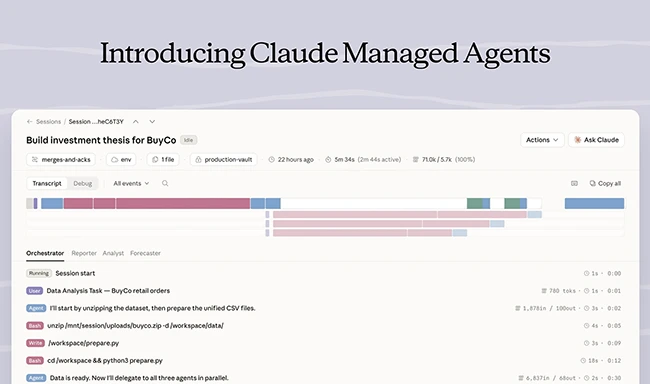
“Until now, building agents meant spending development cycles on secure infrastructure, state management, permissioning, and reworking your agent loops for every model upgrade. Managed Agents pairs an agent harness tuned for performance with production infrastructure to go from prototype to launch in days rather than months,” the company said.
Managed Agents are priced on consumption. Standard Claude platform token rates apply, with an additional charge of $0.08 per session-hour for active runtime.
Execution, memory, and control
Claude Managed Agents run in sandboxed environments with support for persistent memory, allowing agents to retain context across interactions and complete multi-step tasks without additional orchestration.
The platform includes permission controls that define how agents access data and interact with external systems. Monitoring provides visibility into agent activity and supports governance.
Built for agent workflows
Claude Managed Agents are designed for agent-driven workflows using Claude models. Developers can define outcomes and success criteria, allowing agents to iterate toward a result (available in research preview).
In internal testing focused on structured file generation, Managed Agents improved task success rates by up to 10 points over standard prompting loops, with the largest gains on the hardest problems.
The Claude Console includes session tracing, integration analytics, and troubleshooting tools, allowing developers to inspect tool calls, agent decisions, and failure modes.
Early use cases and deployments
Anthropic says teams are using Managed Agents across production workflows, including coding, task automation, and document processing.
“Turns out telling developers what’s wrong with their code isn’t enough: they want you to fix it too. Customers can now go from Seer’s root cause analysis straight to a Claude-powered agent that writes the fix and opens a PR. We chose Claude Managed Agents because it gives us a secure, fully managed agent runtime, allowing us to focus on building a seamless developer experience around the handoff. Managed Agents allowed us to build the integration in weeks and removed the operational overhead of maintaining agent infrastructure,” said Indragie Karunaratne, Senior Director of Engineering, AI/ML at Sentry.
In software development, agents can analyze a codebase, plan fixes, and open pull requests. In business workflows, agents can take on tasks and generate outputs such as documents or presentations. Other use cases include processing financial and legal documents.
