


In Nevada, Attorney General and Democratic candidate for governor Aaron Ford’s campaign has said Gov. Joe Lombardo, a Republican, “botched negotiations” over the future of the Colorado River.
In neighboring Arizona, Rep. Andy Biggs, the Republican Party’s candidate for governor, has said Democratic Gov. Katie Hobbs has cost the state millions of gallons of water from the river.
And the Trump administration accused Hobbs of “playing politics instead of working toward meaningful solutions” when the state filed a motion to join Nevada in its lawsuit against the federal government’s new framework for managing the river after offering no comment on the initial suit filed by the Republican-led state. None of the candidates’ campaigns responded to requests for comment from Inside Climate News.
These barbs come in the waning days before the midterm elections, when six of the seven Colorado River Basin states will cast ballots to elect governors.
Most of those races are likely to have results consistent with the states’ current partisan splits. The Democratic nominee in California, Xavier Becerra, is heavily favored to win his race over Republican Steve Hilton. In Colorado, Democrat Phil Weiser, the current attorney general, has a strong lead over Republican Victor Marx, and in New Mexico, former U.S. Secretary of the Interior Deb Haaland has a comfortable lead over her opponent, Republican Gregg Hull. In Wyoming, Republican state Sen. Eric Barlow holds a commanding lead over Democrat Kenneth Cassner. Ford and Lombardo, however, are locked in a tight race, while Hobbs enjoys more of a cushion over Biggs, according to the polls.
Whoever prevails on election day will be responsible for steering their state through the next political chapter of the Colorado River, where a history of overuse and a historic and punishing drought have made access to water resources one of the biggest flashpoints in the region during this year’s midterms.
Despite any overhaul of leadership in Colorado River Basin states, the basin’s politics are not guaranteed to change, and water is not an equally urgent issue in every race.
“Whether Republicans or Democrats are in charge nationally, or in any of the states, it doesn’t usually make a lot of difference,” said Gary Wockner, founder of the environmental group Save the Colorado, who has lived in the Colorado River Basin for 40 years.
“Water politics are surprisingly nonpartisan—not in an environmentally good way,” he added. “Everyone wants to drain the river and get every drop they legally are allowed to get, or that they think they can get.”
Years of negotiations over how to share the river among the seven Colorado River Basin states have so far failed, leaving the federal government to impose a 10-year framework for water cuts. Those allocation reductions fall exclusively on California, Arizona and Nevada—the Lower Colorado River Basin states—with the latter two suing the Department of Interior over the plan. A large lawsuit involving all seven states, experts say, is still a looming possibility, as the Lower Basin and Upper Basin states disagree over key clauses in the compact that governs the river’s operations.
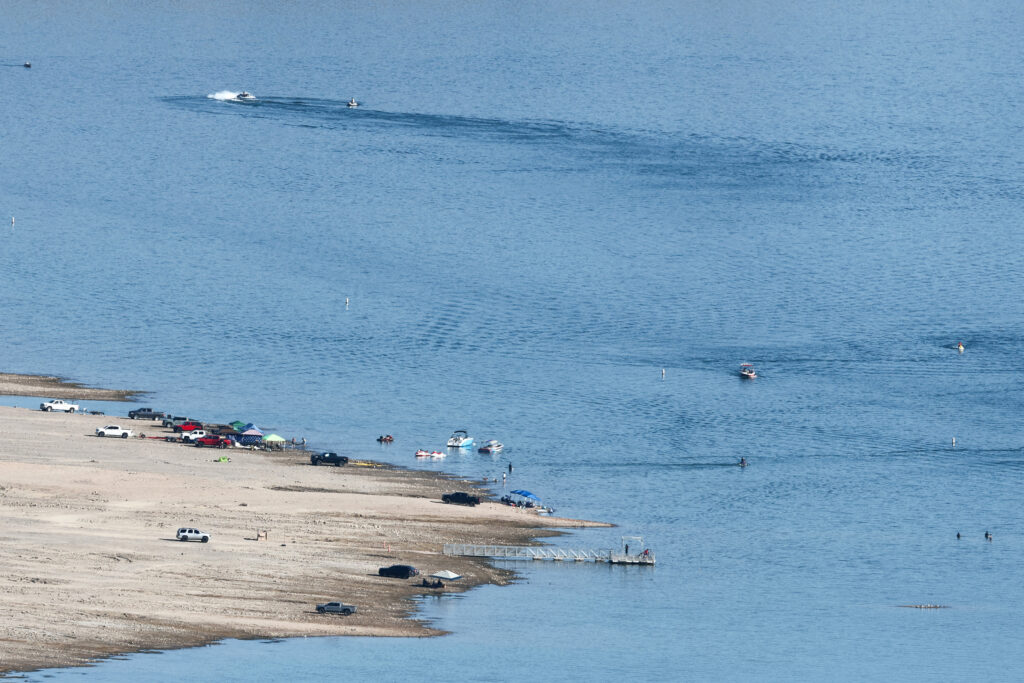
Negotiations over new rules have stalled as the Upper and Lower basins disagree over the size and extent of the necessary cuts, and which states must endure them. The Lower Basin, which historically used more water than it is entitled to, but no longer does, has proposed taking less water under certain drought conditions, past which more cuts would be shared equally between the two basins. The Upper Basin, which has never used its full allotment, has strenuously resisted taking mandatory cuts, arguing that their communities’ position at the headwaters of the basin, where there is more hydrological uncertainty, makes such a move unworkable. The negotiations continue, despite Nevada and Arizona’s lawsuit, but a deal seems no closer.
“This is probably the most pessimistic I’ve ever been about the states being able to reach a consensus,” said Elizabeth Koebele, an associate professor of political science at the University of Nevada, Reno, who researches water policy.
Water is a top issue for many voters in the West. In states like Arizona—where Phoenix could lose all of its supply from the Colorado River in some scenarios under the federal government’s plan—polling from the Center for the Future of Arizona found 69 percent of voters don’t have confidence in the state having enough water in the long-term.
This story is funded by readers like you.
Our nonprofit newsroom provides award-winning climate coverage free of charge and advertising. We rely on donations from readers like you to keep going. Please donate now to support our work.
But farther north, in Colorado, New Mexico and Wyoming, water has figured less prominently in this year’s gubernatorial elections, and those states face no mandatory water cuts under the new federal plan. “They won,” said Wockner, who has sued to prevent Colorado, where he lives, from drawing more water from the river. “They don’t have to say anything.”
A representative for Attorney General Phil Weiser’s gubernatorial campaign declined to comment for this story. A staffer for state Sen. Eric Barlow’s campaign did not respond to a list of questions by the time of publication.
The politics of the Colorado River have become so entrenched that lawmakers in both parties tend to adopt similar positions once they’re in office.
“It’s one thing to use [Colorado River water] as a point during a campaign, and then it’s another thing once the campaign’s over and people are in office” and must make decisions, said Sarah Porter, director of the Kyl Center for Water Policy at Arizona State University.
Porter said it’s unclear how exactly the election will shake up negotiations over the river’s future, and the positions of each state are unlikely to change much. But it is clear “there are personal feelings involved” among the state’s top negotiators, she said.
“When it feels personal, and when people have been there for a very long time, maybe there’s a way to transition to some new people with the potential for finding a way to reach new kinds of agreements that the [current] parties involved haven’t been able to reach,” Porter said.
With tensions so high across the basin, newly elected officials will need to lower the temperature, said Celene Hawkins, Colorado River program director at The Nature Conservancy.
“My hope is, regardless of the outcome of the elections, that we will see a commitment from elected leaders across the basin, and negotiators and staff from state and federal agencies, to finding the long-term solution,” she said. “It’s really hard, but we need to keep working on building that consensus and finding the path to managing a river in a potentially much hotter and drier future for the basin.”
About This Story
Perhaps you noticed: This story, like all the news we publish, is free to read. That’s because Inside Climate News is a 501c3 nonprofit organization. We do not charge a subscription fee, lock our news behind a paywall, or clutter our website with ads. We make our news on climate and the environment freely available to you and anyone who wants it.
That’s not all. We also share our news for free with scores of other media organizations around the country. Many of them can’t afford to do environmental journalism of their own. We’ve built bureaus from coast to coast to report local stories, collaborate with local newsrooms and co-publish articles so that this vital work is shared as widely as possible.
Two of us launched ICN in 2007. Six years later we earned a Pulitzer Prize for National Reporting, and now we run the oldest and largest dedicated climate newsroom in the nation. We tell the story in all its complexity. We hold polluters accountable. We expose environmental injustice. We debunk misinformation. We scrutinize solutions and inspire action.
Donations from readers like you fund every aspect of what we do. If you don’t already, will you support our ongoing work, our reporting on the biggest crisis facing our planet, and help us reach even more readers in more places?
Please take a moment to make a tax-deductible donation. Every one of them makes a difference.
Thank you,

Reporter, Phoenix
Wyatt Myskow covers drought, biodiversity and the renewable energy transition throughout the Western U.S. Based in Phoenix, he previously reported for The Arizona Republic and The Chronicle of Higher Education. Wyatt has lived in the Southwest since birth and graduated from Arizona State University with his bachelor’s degree in journalism.

Reporter, Wyoming and the West
Jake Bolster reports on Wyoming and the West for Inside Climate News. Previously, he worked as a freelancer, covering climate change, energy, and the environment across the United States. He holds a Masters in Journalism from Columbia University.
