LIVE NEWS
  • Calley Means says WH insiders, industry lobbyists foiled MAHA plans
  • Google just made Googlebooks faster, more stable, and less crash-prone
  • ZachXBT revisits Ansem warnings amid Sahil payment claims
  • Fed’s Mary Daly says higher interest rates ‘are likely to be needed’ in inflation fight
  • Claude Code’s “Don’t Ask Again” File Exposes Passwords and Keys in 1,122 Public Copies on GitHub
  • Sudan war and climate change see parents struggle to feed their children | Features News
  • Environmental groups embrace AI, even as they warn of data center impacts
  • An unexpected activist helped block a $5 billion data center : NPR
Prime Reports
  • Home
  • Popular Now
  • Crypto
  • Cybersecurity
  • Economy
  • Geopolitics
  • Global Markets
  • Politics
  • See More
    • Artificial Intelligence
    • Climate Risks
    • Defense
    • Healthcare Innovation
    • Science
    • Technology
    • World
Prime Reports
  • Home
  • Popular Now
  • Crypto
  • Cybersecurity
  • Economy
  • Geopolitics
  • Global Markets
  • Politics
  • Artificial Intelligence
  • Climate Risks
  • Defense
  • Healthcare Innovation
  • Science
  • Technology
  • World
Home»World»COP17: Which countries have released new pledges to tackle nature loss?
World

COP17: Which countries have released new pledges to tackle nature loss?

primereportsBy primereportsOctober 18, 2026No Comments4 Mins Read
Share Facebook Twitter Pinterest LinkedIn Tumblr Reddit Telegram Email
COP17: Which countries have released new pledges to tackle nature loss?
Share
Facebook Twitter LinkedIn Pinterest Email


Some 58% of countries have met a UN call to submit new pledges on addressing nature loss – two years after the original deadline – according to Carbon Brief analysis.

Countries were asked to submit new pledges, known as national biodiversity strategies and action plans (NBSAPs), by the start of the COP16 biodiversity summit in October 2024.

After only 15% of nations met the original deadline, countries agreed at the summit to a new text that “urges” countries to release their NBSAPs “as soon as possible”.

Carbon Brief analysis shows that 113 countries have now come forward with new NBSAPs – up from 55 nations a year ago.

Countries will gather in Yerevan, Armenia, next week for COP17.

COP17 marks the halfway point of the Kunming-Montreal Global Biodiversity Framework (GBF), a landmark agreement made in 2022 to reverse nature decline by 2030.

The summit will provide the stage for the first global review of countries’ progress towards meeting the targets of the GBF.

Global review

In Montreal, Canada, in 2022, nearly every country in the world agreed to the GBF. The overall “mission” of the framework is to “halt and reverse” biodiversity loss by 2030. 

The GBF includes a list of 23 targets for 2030. They cover an expansive range of topics, including restoring ecosystems, addressing climate change and providing developing nations with finance to help cover the costs of protecting nature.

As part of the GBF and its underlying documents, countries agreed to a schedule for monitoring their progress towards achieving the 2030 targets.

This included the preparation of a “global report” of progress coordinated by the UN, which will inform a “global review” undertaken by countries at COP17.

The global report draws on countries’ NBSAPs and national targets. It also draws on countries’ seventh national reports, which were due to be submitted to the UN in February of this year. 

Carbon Brief analysis shows that 113 out of 196 parties (58%) have now met the call to produce a new NBSAP – up from 55 nations just a year ago. 
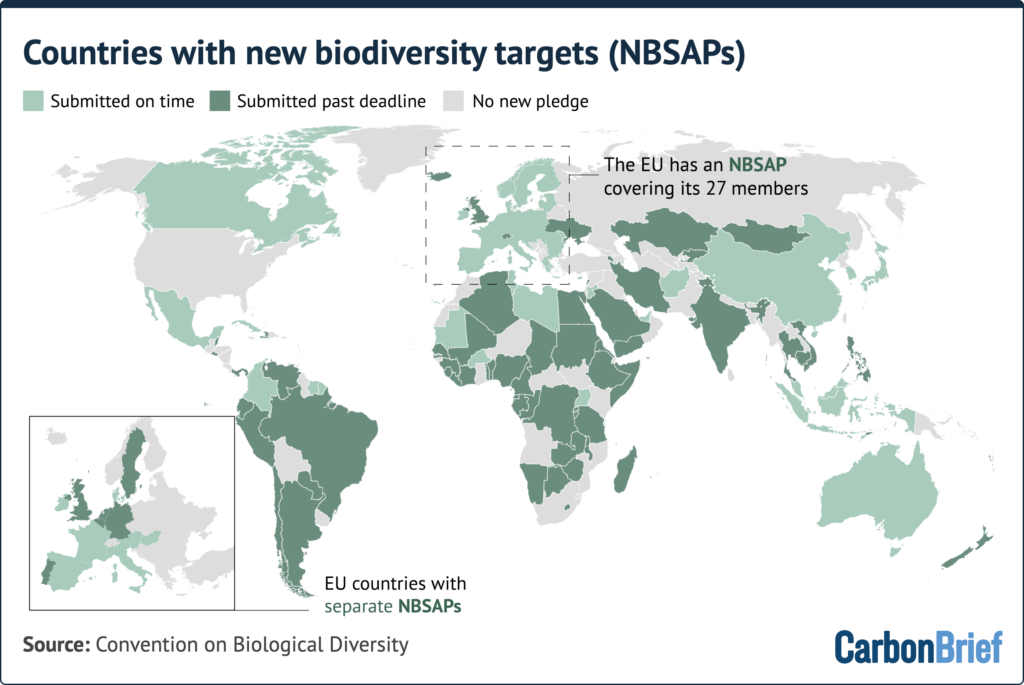
Map of the world showing which countries have met the UN call to submit national biodiversity strategies and action plans (NBSAPs).
Map by Carbon Brief.

Since last year, many African nations have now published new NBSAPs.

African countries that have released new plans in the last year include: Algeria, Benin, Botswana, Cameroon, Comoros, Congo, Côte d’Ivoire, the Democratic Republic of Congo, Egypt, Equatorial Guinea, Eritrea, Ethiopia, Gabon, Gambia, Guinea, Lesotho, Liberia, Madagascar, Malawi, Mali, Namibia, Rwanda, Senegal, Sierra Leone, Somalia, Sudan, Zambia and Zimbabwe.

More South American nations have also published new NBSAPs. This includes Brazil – the world’s most biodiverse nation – as well as Belize and Chile.

COP17 host nation Armenia published its new NBSAP in April.

According to the GBF and its underlying documents, countries that were “not in a position” to meet the deadline to submit NBSAPs ahead of COP16 were requested to instead submit national targets.

Unlike NBSAPs, national targets simply list biodiversity goals that countries will aim for, without an accompanying plan for how they will be achieved.

Four of the world’s megadiverse nations – countries that account for the majority of Earth’s species – have not yet published new NBSAPs. These countries are Papua New Guinea, Peru, South Africa and the US.

The US is the only UN member country that is not a signatory to the UN Convention on Biological Diversity.

The country with the most land on Earth, Russia, has also not produced a new NBSAP.

By the end of COP16, some 119 parties had produced at least one national target. Two years later, this figure has risen to 175, or 89% of countries.

In addition, around half of countries met the deadline to produce their seventh national reports by February of this year. This figure has now risen to 73% of countries.

Over the past two years, many developing countries have expressed concerns that a lack of available funding has prevented them from publishing their NBSAPs.

A spokesperson for the Global Environment Facility (GEF), the multilateral fund that provides funding to help with the preparation of NBSAPs, told Carbon Brief in 2025 that 120 out of 139 countries that had requested financial support since COP16 had been able to access it.

The spokesperson added that the UN Environment Programme was “working to resolve outstanding issues” to allow the remaining 19 countries to access financial assistance.


COP17: Tracking progress towards the UN’s 2030 nature targets

COP17: Developed countries ‘fall far short’ of UN targets for nature finance 

Interactive: Tracking negotiating texts at the COP17 biodiversity summit

Analysis: Lula presidency saved at least 20,000km2 of Brazilian Amazon since 2022

Share. Facebook Twitter Pinterest LinkedIn Tumblr Email
Previous ArticlePharmalittle: HHS peptide plan proceeds, Trump pharma holdings rise
Next Article Google Open-Sources Harness2, a Recursive Agent Harnessing Framework
primereports
  • Website

Related Posts

World

European flights targeted by a week of hoaxes : NPR

November 6, 2026
World

Interactive: Tracking negotiating texts at the COP31 climate summit

November 6, 2026
World

Updating Maine’s Coastal Bluff Maps to Improve Resilience Planning

November 5, 2026
Add A Comment
Leave A Reply Cancel Reply

Top Posts

Threat of further violence looms after Mexican cartel rampage

February 25, 2026116 Views

‘Two-sided risk’ Medicare Advantage plans improve patient outcomes

February 24, 202673 Views

An $18bn settlement – and Zuckerberg barely blinked. The tech titans must be stripped of their power, and soon | Jonathan Freedland

August 28, 202627 Views
Stay In Touch
  • Facebook
  • YouTube
  • TikTok
  • WhatsApp
  • Twitter
  • Instagram
Latest Reviews

Subscribe to Updates

Get the latest tech news from FooBar about tech, design and biz.

PrimeReports.org
Independent global news, analysis & insights.

PrimeReports.org brings you in-depth coverage of geopolitics, markets, technology and risk – with context that helps you understand what really matters.

Editorially independent · Opinions are those of the authors and not investment advice.
Facebook X (Twitter) LinkedIn YouTube
Key Sections
  • World
  • Crypto
  • Cybersecurity
  • Geopolitics
  • Global Markets
  • Artificial Intelligence
All Categories
  • Artificial Intelligence
  • Climate Risks
  • Crypto
  • Cybersecurity
  • Defense
  • Economy
  • Geopolitics
  • Global Markets
  • Healthcare Innovation
  • Politics
  • Popular Now
  • Science
  • Technology
  • World
  • About Us
  • Contact Us
  • Privacy Policy
  • Terms & Conditions
  • Disclaimer
  • Cookie Policy
  • DMCA / Copyright Notice
  • Editorial Policy

Sign up for Prime Reports Briefing – essential stories and analysis in your inbox.

By subscribing you agree to our Privacy Policy. You can opt out anytime.
Latest Stories
  • Calley Means says WH insiders, industry lobbyists foiled MAHA plans
  • Google just made Googlebooks faster, more stable, and less crash-prone
  • ZachXBT revisits Ansem warnings amid Sahil payment claims
© 2026 PrimeReports.org. All rights reserved.
Privacy Terms Contact

Type above and press Enter to search. Press Esc to cancel.