
LIVE NEWS
  • Eridu Cuts To The AI Networking Chase With High Radix Switch System
  • The critical role of soil moisture in compound hazards
  • Trump’s war priorities, FCC on war coverage, Save America Act : NPR
  • Oncogene, Grail CEO, Epstein, Prasad: Readout Newsletter
  • Today’s NYT Connections: Sports Edition Hints, Answers for March 16 #539
  • Holiday spending and export demand drive China’s early year economic momentum
  • Digital Asset Treasury Companies Shift From Accumulation To Active Management
  • Plan to give environment officers police-style powers
Prime Reports
  • Home
  • Popular Now
  • Crypto
  • Cybersecurity
  • Economy
  • Geopolitics
  • Global Markets
  • Politics
  • See More
    • Artificial Intelligence
    • Climate Risks
    • Defense
    • Healthcare Innovation
    • Science
    • Technology
    • World
Prime Reports
  • Home
  • Popular Now
  • Crypto
  • Cybersecurity
  • Economy
  • Geopolitics
  • Global Markets
  • Politics
  • Artificial Intelligence
  • Climate Risks
  • Defense
  • Healthcare Innovation
  • Science
  • Technology
  • World
Home»Science»Deep underground, a telescope may soon detect ghosts of stars that died before Earth existed
Science

Deep underground, a telescope may soon detect ghosts of stars that died before Earth existed

primereportsBy primereportsMarch 15, 2026No Comments4 Mins Read
Share Facebook Twitter Pinterest LinkedIn Tumblr Reddit Telegram Email
Deep underground, a telescope may soon detect ghosts of stars that died before Earth existed
Share
Facebook Twitter LinkedIn Pinterest Email


This article was originally published at The Conversation. The publication contributed the article to Space.com’s Expert Voices: Op-Ed & Insights.

Pablo Martinez Mirave is a Postdoctoral Fellow on Theoretical Particle Astrophysics at the Niels Bohr Institute, University of Copenhagen.

Imagine looking up at the night sky and seeing a star suddenly burst into a blaze of light brighter than anything nearby. A flash so bright that it briefly outshines an entire galaxy before fading forever.

Article continues below


You may like

This violent fate is rare: fewer than about 1% of stars are big enough to end their lives this way. Indeed, these dramatic explosions only occur in so-called “massive stars”. These are stars with a mass roughly eight times or more that of the Sun.

But these cosmic explosions, known as supernovas, have naturally fascinated astronomers for centuries. In 1572, for instance, Danish astronomer Tycho Brahe observed a supernova explosion so bright that it could be seen with the naked eye for two years.

Yet what we can see with our eyes, or even with powerful telescopes, when these stars die, is only a tiny fraction of the story. Because most of the energy from a supernova is carried away by neutrinos, these are nearly invisible particles often called “ghost particles” because they pass through almost everything in their path.

Scientists are now finally on the verge of seeing these ghostly messengers. With the help of an extremely powerful telescope buried deep underground in Japan, astronomers may be able to catch a glimpse of these stellar “ghosts” – and with it the remnants of explosions from stars that died as long as 10 billion years ago.

Breaking space news, the latest updates on rocket launches, skywatching events and more!

Particles from before time

And there’s a really good chance that scientists might be able to finally see these ghost particles this year. This is largely due to Japan’s Super-Kamiokande telescope receiving an upgrade, which significantly enhances its ability to detect supernova neutrinos.

For me, as a particle astrophysicist, this would probably be one of the most exciting scientific achievements in my lifetime. Indeed, it would mean we could see particles that were produced even before the Earth itself existed, as the telescope is now sensitive enough to catch the faint “glow” of all the exploding stars in the universe.
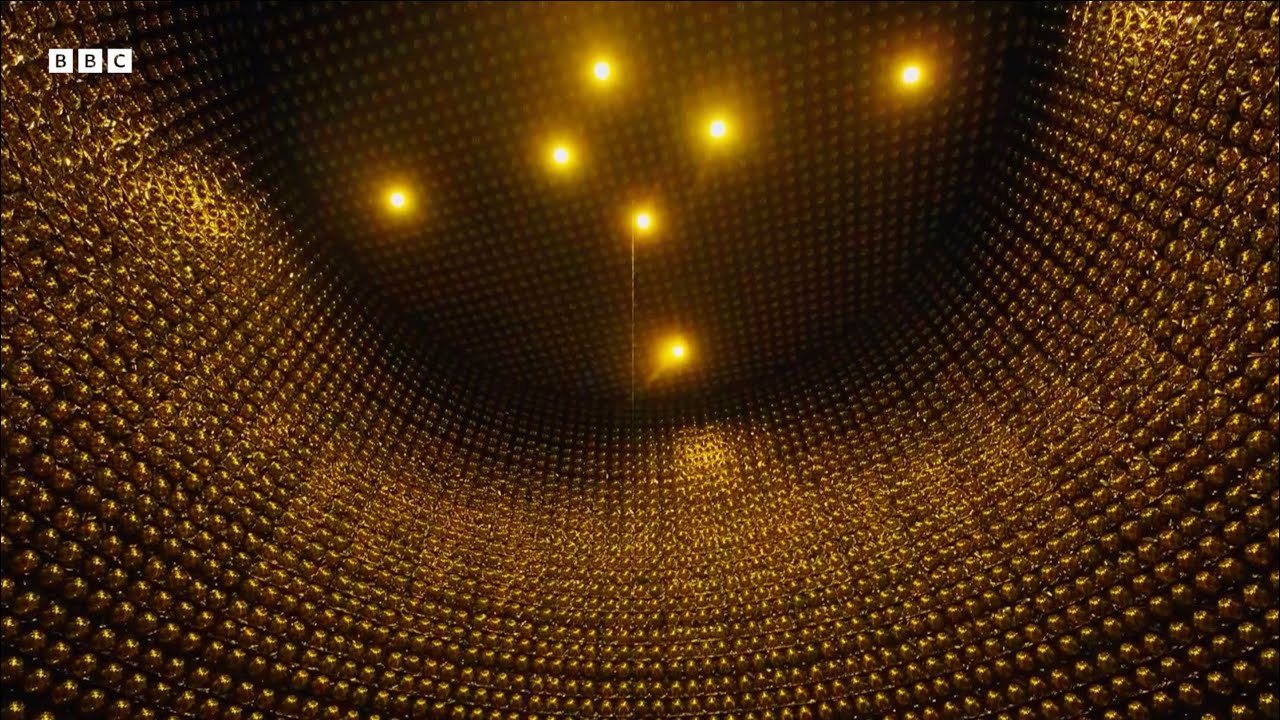
Exploring a $100m Underground Neutrino Detector | Science’s Greatest Mysteries | BBC Earth Science – YouTube
Deep underground, a telescope may soon detect ghosts of stars that died before Earth existed


Watch On

This is all possible because neutrinos almost never interact with anything. They have no electric charge. So they can travel through space – and even through entire planets – without being absorbed or scattered, so almost nothing can stop them.


What to read next

In fact, billions of these ghostly particles are passing through your body every second – and you don’t even notice – and some of them have been travelling for more than 10 billion years to get here.

When a star dies

Big ideas lead to big questions, and one such question astrophysicists are trying to figure out is what remains after the explosion of such a star.

Does the collapsing core become a black hole? Or does it form a different type of star known as a neutron star, which then slowly cools over time? A neutron star is an incredibly dense object, only about 12 miles (20 kilometers) across, roughly the size of a large city or about the length of Manhattan.

If scientists are able to detect the combined signal from all the supernovae that have ever occurred, it would bring us closer to being able to answer these questions. It would also allow us to study the deaths of stars across the entire history of the universe, using particles that have been travelling toward us for billions of years without ever stopping.

Supernovas are rare in our galaxy, happening only once every few decades. But across the universe, a massive star explodes in a supernova roughly once every second. When they explode, they release enormous energy: only about 1% is visible light, while 99% escapes as neutrinos.

Even though these neutrinos are almost invisible, they carry the story of every star that has ever exploded – and now, for the first time, we may be able to catch them.

So if 2026 does bring the first clear detection, it will mark a new era in astronomy. For the first time, we won’t just observe the brilliant explosions of nearby stars, but the collective story of all the massive stars that have ever lived and died.

And it all starts with a telescope buried deep underground in Japan, patiently watching for the faint, ghostly glow of the universe’s oldest explosions.

Share. Facebook Twitter Pinterest LinkedIn Tumblr Email
Previous ArticleSwedish court orders detention of Russian captain of tanker boarded off Sweden
Next Article Why the ‘narrow,’ ‘short-term’ sanctions reversal for Russia is neither
primereports
  • Website

Related Posts

Science

Astronomers just found the source of the brightest fast radio burst ever

March 15, 2026
Science

New study raises concerns about AI chatbots fueling delusional thinking | AI (artificial intelligence)

March 15, 2026
Science

Former dairy farm could become peat research centre

March 14, 2026
Add A Comment
Leave A Reply Cancel Reply

Top Posts

Global Resources Outlook 2024 | UNEP

December 6, 20255 Views

The D Brief: DHS shutdown likely; US troops leave al-Tanf; CNO’s plea to industry; Crowded robot-boat market; And a bit more.

February 14, 20264 Views

German Chancellor Merz faces difficult mission to Israel – DW – 12/06/2025

December 6, 20254 Views
Stay In Touch
  • Facebook
  • YouTube
  • TikTok
  • WhatsApp
  • Twitter
  • Instagram
Latest Reviews

Subscribe to Updates

Get the latest tech news from FooBar about tech, design and biz.

PrimeReports.org
Independent global news, analysis & insights.

PrimeReports.org brings you in-depth coverage of geopolitics, markets, technology and risk – with context that helps you understand what really matters.

Editorially independent · Opinions are those of the authors and not investment advice.
Facebook X (Twitter) LinkedIn YouTube
Key Sections
  • World
  • Geopolitics
  • Popular Now
  • Artificial Intelligence
  • Cybersecurity
  • Crypto
All Categories
  • Artificial Intelligence
  • Climate Risks
  • Crypto
  • Cybersecurity
  • Defense
  • Economy
  • Geopolitics
  • Global Markets
  • Healthcare Innovation
  • Politics
  • Popular Now
  • Science
  • Technology
  • World
  • About Us
  • Contact Us
  • Privacy Policy
  • Terms & Conditions
  • Disclaimer
  • Cookie Policy
  • DMCA / Copyright Notice
  • Editorial Policy

Sign up for Prime Reports Briefing – essential stories and analysis in your inbox.

By subscribing you agree to our Privacy Policy. You can opt out anytime.
Latest Stories
  • Eridu Cuts To The AI Networking Chase With High Radix Switch System
  • The critical role of soil moisture in compound hazards
  • Trump’s war priorities, FCC on war coverage, Save America Act : NPR
© 2026 PrimeReports.org. All rights reserved.
Privacy Terms Contact

Type above and press Enter to search. Press Esc to cancel.