


It may have taken many years and what we presume was a certain amount of patience as Michael Dell watched his custom server maker rivals working for the hyperscalers and clouds get the vast majority of GPU allocations, but AI is a driving force for the company that bears his name.
And so is an inevitable server upgrade cycle that has been a long time coming – and that has been delayed in part by AI spending and then accelerated as companies try to free up power and space in their datacenters by modernizing their application and database server fleets to make way for power-hungry AI servers.
This is the opposite of the perfect storm, which is compounding bad news. As far as I know, we don’t have a name for that converse, so I guess we can just call it a harmonic resurgence. And now that the partners of Nvidia and AMD can make more GPU accelerators than they could several years ago, Dell is getting a lot more GPU allocations, and I think a disproportionately larger part of AI system orders because it has its supply chain and factories in order and can actually line up iron to run against its swelling GenAI revenue backlog.
In a conference call going over the company’s second quarter of fiscal 2027 financial results, Jeff Clarke, Dell’s chief operating officer and vice chairman, said that it took eight quarters to get 3,200 customers who had bought an “AI factory.” And the next 3,300 customers were closed in only three quarters, for a total of 6,500 unique organizations that have deployed AI systems with PowerEdge brands on them. A lot of those customers are Tier 2 clouds and service providers as well as neoclouds and sovereigns, but now large enterprises are also looking to Dell, their traditional server supplier, to not only upgrade their aging iron, but to supply AI clusters for inference and maybe some training as well.
Dell’s server business is hitting on all cylinders, and Clarke explained that there were over 1.2 million servers in the Dell installed base that were at the PowerEdge 14G generation or older. The 14G machines were announced in 2017 and ramped in 2018. So this iron in on the order of eight years old or older. That is a long time to keep a server in the field, and the current 17G machines from two years ago and the forthcoming 18G machines due next month allow workloads to be consolidated massively. Clarke pegs it at anywhere from six to eight of these vintage servers collapsed to one 17G system, and anywhere from twelve to fourteen for one 18G machine.
These are much more heavily configured 17G or 18G machines that customers are buying to do consolidations, and so they are inherently more expensive. Dell is also passing on increasing costs for DRAM, flash, CPUs, and other peripherals, which further boosts revenues for traditional servers.
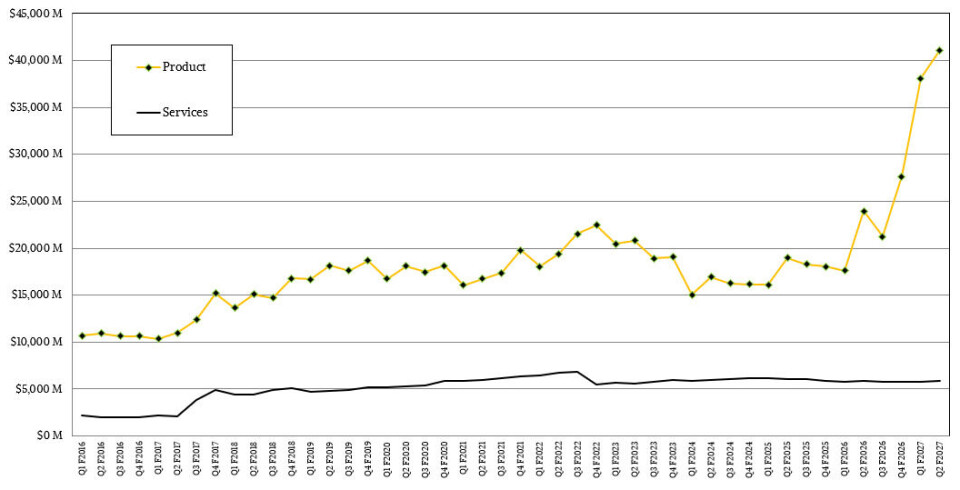
In the quarter that ended on July 31, Dell booked $41.11 billion in product sales, up 71.8 percent year on year and up 7.9 percent sequentially. Services revenues pottered along and were flat at $5.86 billion.
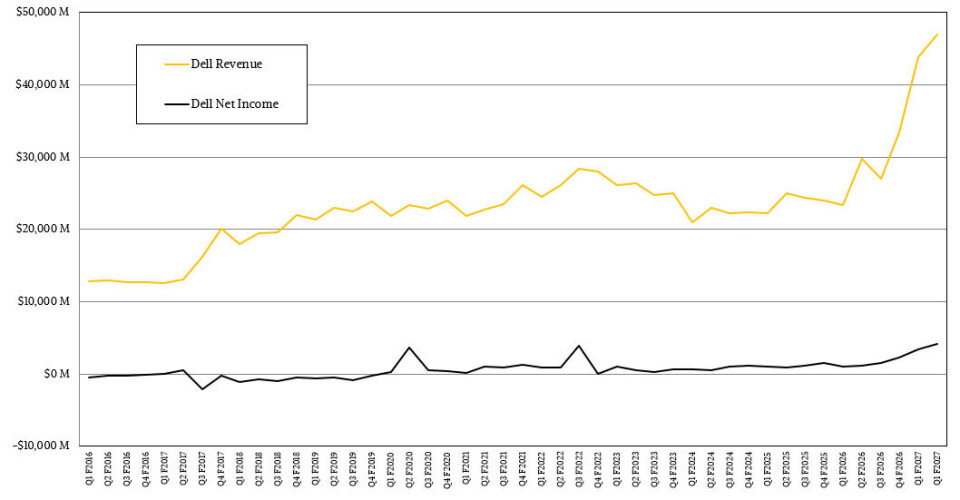
Combined product and services revenues totaled $46.97 billion, up 57.7 percent, and thanks to Dell maximizing its CPU, GPU, DRAM, and flash allocations, further optimizing its massive system manufacturing operations, and boosting margins on PCs, operating income for the company rose by 3.1X to $5.36 billion. Net income in the quarter was $4.13 billion, up 3.55X year on year and representing 8.8 percent of revenues. This is the highest level of profitability for Dell in our coverage since the Great Recession a decade and a half ago excepting Q2 F2020 and Q3 F2022, when it was selling off parts of the company and profited nicely from that.
Still, as you can see, it takes a lot more dollars to drive an incremental gain in net income. Dell has moved from the kind of margins one of the large grocery store chains or its original design manufacturer (ODM) rivals “enjoy” of around 2 percent to 3 percent to something akin to a software company in a very aggressive and non-legacy part of the market of around 8 percent to 10 percent. That is an improvement, but Dell is working hard to get there. And we have not looked at the numbers yet, but we strongly believe that Dell is doing much better than its original equipment manufacturer (OEM) peers like Hewlett Packard Enterprise, Lenovo, Supermicro, and the rebadged Inspur now known as IEIT Systems, which rules in China.
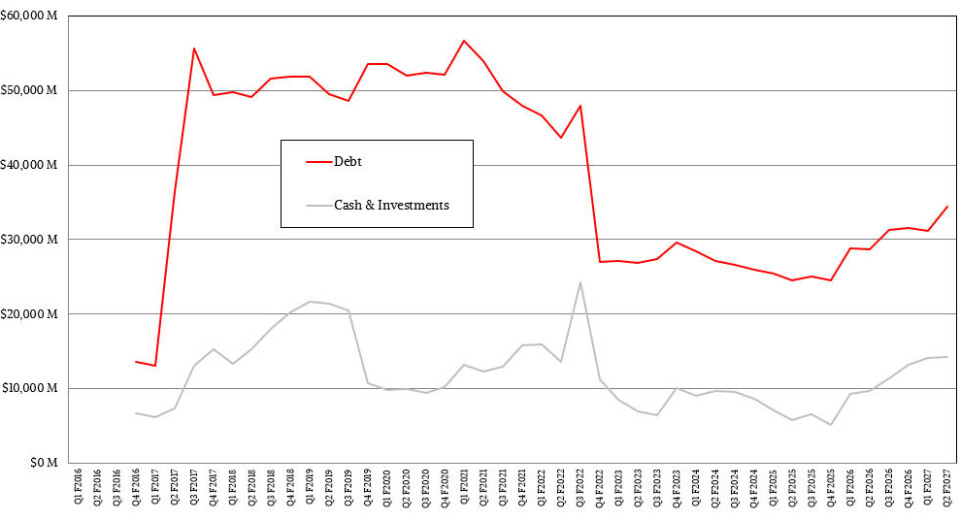
It is interesting to note that Dell’s debt load is on the rise again, even if it is nowhere near where it was when Dell acquired EMC and VMware a decade ago and took itself private a few years later. The debt load went below $30 billion after VMware was spun out and was trending responsibly down over several years as the cash got pinched. Both cash and debt are rising at roughly the same rates, which is good, so the relative net debt is not changing much despite the heavy investment that is required for AI systems.
Michael Dell is the fifth richest man on Earth, and unless Wall Street is making a fuss, there is no reason not to do stock buybacks to drive up the net worth of Dell, the man, and his wife, who together own 41 percent of the shares in the company. Similarly, they get 41 percent of dividend payments, too. All of this cash – $2.2 billion in the second fiscal quarter – could be used to pay down debt, as could some of its $14.25 billion in cash and investments.
But as I said, Wall Street doesn’t seem to care. Particularly with Dell’s revenues growing faster than its debts.
Let’s drill down into Dell’s server racket a bit.
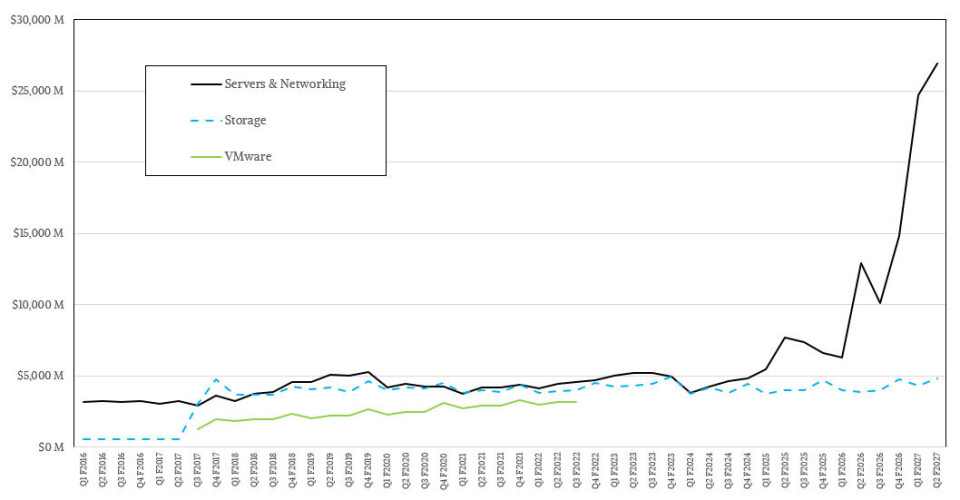
Dell’s server and networking business, which is mostly servers, rose by 2.1X to $26.93 billion, up 9.1 percent sequentially. The company’s storage business, which is built on the EMC foundation, was up 25.8 percent to $4.85 billion.
Clark gave an update of sorts on the Project Lightning parallel file system aimed at high end AI workloads, something that has been cooking for the past two years and that is aimed at taking on Lustre (controlled by DataDirect Networks) as well as storage from VAST Data, WEKA, and Everpure (formerly Pure Storage). Lightning is not based on Isilon’s OneFS, a very good HPC file system that has a long history outside of Dell and that is at the heart of the PowerScale high-end systems that are managing very large files. Lightning, by contrast, is aimed at workloads that have tons of small I/Os against block storage running in flash.
“Lightning, our parallel file system designed for native AI use cases, we continue to have the product out in the field,” Clarke explained. “We continue to see interest. It is still a relatively new product. It is in beta at several customers. We are in runoffs against other competitors with the product. That will continue. And as it builds momentum, I am certain we will give you an update in the future. But that’s where Lightning is at the moment.”
The competition is probably not worried at this point.
Add all that revenue up and the Infrastructure Solutions Group had $31.78 billion in sales, up 89.2 percent year on year, with operating income of $4.78 billion, up 3.25X. The $15 billion PC business (up 20.2 percent year on year) at Dell only had $1.14 billion in operating income (up 42.2 percent).
Dell has been explicitly breaking its AI systems business separate from its traditional server and networking business for the past two quarters, and I have been doing the math back to Q4 F2022 with my own model to show just how fast this AI business has taken off for Dell.
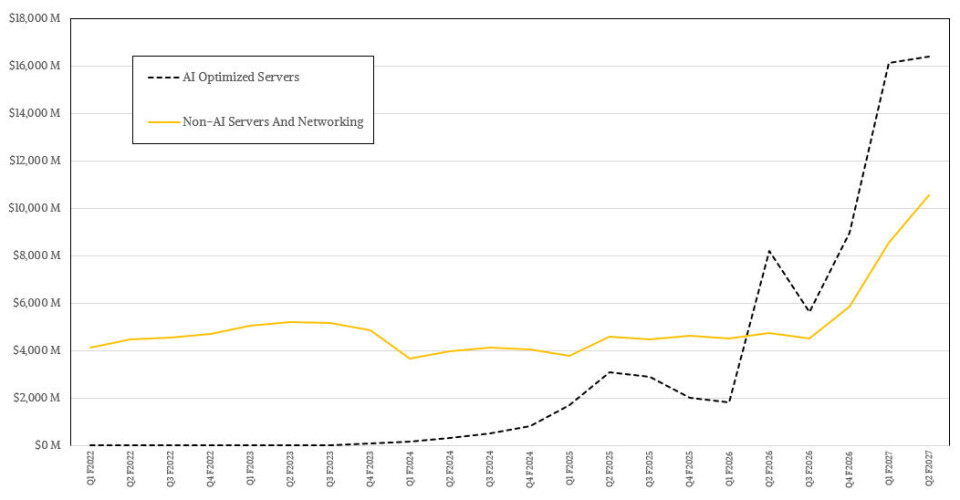
Dell’s AI system business was bigger than its traditional server business a year ago, and it is very likely that the gap will continue to be large. But traditional servers are, as I said at the top of this story, booming and the gap closed quite a bit for at least this quarter and it looks like it will surpass AI server sales in Q4, if you can believe it.
To be precise, Dell sold $16.4 billion in AI systems, double from a year ago and almost the same as in Q1 F2027. Traditional servers plus networking hit an all-time quarterly high that makes the Dot Com boom look like a joke, with sales of $10.53 billion, up 2.2X from the year ago period.
On the AI systems front, Dell ended the quarter with $95 billion in bookings, and $60.9 billion of that came within the quarter. That backlog is 8.1X larger than a year ago.
Looking ahead, Dell expects around $19 billion in AI system sales in Q3 and another $22.5 billion in Q4, which would bring the full year to $74 billion. If you do the math on the ISG forecasts and back out traditional servers, you get $15.6 billion in Q3 and $25.1 billion. Yup, traditional servers are set to eclipse AI servers in Q4, just as “Vera-Rubin” systems from Nvidia are ramping to full volume.
We live in crazy times.
“As we see it, agentic demand is reshaping the datacenter in underlying infrastructure,” Clarke said. “Inference is past training, and it is pure demand in our industry. We think the tokens that inference drives is going to grow 87X to 3,600 quadrillion tokens by 2030. Training demand grows 5X to 850 zettaflops by 2030. Enterprise agentic is expected to be the single largest workload by 2028. We are expecting AI to be 75 percent of all datacenter demand by 2030, adding 200 GW of power over that same time frame, and half of that, we believe, is right in our sweet spot with our customers, the neocloud, sovereigns and enterprises. And if you look at that math, we think the opportunity in front of us is more than $1 trillion over that time frame. And we believe we are well positioned. We believe that our model is differentiated, that our engineering is differentiating ourselves with every customer that we interact with. The scale of our deployment capabilities is unmatched globally.”
Well, Supermicro and IEIT Systems would probably argue with that. And so would Sanmina, which took over the ZT Systems business from AMD. So would Quanta Computer and Foxconn as well. The point is, Dell is right in there, competing with the ODMs and dwarfing its OEM peers. That is what is truly unexpected. And it all comes down to Nvidia allocating GPUs to Dell to get them into neoclouds, sovereigns, and large enterprises so Big Green can lessen its dependence on the hyperscalers and cloud builders that are all making their own XPU accelerators as well as buying tons of GPUs from Nvidia.
