



PORTLAND, USA, October 6 (IPS) – Dementia is a rapidly growing global health challenge that affects many millions of people worldwide and places significant economic, healthcare, and social strains on societies, particularly as populations age.
Families, community organizations, and governments face growing difficulties in providing adequate care and support for older adults living with dementia.
A debilitating neurological condition, dementia is caused by various diseases or injuries that damage the brain and impair its functioning. Its increasing prevalence has made it a pressing global health concern.
Dementia can affect memory, thinking, communication, mood, and behavior, as well as a person’s ability to perform everyday activities. Symptoms generally worsen over time, often placing substantial emotional, physical, and financial burdens on individuals, families, caregivers, and health systems.
The number of people living with dementia is rising rapidly as populations age and life expectancies increase.
Dementia, however, is not a normal part of aging. Although some changes in memory and functioning are common among older adults, dementia can significantly impair memory, thinking, judgment, and the ability to perform everyday activities.
Dementia is the seventh leading cause of death worldwide and a major cause of disability and dependency among older adults.
Alzheimer’s disease is the most common type of dementia, accounting for roughly 60–70% of all dementia cases. Other types include vascular dementia, dementia with Lewy bodies, which is associated with abnormal protein deposits in nerve cells, and frontotemporal dementia, which involves degeneration of the brain’s frontal and temporal lobes.
Dementia affects not only individuals but also families, healthcare systems, and society as a whole. Its growing prevalence is creating substantial economic, healthcare, and social pressures worldwide.
As the number of people living with dementia continues to rise, healthcare systems face increasing demand for medical and support services. Governments and communities must devote additional resources to meet these needs, while families often assume significant and demanding caregiving responsibilities.
Hospitals and long-term care facilities also face growing pressure because people with advanced dementia may require intensive, around-the-clock supervision and assistance with everyday activities.
Beyond direct healthcare and long-term care expenses, dementia generates substantial indirect costs. These include lost productivity when people with dementia can no longer work and reduced workforce participation among family members who leave or reduce employment to provide unpaid care. Together, these direct and indirect costs add substantially to the broader economic and social burden of dementia.
Women are disproportionally affected by dementia, experiencing a greater burden of morbidity and disability than men. Women account for approximately two-thirds of deaths from Alzheimer’s disease and other forms of dementia worldwide and provide about 70% of informal care hours delivered by family and friends.
People who care for relatives with dementia face greater health risks than those caring for family members without dementia, and these risks can persist even after their relatives have died. Caring for people with dementia therefore places substantial burdens on families and society, while the growing global burden of dementia care remains largely underestimated.
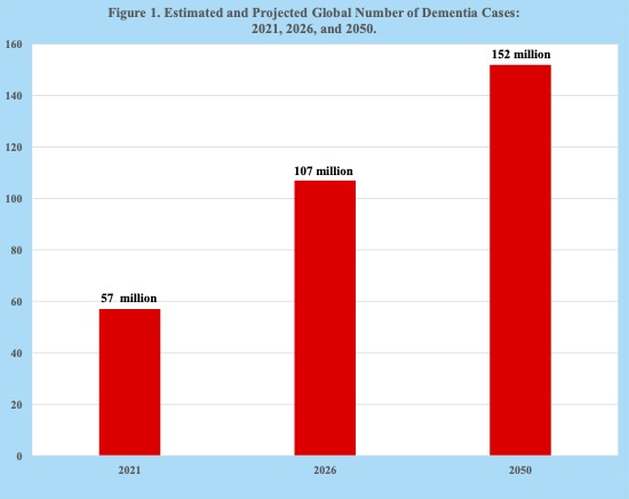
In 2021, approximately 57 million people were living with dementia, according to the World Health Organization, and dementia caused about 2 million deaths. With nearly 10 million new cases of dementia occurring each year, largely reflecting population ageing and increasing longevity, the number of people living with dementia is projected to reach about 107 million by 2026 and more than 150 million by 2050 (Figure 1).
Dementia can affect memory, thinking, communication, mood, and behavior. Early signs and symptoms of dementia are often observable and may involve difficulties with memory, attention, communication, reasoning, judgement, and processing visual information.
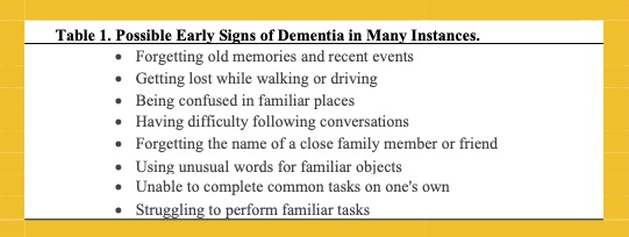
Possible early signs of dementia include forgetting recent events or familiar information, getting lost while walking or driving, becoming confused in familiar places, having difficulty following conversations, forgetting the names of close family members or friends, using unusual words to refer to familiar objects, and struggling to complete routine or familiar tasks independently (Table 1).
Although there is currently no known cure for dementia, WHO guidelines report that up to 45% of dementia risk could potentially be prevented or delayed.
The WHO guidelines recommend several healthy behaviors and lifestyle interventions that may reduce dementia risk. These include cognitive training and stimulation, and participation in social activities for adults with normal cognition or mild cognitive impairment.
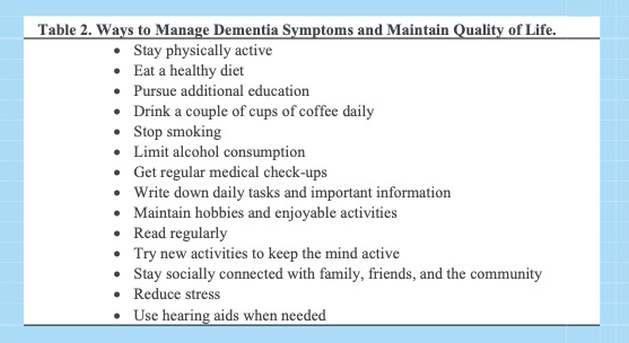
Other measures that may help reduce dementia risk and support quality of life and well-being include staying physically active, pursuing additional education, eating a healthy diet, drinking a couple of cups of coffee daily, quitting smoking, limiting alcohol consumption, reading regularly, engaging in mentally stimulating activities, and maintaining social connections. Keeping track of daily tasks, managing stress, and obtaining regular medical check-ups may also help people maintain independence and well-being (Table 2).
Some country studies report that each additional year of education is associated with a lower risk of dementia, with the protective association continuing beyond high school. In other words, additional years of education may provide cumulative protection against dementia. Recent research has also found that hearing aids can reduce the rate of cognitive decline in older adults at high risk of dementia by nearly 50%.
Much can also be done to support people living with dementia and those who care for them. Caring for a person with dementia, however, can be challenging and can affect caregivers’ own health and well-being.
Providing care requires patience, clear communication, and attention to the person’s emotional well-being.
Helpful caregiving tips include starting discussing care needs early, speaking calmly and clearly, avoiding arguments, providing reassurance, and avoiding questions such as “Don’t you remember?”. Other strategies include distracting an agitated person with a snack, photo album, humor, or soothing music; maintaining a consistent routine and familiar mealtime setting; encouraging independence and regular exercise; using written to-do lists and reminders; simplifying choices; and ensuring a safe environment.
Caregivers should also prioritize their own physical and emotional well-being. The demands of dementia caregiving can contribute to emotional stress, physical exhaustion, and burnout.
Helpful self-care strategies include taking regular breaks, seeking assistance from family members or others involved in caregiving, maintaining social connections, engaging in regular physical activity, and seeking mental health support when needed. These measures can help reduce stress and exhaustion and lower the risk of caregiver burnout.
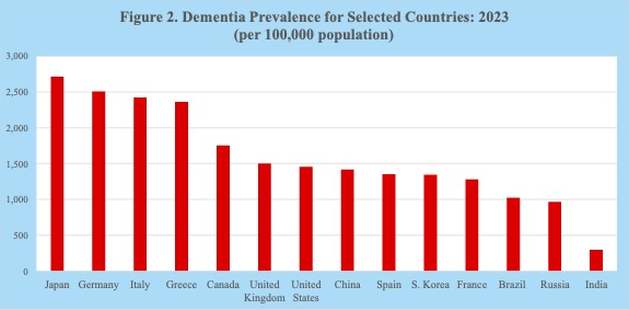
Although age itself does not cause of dementia, it is the strongest known risk factor, with the likelihood of developing dementia generally increasing with age. Consequently, countries with older populations, such as Japan, Germany, Italy, and Greece, tend to report higher dementia rates (Figure 2).
In sum, dementia is a rapidly rising global health challenge, particularly as populations age. Countries face increasing difficulties in providing adequate care and support for older adults living with dementia.
Given the limited availability of effective treatments, there is an urgent need for comprehensive national strategies to prevent or delay dementia and address its broader social, economic, and health consequences. Such strategies should take a coordinated, long-term approach to strengthening prevention, improving care and support services, and reducing the burden on individuals, families, communities, and health systems.
Joseph Chamie is a consulting demographer, a former director of the United Nations Population Division, and author of numerous publications on population issues.
© Inter Press Service (20261006111301) — All Rights Reserved. Original source: Inter Press Service
