

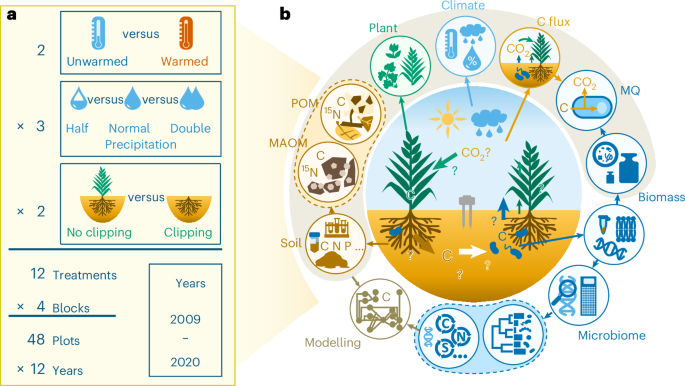
García-Palacios, P. et al. Evidence for large microbial-mediated losses of soil carbon under anthropogenic warming. Nat. Rev. Earth Environ. 2, 507–517 (2021).
Bossio, D. A. et al. The role of soil carbon in natural climate solutions. Nat. Sustain. 3, 391–398 (2020).
IPCC. Climate Change 2021—The Physical Science Basis (eds Masson-Delmotte, V. et al.) (Cambridge Univ. Press, 2023).
Zhou, J. et al. Microbial mediation of carbon-cycle feedbacks to climate warming. Nat. Clim. Change 2, 106–110 (2012).
Luo, Y. Terrestrial carbon-cycle feedback to climate warming. Annu. Rev. Ecol. Evol. System. 38, 683–712 (2007).
Friedlingstein, P. et al. Uncertainties in CMIP5 climate projections due to carbon cycle feedbacks. J. Clim. 27, 511–526 (2014).
Cox, P. M., Betts, R. A., Jones, C. D., Spall, S. A. & Totterdell, I. J. Acceleration of global warming due to carbon-cycle feedbacks in a coupled climate model. Nature 408, 184–187 (2000).
Crowther, T. W. et al. Quantifying global soil carbon losses in response to warming. Nature 540, 104–108 (2016).
Liu, W., Zhang, Z. H. E. & Wan, S. Predominant role of water in regulating soil and microbial respiration and their responses to climate change in a semiarid grassland. Glob. Change Biol. 15, 184–195 (2009).
Zhang, Z. et al. Effect of climate warming on the annual terrestrial net ecosystem CO2 exchange globally in the boreal and temperate regions. Sci. Rep. 7, 3108 (2017).
D’Orangeville, L. et al. Northeastern North America as a potential refugium for boreal forests in a warming climate. Science 352, 1452–1455 (2016).
Chen, Y. et al. Warming has a minor effect on surface soil organic carbon in alpine meadow ecosystems on the Qinghai–Tibetan Plateau. Glob. Change Biol. 28, 1618–1629 (2022).
Ziegler, S. E. et al. Climate warming can accelerate carbon fluxes without changing soil carbon stocks. Front. Earth Sci. 5, 2 (2017).
van Gestel, N. et al. Predicting soil carbon loss with warming. Nature 554, E4–E5 (2018).
Bai, T., Wang, P., Qiu, Y., Zhang, Y. & Hu, S. Nitrogen availability mediates soil carbon cycling response to climate warming: a meta-analysis. Glob. Change Biol. 29, 2608–2626 (2023).
Carney, K. M., Hungate, B. A., Drake, B. G. & Megonigal, J. P. Altered soil microbial community at elevated CO2 leads to loss of soil carbon. Proc. Natl Acad. Sci. USA 104, 4990–4995 (2007).
Wu, L. et al. Reduction of microbial diversity in grassland soil is driven by long-term climate warming. Nat. Microbiol. 7, 1054–1062 (2022).
Reich, P. B. et al. Synergistic effects of four climate change drivers on terrestrial carbon cycling. Nat. Geosci. 13, 787–793 (2020).
Yuan, X. et al. Plant and microbial regulations of soil carbon dynamics under warming in two alpine swamp meadow ecosystems on the Tibetan Plateau. Sci. Total Environ. 790, 148072 (2021).
Huntington, T. G. Evidence for intensification of the global water cycle: review and synthesis. J. Hydrol. 319, 83–95 (2006).
Reichstein, M. et al. Climate extremes and the carbon cycle. Nature 500, 287–295 (2013).
Easterling, D. R. et al. Climate extremes: observations, modeling, and impacts. Science 289, 2068–2074 (2000).
Wang, J. et al. Precipitation manipulation and terrestrial carbon cycling: the roles of treatment magnitude, experimental duration and local climate. Glob. Ecol. Biogeogr. 30, 1909–1921 (2021).
Schuur, E. A. G. et al. Climate change and the permafrost carbon feedback. Nature 520, 171–179 (2015).
Rineau, F. et al. Towards more predictive and interdisciplinary climate change ecosystem experiments. Nat. Clim. Change 9, 809–816 (2019).
Wei, X. et al. Responses of soil C pools to combined warming and altered precipitation regimes: a meta-analysis. Glob. Ecol. Biogeogr. 32, 1660–1675 (2023).
Song, B. et al. Light and heavy fractions of soil organic matter in response to climate warming and increased precipitation in a temperate steppe. PLoS ONE 7, e33217 (2012).
Poeplau, C. Grassland soil organic carbon stocks along management intensity and warming gradients. Grass Forage Sci. 76, 186–195 (2021).
Pulido, M., Barrena-González, J., Badgery, W., Rodrigo-Comino, J. & Cerdà, A. Sustainable grazing. Curr. Opin. Environ. Sci. Health 5, 42–46 (2018).
Guo, X. et al. Climate warming leads to divergent succession of grassland microbial communities. Nat. Clim. Change 8, 813–818 (2018).
Guo, X. et al. Climate warming accelerates temporal scaling of grassland soil microbial biodiversity. Nat. Ecol. Evol. 3, 612–619 (2019).
Zhang, Y. et al. Experimental warming leads to convergent succession of grassland archaeal community. Nat. Clim. Change 13, 561–569 (2023).
Chen, H. et al. Carbon and nitrogen cycling on the Qinghai–Tibetan Plateau. Nat. Rev. Earth Environ. 3, 701–716 (2022).
Mishra, U. & Riley, W. J. Scaling impacts on environmental controls and spatial heterogeneity of soil organic carbon stocks. Biogeosciences 12, 3993–4004 (2015).
Melillo, J. M. et al. Long-term pattern and magnitude of soil carbon feedback to the climate system in a warming world. Science 358, 101–105 (2017).
Rocci, K. S., Lavallee, J. M., Stewart, C. E. & Cotrufo, M. F. Soil organic carbon response to global environmental change depends on its distribution between mineral-associated and particulate organic matter: a meta-analysis. Sci. Total Environ. 793, 148569 (2021).
Schmidt, M. W. I. et al. Persistence of soil organic matter as an ecosystem property. Nature 478, 49–56 (2011).
Soong, J. L. et al. Five years of whole-soil warming led to loss of subsoil carbon stocks and increased CO2 efflux. Sci. Adv. 7, eabd1343 (2021).
Guo, X. et al. Particulate and mineral-associated organic carbon turnover revealed by modelling their long-term dynamics. Soil Biol. Biochem. 173, 108780 (2022).
Chen, Y. et al. Long-term warming reduces surface soil organic carbon by reducing mineral-associated carbon rather than “free” particulate carbon. Soil Biol. Biochem. 177, 108905 (2023).
Xu, X. et al. Global pattern and controls of soil microbial metabolic quotient. Ecol. Monogr. 87, 429–441 (2017).
Guo, X. et al. Gene-informed decomposition model predicts lower soil carbon loss due to persistent microbial adaptation to warming. Nat. Commun. 11, 4897 (2020).
Chari, N. R. & Taylor, B. N. Soil organic matter formation and loss are mediated by root exudates in a temperate forest. Nat. Geosci. 15, 1011–1016 (2022).
Wieder, W. R., Bonan, G. B. & Allison, S. D. Global soil carbon projections are improved by modelling microbial processes. Nat. Clim. Change 3, 909–912 (2013).
Tao, X. et al. Experimental warming accelerates positive soil priming in a temperate grassland ecosystem. Nat. Commun. 15, 1178 (2024).
Wang, G. et al. Soil enzymes as indicators of soil function: a step toward greater realism in microbial ecological modeling. Glob. Change Biol. 28, 1935–1950 (2022).
Luo, Y. et al. Modeled interactive effects of precipitation, temperature, and CO2 on ecosystem carbon and water dynamics in different climatic zones. Glob. Change Biol. 14, 1986–1999 (2008).
Tao, F. et al. Microbial carbon use efficiency promotes global soil carbon storage. Nature 618, 981–985 (2023).
Kikstra, J. S. et al. The IPCC Sixth Assessment Report WGIII climate assessment of mitigation pathways: from emissions to global temperatures. Geosci. Model Dev. 15, 9075–9109 (2022).
Matthews, H. D. & Wynes, S. Current global efforts are insufficient to limit warming to 1.5 °C. Science 376, 1404–1409 (2022).
Zhang, S. et al. Reconciling carbon quality with availability predicts temperature sensitivity of global soil carbon mineralization. Proc. Natl Acad. Sci. USA 121, e2313842121 (2024).
Zhang, Q. et al. Water limitation regulates positive feedback of increased ecosystem respiration. Nat. Ecol. Evol. 8, 1870–1876 (2024).
Metze, D. et al. Microbial growth under drought is confined to distinct taxa and modified by potential future climate conditions. Nat. Commun. 14, 5895 (2023).
AghaKouchak, A. et al. Climate extremes and compound hazards in a warming world. Annu. Rev. Earth Planet. Sci. 48, 519–548 (2020).
Maestre, F. T. et al. Increasing aridity reduces soil microbial diversity and abundance in global drylands. Proc. Natl Acad. Sci. USA 112, 15684–15689 (2015).
Xu, X. et al. Unchanged carbon balance driven by equivalent responses of production and respiration to climate change in a mixed-grass prairie. Glob. Change Biol. 22, 1857–1866 (2016).
Cotrufo, M. F., Ranalli, M. G., Haddix, M. L., Six, J. & Lugato, E. Soil carbon storage informed by particulate and mineral-associated organic matter. Nat. Geosci. 12, 989–994 (2019).
Leuthold, S., Haddix, M., Lavallee, J. & Cotrufo, M. F. Physical fractionation techniques. In Reference Module in Earth Systems and Environmental Sciences 1–13 (Elsevier, 2022).
McLean, E. Soil pH and lime requirement. In Methods of soil Analysis. Part 2. Chemical and Microbiological Properties, 2nd ed. (ed. Page, A. L.) Ch. 12 (American Society of Agronomy & Soil Science Society of America, 1982).
Frank, D. A. & McNaughton, S. J. Aboveground biomass estimation with the canopy intercept method: a plant growth form caveat. Oikos 57, 57–60 (1990).
Xu, X. et al. Plant community structure regulates responses of prairie soil respiration to decadal experimental warming. Glob. Change Biol. 21, 3846–3853 (2015).
Gong, H. et al. Soil microbial DNA concentration is a powerful indicator for estimating soil microbial biomass C and N across arid and semi-arid regions in northern China. Appl. Soil Ecol. 160, 103869 (2021).
Rosinger, C., Rousk, J., Bonkowski, M., Rethemeyer, J. & Jaeschke, A. Rewetting the hyper-arid Atacama Desert soil reactivates a carbon-starved microbial decomposer community and also triggers archaeal metabolism. Sci. Total Environ. 892, 164785 (2023).
Nilsson, R. H. et al. The UNITE database for molecular identification of fungi: handling dark taxa and parallel taxonomic classifications. Nucleic Acids Res. 47, D259–D264 (2019).
Zhou, J. et al. High-throughput metagenomic technologies for complex microbial community analysis: open and closed formats. MBio 6, e02288-02214 (2015).
Bates, D., Mächler, M., Bolker, B. & Walker, S. Fitting linear mixed-effects models using lme4. J. Stat. Softw. 67, 1–48 (2015).
Oksanen, J. et al. Vegan: community ecology package. R package version 2.0-10 (2013).
Lefcheck, J., Byrnes, J. & Grace, J. Package ‘piecewiseSEM’. R package version 1 (2016).
Wang, G. et al. Soil moisture drives microbial controls on carbon decomposition in two subtropical forests. Soil Biol. Biochem. 130, 185–194 (2019).
Wang, G., Li, W., Wang, K. & Huang, W. Uncertainty quantification of the soil moisture response functions for microbial dormancy and resuscitation. Soil Biol. Biochem. 160, 108337 (2021).
Liang, J. et al. Evaluating the E3SM land model version 0 (ELMv0) at a temperate forest site using flux and soil water measurements. Geosci. Model Dev. 12, 1601–1612 (2019).
Li, J. et al. Reduced carbon use efficiency and increased microbial turnover with soil warming. Glob. Change Biol. 25, 900–910 (2019).
Huang, W. et al. High carbon losses from oxygen-limited soils challenge biogeochemical theory and model assumptions. Glob. Change Biol. 27, 6166–6180 (2021).
Zhou, S. et al. Enhanced understanding of soil methane processes through modeling microbial kinetics and taxonomy. Soil Biol. Biochem. 207, 109838 (2025).
Guisan, A. & Zimmermann, N. E. Predictive habitat distribution models in ecology. Ecol. Model. 135, 147–186 (2000).
Ellsworth, D. S. et al. Photosynthesis, carboxylation and leaf nitrogen responses of 16 species to elevated pCO2 across four free-air CO2 enrichment experiments in forest, grassland and desert. Glob. Change Biol. 10, 2121–2138 (2004).
Batstone, D. J., Pind, P. F. & Angelidaki, I. Kinetics of thermophilic, anaerobic oxidation of straight and branched chain butyrate and valerate. Biotechnol. Bioeng. 84, 195–204 (2003).
Yang, Z. zhifengyang-ou/MEND-warming-soil-C: MEND for simulating soil C feedback under climate change (1.0.0). Zenodo https://doi.org/10.5281/zenodo.18396578 (2026).
