

Sample and procedure
We received ethical approval from the University Teaching and Ethics Committee at the University of St Andrews. Participants were emailed by Extinction Rebellion UK asking them to take part in a 2-min survey. At the end of this, they were invited to complete a separate, anonymous survey, which includes the measures reported here. Before completing the survey, participants were informed about the voluntary nature of their participation and gave their informed consent. We removed the data from 287 participants who completed less than 85% of the survey, did not consent to take part or who failed the attention check, leaving a total sample size of 1,375 participants. Participants took an average of 17 min to complete the survey.
Measures
Only measures that are relevant to the present research are presented here. A complete list of measures for the survey and decisions on scale formation are available in Supplementary Information. All scales, if not indicated otherwise, were measured on a five-point Likert scale.
Demographics and past event participation
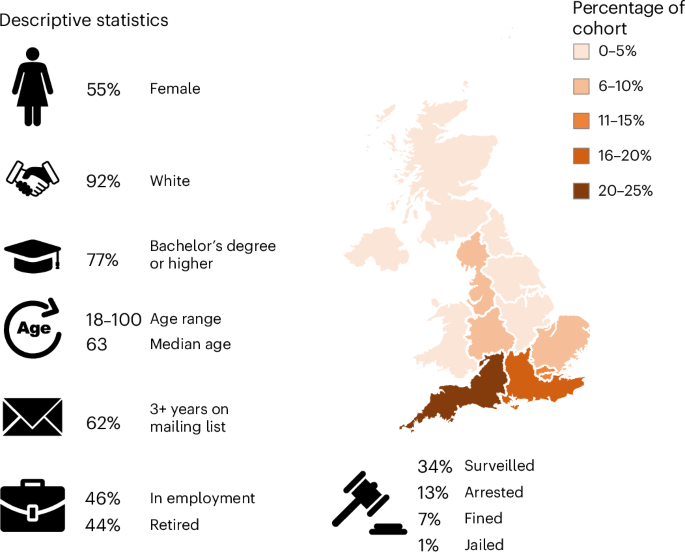
Participants were asked their age, gender, education level (no formal education, some primary education, some secondary education, completed secondary education vocational qualification, now in college or university, some college or university education, but no degree, Bachelor’s degree, Master’s degree, Doctorate or other advanced degree), race (Asian/Asian British, Black/African/Caribbean/Black British, White, Mixed/Multiple ethnic groups, Other ethnic group or background), the nation and/or country in the UK where participants lived (South West, South East, Greater London, East of England, West Midlands, East Midlands, Yorkshire and Humber, North West, North East, Scotland, Wales, Northern Ireland, outside the UK), income (£20,000 or less, £20,001–£40,000, £40,001–£60,000, £60,001–£80,000, £80,001–£100,000, more than £100,000) and class (text entry). They were also asked to state how long they had been a subscriber to the Extinction Rebellion UK emailing list (for <1 month, 1–6 months, 6 months to 1 year, 1–2 years, for >3 years). For an overview of the sample demographics, see Fig. 1. Finally, participants were asked to list the extent to which, on a five-point Likert scale, they had been involved in activities with Extinction Rebellion UK (attended events, for example a protest, organized events, for example helped to organize a protest or local group meetings, engaged in outreach, for example gave a talk, manned a stall or distributed pamphlets, back-office volunteering, for example rebel ringing, administration or using skill sets, or online activism, for example sharing petitions or social media posts and raising or donating money).
Environmental concern
We adapted the degree to which participants felt concern about climate change from former research26, on a five-point Likert scale based on ‘How worried are you about the following issue?’ (the climate crisis and biodiversity loss) r = 0.56, P < 0.001.
Environmental movement identification
Participants were asked the extent to which they socially identified with the climate protest movement, on a five-point Likert scale based on ‘To what extent do you agree or disagree with the following statements?’ (I see myself as a member of the climate protest movement; I identify with members of the climate protest movement), r = 0.57, P < 0.001, adapted from previous research30.
Political, identity consolidation and participative efficacy
Participants were asked to rate their belief that Extinction Rebellion UK could achieve its political goals (political efficacy35) on a five-point Likert scale based on ‘To what extent do you think that climate activism in the United Kingdom is effective in achieving the following goals’ (increasing government protection for populations vulnerable to the climate crisis, ensuring government action to rapidly reduce CO2 emissions, increasing regulations of companies that pollute the environment, changing the behaviour of individuals to be more environmentally friendly, improving media coverage of climate activism), α = 0.79. We also measured identity consolidation efficacy35, also on a five-point Likert scale based on ‘To what extent do you think that climate activism in the United Kingdom is effective in achieving the following goals’ (strengthening solidarity within the climate activist movement, increasing public support for the climate movement), r = 0.47, P < 0.001. Finally, we measured participative efficacy on a single five-point Likert scale based on ‘How much, if at all, do you believe that you, as an individual, can contribute to the climate movement’s success?’27.
Anticipated and experienced repression
We measured anticipated repression20 for climate protesters with four items on a five-point Likert scale and based on ‘How likely do you think it is that climate protesters in the UK will experience the following’ (surveillance, arrest, fines, jail time) α = 0.84. We also asked participants whether they had ever experienced the following as a climate protester: surveillance, arrest, fines and jail time (yes is 1, no is 0). The responses were summed to create an index of experienced repression.
Anger, fear, outrage and contempt
Participants stated whether they felt angry, outrage, contempt and fear about how the criminal justice system was treating climate protesters in the UK on a five-point Likert scale, adapted from previous research37,38. Note that, as a result of high correlations, the items anger and outrage were combined into a single construct (r = 0.74, P < 0.001).
Normative and non-normative future collective action intentions
Participants indicated their willingness to engage in a range of normative and non-normative collective actions, adapted from previous research15,37. Participants indicated how willing they would be to participate in six normative climate actions in the future (a public demonstration, a workplace strike, a protest outside parliament, a company boycott, sign a petition or open letter, a digital action), each measured on a five-point Likert scale. Note that the inter-item correlation revealed that ‘a workplace strike’ was below the recommended threshold of 0.3 (ref. 73), given this, and the rarity of this action in climate activism41, we removed this item from the measure, leaving five items (α = 0.68). Re-running the analyses with the workplace strike item included in our normative collective action scale yielded no major differences in results. This was with the exception of the small, negative association between experienced repression and normative action tendencies in model 3, which became non-significant; we therefore caution that this small effect is not stable when removing a workplace strike (see Supplementary Information for more information on the removal of the workplace strike item, and for model results when the item is included; Supplementary Tables 11, 12 and 13). All other effects did not change in directionality or significance. There were also no substantive changes to either mediation model.
To assess non-normative collective action intentions, we asked participants seven items on their willingness to take non-normative action in the future15,37 (a sit-in or lock-on, block streets or public buildings, take action to disrupt major polluters, occupy a threatened natural space, an action involving property damage, an action that is likely to result in arrest, an action that is likely to result in arrest with serious jail time), each measured on a five-point Likert scale (α = 0.87).
Analyses
All analyses were performed on SPSS v.29 and using the PROCESS macro v.4.3, models 1 and 4. R v.4.4.1 was used for data visualization. Except for experienced repression (7.3%), all other variables had low proportions of missing data (<3%). Analysis of the items constituting experienced repression revealed that only the surveillance item had >5% missing data. Little’s test74 revealed that the data were not missing-completely-at-random. Independent samples t-tests indicated that missingness was not significantly related to observed variables, implying that the missingness was missing-not-at-random. To assess the impact of the item on results, we ran both hierarchical regression and mediation analyses with and without the item, which resulted in negligible changes to coefficients and standard errors. We thus decided to keep the original four-item measure.
To assess how anticipated repression and the emotions of anger/outrage, contempt and fear build on SIMCA27 variables for normative and non-normative collective action intentions, we ran a hierarchical multiple regression using the software SPSS v.29 including past event participation as the control, adding environmental concern, environmental movement identification, political, identity consolidation and participative efficacies in model 2, anticipated repression and experienced repression in model 3 and anger/outrage, contempt and fear in model 4. Two variables (environmental concern and environmental movement identification) indicated excess skewness (>2), however residuals did not show violations of assumptions (non-normality, multicollinearity, cases with undue leverage or nonlinearity). We ran hierarchical multiple regression models using bootstrapping (5,000 samples) to compare coefficients and bootstrapped coefficients and standard errors. There were negligible changes to all standard errors and coefficients (<0.03), therefore, we interpreted the non-bootstrapped, standardized coefficients and standard errors throughout. Following this, and based on correlational findings20 and recent experimental evidence21,75, we explored indirect emotional effects on normative and non-normative collective actions from anticipated and experienced repression using the PROCESS software macro v.4.3, model 4.
Preregistration and deviations
Overview of hypotheses
We preregistered hypotheses before data collection in December 2024 (https://osf.io/n38r7). Drawing on SIMCA27 and its recent extensions, we first assessed the extent to which grievances (operationalized as environmental concern), identification with the environmental movement and efficacy beliefs predicted collective action intentions, over and above past involvement in activism. We hypothesized that environmental concern and environmental movement identification positively predict intentions to engage in normative (H1 and H2) and non-normative (H3 and H4) collective action in the future. In line with previous research that has documented opposing effects of efficacy on normative and non-normative collective action37,53, we expected positive effects of political efficacy, identity consolidation efficacy and participative efficacy on normative action intentions (H5–H7) and negative effects of these variables on non-normative action intentions (H8–H10). Thus, we considered the possibility that a lower perceived effectiveness of climate protest in achieving policy change and group mobilization goals, as well as frustrations involved with a perceived lack of participative efficacy, motivates people to participate in more radical, non-normative collective action.
There are competing, plausible hypotheses for the effects of repression on future action intentions. On the one hand, anticipating punitive consequences for activists, or having experienced such consequences in the past (that is, having experienced surveillance, arrest, fines or jail time because of protest participation), can have a negative, deterrent effect on future normative (H11a and H12a) and non-normative (H13a and H14a) action intentions19,20,21,57,75. On the other, anticipated and experienced repression can also act as grievances19,20 that increase action commitment and galvanize normative (H11b and H12b) and non-normative (H13b and H14b) action intentions. We further investigated the role of specific emotions in response to government repression. In line with work demonstrating the differential effects of anger and contempt on distinct forms of collective action37,52, we expected that anger/outrage about government repression would positively predict normative collective action intentions (H15) and anticipated that contempt would positively predict non-normative collective action intentions (H16)37,39,52. We also hypothesized that fear, as an action-inhibiting emotion46,48, would negatively predict both normative (H17) and non-normative collective action intentions (H18)20,21,40.
Finally, we explored indirect effects of anticipated and experienced repression via these emotions to disentangle potentially opposing effects of repression. We expected positive indirect effects of anticipated and experienced repression on normative action intentions via anger/outrage (H19 and H20) and on non-normative collective action intentions via contempt (H21 and H22). We further expected negative indirect effects of anticipated and experienced repression on the two types of collective action via fear (H23–H26).
Note that H5–H7 were unintentionally omitted from the preregistration due to an error, but are strongly supported by prior research20,27,28. Moreover, since we articulated competing hypotheses in the preregistration for the effects of anticipated repression (H11a/b and H13a/b), we treat these hypotheses as exploratory. The alternative hypotheses for the impact of experienced repression on action tendencies (H12a/b and H14a/b), as well as the indirect effects of repression on action tendencies via emotion (H19–H26) were not preregistered. The test of an additional preregistered hypothesis that experienced repression will increase action intentions particularly for those who are highly identified with the climate protest movement (that is, an interaction between experienced repression and identification in predicting future action intentions) is presented in Supplementary Information. Also note that hypotheses stated in the preregistration were not numbered and that there are slight deviations in the labelling of constructs (see, however, the detailed reporting of measures in the preregistration). Furthermore, for reasons of brevity, for hypotheses that did not differ for normative and non-normative collective action intentions, we simply referred to collective action intentions in the preregistration.
Note that, although we preregistered a two-stage hierarchical regression approach distinguishing core collective action predictors in step 1 and repression-related variables in step 2 while controlling for past participation in each step, we decided to extend the model to four blocks to allow for a more fine-grained and theoretically informative analysis. This decision was driven by the desire to better isolate the unique contribution of each conceptually distinct set of variables and to more clearly interpret their incremental predictive value. Importantly, this extension remains consistent with the rationale underlying the preregistration, while improving the interpretability of the findings. Please see Supplementary Table 1 for a full overview of hypotheses and preregistration status.
Ethics statement
We received ethical approval from the University Teaching and Ethics Committee at the University of St Andrews (first and last authors’ institution ethics board). Participants provided informed consent before taking part in the survey.
Reporting summary
Further information on research design is available in the Nature Portfolio Reporting Summary linked to this article.
