

The Trump 2.0 worldview is now on paper for the world to see. Late Thursday, the Trump administration released its National Security Strategy (NSS), a twenty-nine-page document outlining its principles and priorities for US foreign policy. The document articulates what US strategy is—for example, a focus on the Western Hemisphere and a “Trump Corollary” to the Monroe Doctrine. And it addresses what US strategy isn’t: continued pursuit of a post–Cold War goal of “permanent American domination of the entire world,” which the NSS describes as a “fundamentally undesirable and impossible goal.”
Below, our experts dig into what the strategy includes and leaves out—and emerge with their biggest takeaways. This post will be updated as more contributions come in.
Click to jump to an expert analysis:
Matthew Kroenig: Where the NSS succeeds—and falls short
Jason Marczak: The NSS gives new insight into Trump’s Venezuela goals
Daniel Fried: The NSS offers an inconsistent but workable set of elements
Thomas S. Warrick: An emphasis on national sovereignty and business interests
Where the NSS succeeds—and falls short
While they might not have conceived of it this way, the true challenge facing the authors of the United States’ new national security was how to update the country’s mostly successful eighty-year, post-World War II grand strategy for a new era. The new National Security Strategy’s greatest strengths, therefore, come when it doubles down on past principles that still work and identifies creative solutions to new problems.
The strategy is traditional in its strong support for nuclear deterrence and preventing hostile powers from dominating important regions. It calls for strong alliances in Europe and the Indo-Pacific—to be achieved in part by allies stepping up to do more for their own defense and greater coordination on economic security. The document prioritizes achieving freer and fairer terms for global trade and deeper economic engagement in most world regions.
It provides creative solutions for new challenges with a suite of policies to address the downsides of globalization (on border security, revitalizing domestic manufacturing, and so on) and by laying out a vision for US victory in the new tech arms race.
The document falls short where it rejects principles that have worked in the past (e.g., the pragmatic promotion of democracy and human rights) and where it fails to clearly identify and address new challenges before the country (the threat from revisionist autocracies and their interlinkages should have received much more attention).
—Matthew Kroenig is vice president and senior director of the Atlantic Council’s Scowcroft Center for Strategy and Security and the Council’s director of studies.
The NSS gives new insight into Trump’s Venezuela goals
The new NSS is clear: The Western Hemisphere is now the United States’ top priority. This is a long overdue and welcome shift, as US interests should begin close to home. The strategy captures on paper what we have seen from the Trump administration in action thus far, including the twin goals laid out of “Enlist and Expand.” This approach underpins efforts to control migration, stop the proliferation of drug cartels, reduce nonfriendly foreign influence, and secure critical supply chains. But also, and importantly, it includes incentivizing new waves of US investment, since strong domestic economies serve US interests.
The priorities laid out in the NSS—from a holistic perspective—dovetail with many of the interests of countries across the Western Hemisphere, such as security and economic growth, which have been the top concerns of voters in recent elections. There’s also a regional yearning for greater US investment, especially in infrastructure such as telecommunications, technology, and ports, all of which simply has not come at the desired scale. The NSS provides a blueprint for the broader US government to elevate its role in these critical sectors, and it underscores the need for a whole-of-government approach.
The strategy gives insight into the Trump administration’s ultimate goal in Venezuela. A country where Maduro and his cronies currently provide safe haven for criminal groups, profit from trafficking, and welcome the influence of foreign adversaries is a direct threat to US national security. Success in Venezuela, therefore, means ushering in a democratic government that’s a genuine US partner as part of the goal to “expand” US partnerships. And a US shift to the Western Hemisphere as part of the “Trump Corollary” to the Monroe Doctrine also signals that the redeployment of US forces to the Caribbean is not time-bound.
The NSS further details a multi-pronged hemispheric effort to counter the influence of external powers, including Russia and, especially, China. For China, this means addressing Beijing’s growing footprint across commerce, investment, soft diplomacy, military training, and more. What should we look at next? How will implementation be prioritized, and how will this strategy translate at the country level across the hemisphere?
—Jason Marczak is vice president and senior director at the Atlantic Council’s Adrienne Arsht Latin America Center.
The Western Hemisphere “Trump Corollary” is a logical focus on strategic geography
Trump’s NSS is a much-needed corrective to decades of “strategies” that, through their failure to force difficult choices about priorities and resource allocation, commit the United States to an overstretched conception of national strategy. This NSS is remarkably and refreshingly frank about the essential objectives of the United States: securing the homeland, which requires a secure Western Hemisphere, and preventing outside great power adversaries from exerting malign influence in the hemisphere. The “Trump Corollary” to the Monroe Doctrine, which seeks to guarantee US access to key hemispheric locations (think the Panama Canal, Greenland, and much of the Caribbean) will likely stand as an overt, twenty-first century statement of a logical and previously unexceptional focus on strategic geography. The Trump Corollary carries real security and economic implications for American interests and security in the homeland. This strategic focus is likely to encourage new resources dedicated to intelligence, military, law enforcement, and economic statecraft programs focused on the hemisphere.
The administration’s statement of intent for the Indo-Pacific is a consistent throughline from its 2017 NSS, but it also reflects evolving geopolitical realities. The NSS reiterates US commitment to preserving a free and open Indo-Pacific and strengthening regional partners and allies against China’s malign activity. It defines the region as the essential non-hemispheric theater for geopolitical competition. Importantly, the NSS seeks to draw a line between security in our hemisphere and deterrence of Beijing more broadly. This makes explicit a long-running reality of the US competition with China: Beijing seeks to distract the United States from maintaining the status quo in the Indo-Pacific by pursuing adversarial activities in the Western Hemisphere.
Finally, the NSS is a useful thematic reminder that US national strength stems from more than simply the military balance. The strategy is explicit on the need for a strong defense-industrial and manufacturing base to sustain that military balance, alongside dominance in technologies such as artificial intelligence (AI), quantum, and supercomputing. The NSS should be understood as a limiting document that seeks to more narrowly define US objectives globally, while also expanding the definition of US national power in a more comprehensive direction, building upon Trump’s long-stated belief that economic security is national security.
Taken together, these lines of effort reflect a coordinated, holistic approach to preserving US national power in the decades to come.
—Alexander B. Gray is a nonresident senior fellow with the GeoStrategy Initiative at the Atlantic Council’s Scowcroft Center for Strategy and Security. Gray most recently served as deputy assistant to the president and chief of staff of the White House National Security Council (NSC).
The NSS offers an inconsistent but workable set of elements
The newly released NSS seems to combine:
- an overlay of post-Iraq/Afghanistan weariness and reaction, a sort of right-wing version of the post-Vietnam “come home, America” thinking of the Democrats in the early 1970s;
- ideological posturing, particularly directed against Europe with a sharp partisan element of support for “patriotic” (presumably meaning nationalist and nativist) parties;
- a call for fortress America (the document refers to the “Trump Corollary to the Monroe Doctrine,” which seems to mean a desire to prevent outside powers such as China from establishing economic leverage in the hemisphere);
- a strong assertion of US interests in pushing back on Chinese economic coercion and distortion of global trade as well as Chinese expansionism. The section on Asia has good language about no change to the Taiwan “status quo” and lots about protecting the Western Pacific island chains;
- possibly workable language on economic policy, with emphasis on preventing foreign domination of critical resources and technologies and foreign exploitation of international trade, and;
- inconsistent, occasionally odd, and probably compromise language on Europe that combines partisan hostility to Europe’s mainstream politics with grudging but welcome recognition that the United States needs to work with Europe.
The NSS is weak on Russia, which is mentioned only in a European context. But it does call for a “cession of hostilities” in Ukraine that leaves Ukraine a “viable state” and terms this a “core interest” of the United States. That’s not sufficient, given Russian President Vladimir Putin’s refusal to engage in US efforts to end the war, but it is good enough to support a good-enough policy, if the Trump team decides to push Russia to achieve this core interest.
The strategy’s ideological hostility toward Europe combines with its implied bitterness over perceived US overextension and general disdain for “values” to drive US withdrawal from leadership of the free world—and even the concept of the free world itself. At the same time, the NSS elsewhere recognizes that the United States will need its friends, Europe included, to contend with its adversaries, especially China. This gives the NSS an internal incoherence. To a policy practitioner, the incoherence could provide an opportunity to build on the NSS’s better elements.
—Daniel Fried is the Weiser Family distinguished fellow at the Atlantic Council. He formerly served as special assistant and National Security Council senior director for presidents Bill Clinton and George W. Bush, ambassador to Poland, and assistant secretary of state for Europe.
The NSS offers a more realistic framing for international assistance
The second Trump administration’s NSS is as much an economic statecraft strategy as it is a national security strategy, justifying US internationalism primarily based on economic interests, particularly in the Western Hemisphere, and, perhaps surprisingly for those concerned about the merger of the United States Agency for International Development (USAID) into the Department of State, reinforcing the importance of soft power.
It frames foreign policy around traditional economic statecraft objectives such as preserving secure supply chains, access to raw materials, protecting US export markets, and ensuring dominance of US technology and industrial capacity. International assistance is not dismissed, but it is also not presented as a tool of humanitarian obligation or for providing global public goods. Rather, assistance is considered meaningful when it helps protect or advance US interests.
While this may seem cold-hearted, it actually reflects what many in the Global South already assume to be the reality of all foreign assistance and is how this funding has been justified to the American people for decades. Even as the United States provides food aid, for instance, US leaders talk about it as helping US farmers or creating global stability to ensure Americans’ own safety and prosperity. The NSS also notes plans to scale up the use of two of the most important US government development tools, the Development Finance Corporation and the Millennium Challenge Corporation, particularly in the Western Hemisphere, reversing a Department of Government Efficiency (DOGE)-era assault on development in general.
—James Mazzarella is a senior fellow with the Atlantic Council’s Freedom and Prosperity Center. From 2017 to 2019, he served at the White House’s National Security Council (NSC) and National Economic Council, first serving as director of international development and then senior director for global economics and development.
—Kimberly Donovan is the director of the Economic Statecraft Initiative within the the Atlantic Council’s GeoEconomics Center. She previously served as acting associate director of the Financial Crimes Enforcement Network’s (FinCEN) Intelligence Division, in the US Treasury Department.
An emphasis on national sovereignty and business interests
As expected, the new National Security Strategy is a combination of traditional views of the importance of American power, but with an emphasis on national sovereignty and business interests as a driver of international engagement. For the first time in decades, the Western Hemisphere is given precedence, with the strategic goal of reducing mass migration. Border security is seen as a key element of national security―a proposition that most Americans would agree with, even if they disagree on how to handle immigration enforcement domestically. More paragraphs in the NSS are devoted to Asia (25) than Europe, the Middle East, and Africa combined (13, 7, and 3).
Counterterrorism, soon to be the subject of its own national strategy, is barely mentioned, but previews of the counterterrorism strategy show a vision of global terrorism reduced to a problem that governments can deal with on their own, with limited outside support needed. This would represent important progress and is a goal that would benefit the United States and its counterterrorism partners around the world.
—Thomas S. Warrick is a nonresident senior fellow in the Scowcroft Middle East Security Initiative and a former deputy assistant secretary for counterterrorism policy in the US Department of Homeland Security.
Trump’s energy- and technology-dominance goals will need more of a focus on resilience
The 2025 NSS clearly outlines ambitions for US energy, industrial, and technological dominance. However, to secure long-term success in those aims, I believe the document should place even greater emphasis on building resilience—both in infrastructure and in financial systems.
Resilient, modern infrastructure is the foundation of reliable energy and technological networks. Without robust power grids, supply chains, and communications systems, ambitions for advanced nuclear reactors, AI-driven innovation, and export leadership remain fragile. Supporting that infrastructure—and embedding redundant, disaster-resistant systems—gives real durability to the energy- and technology-dominance goals.
Likewise, broadening access to financial opportunities and capital—especially for infrastructure, clean energy, and emerging tech—would strengthen economic inclusion and mobilize domestic innovation at scale. A strategy anchored in resilience and financial empowerment would therefore bolster not just short-term gains, but enduring strength, capacity, and stability for decades.
—Jorge Gastelumendi is the senior director of the Atlantic Council’s Climate Resilience Center.
Further reading

Fri, Dec 5, 2025
After Maduro
New Atlanticist
By
Jason Marczak
Opposition leaders have a plan for a democratic transition when Venezuelan strongman Nicolás Maduro leaves power.
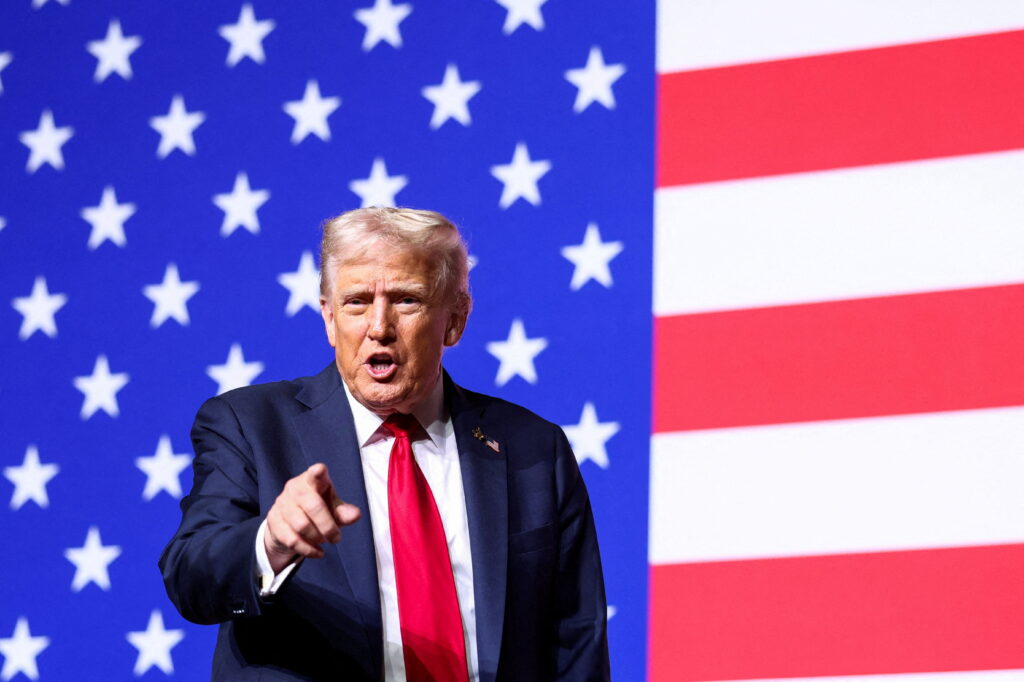
Image: US President Donald Trump gestures after speaking during a meeting of senior military leaders convened by U.S. Defense Secretary Pete Hegseth, at Marine Corps Base Quantico in Quantico, Virginia, U.S., September 30, 2025. REUTERS/Kevin Lamarque
