
LIVE NEWS
  • ShinyHunters Extorted Boeing Spin-off Prior to Arrests – Krebs on Security
  • Ukraine can help Europe counter Russia’s escalating shadow war
  • Why is Applied Optoelectronics stock surging today?
  • Zcash developers set January target for quantum-resistant payments after ‘bunker mode’ scare
  • To capture impact of abortion restrictions, researcher Betsy Pleasants studies Reddit
  • Hurricane Isaias live updates: Gulf coast braces for storm, Florida declares state of emergency
  • Claude can now build your dashboards
  • Trump administration investigates universities for J-1 visa fraud
Prime Reports
  • Home
  • Popular Now
  • Crypto
  • Cybersecurity
  • Economy
  • Geopolitics
  • Global Markets
  • Politics
  • See More
    • Artificial Intelligence
    • Climate Risks
    • Defense
    • Healthcare Innovation
    • Science
    • Technology
    • World
Prime Reports
  • Home
  • Popular Now
  • Crypto
  • Cybersecurity
  • Economy
  • Geopolitics
  • Global Markets
  • Politics
  • Artificial Intelligence
  • Climate Risks
  • Defense
  • Healthcare Innovation
  • Science
  • Technology
  • World
Home»Cybersecurity»Google: AI Is Changing the Pace and Profile of Vulnerability Discovery
Cybersecurity

Google: AI Is Changing the Pace and Profile of Vulnerability Discovery

primereportsBy primereportsSeptember 30, 2026No Comments4 Mins Read
Share Facebook Twitter Pinterest LinkedIn Tumblr Reddit Telegram Email
Google: AI Is Changing the Pace and Profile of Vulnerability Discovery
Share
Facebook Twitter LinkedIn Pinterest Email


The number of vulnerabilities disclosed each month doubled in 2026, and the monthly average of vulnerabilities exploited in the wild nearly doubled, according to a new report from Google Threat Intelligence Group (GTIG).

Analyzing disclosures from January 2025 through August 2026, GTIG found that monthly disclosures rose from 5,045 in January 2026 to 10,477 in July, peaking at 10,740 in August.

“We found that AI is measurably changing not just the pace of vulnerability discovery and exploitation, but also the types and typical risk profiles of vulnerabilities that are being discovered,” GTIG says.

The researchers caution that raw volume can be misleading, as automated CVE assignment in open source ecosystems can inflate the numbers. Vulnerabilities whose description mentions the Linux kernel alone generated roughly 5,000 CVEs between January and August, with no in-the-wild zero-day exploitation observed.

High-risk disclosures, based on GTIG’s own ratings rather than CVSS, grew 167%, from 131 in January to 350 in August. In addition, GTIG recorded 141 distinct exploited vulnerabilities in the first eight months of 2026, more than the 127 seen in all of 2025. That’s an average of 18 per month, up from 10.5 last year.

Still, only 0.23% of this year’s disclosed vulnerabilities, roughly one in 431, were observed being exploited.

Advertisement. Scroll to continue reading.

Zero-day exploitation increased only marginally, from an average of eight per month in 2025 to 11 per month in 2026, although the count jumped to 22 in August. Zero-days made up 62% of the vulnerabilities exploited between January and August.

GTIG suggests that the growth in exploitation came primarily from n-days. Exploitation of high-risk vulnerabilities also more than doubled, from 28 in 2025 to 75 in the first eight months of 2026.

“It is possible that threat actors are finding it more accessible or efficient to use LLMs and AI tools to automate analysis of differences between product versions, patches, vulnerability disclosure announcements, and Proof-of-Concept (POC) code to rapidly weaponize n-days, rather than to discover new zero-days,” the report reads.

Vulnerabilities that GTIG identified as likely discovered by AI between January and August show a different risk profile. Of these, 39% were rated low-risk and 58% medium-risk, compared to 69% and 28%, respectively, for non-AI vulnerabilities.

GTIG says this likely reflects how research programs deploy AI agents, tasking them with auditing critical infrastructure and sensitive privilege boundaries with a focus on higher-impact findings.

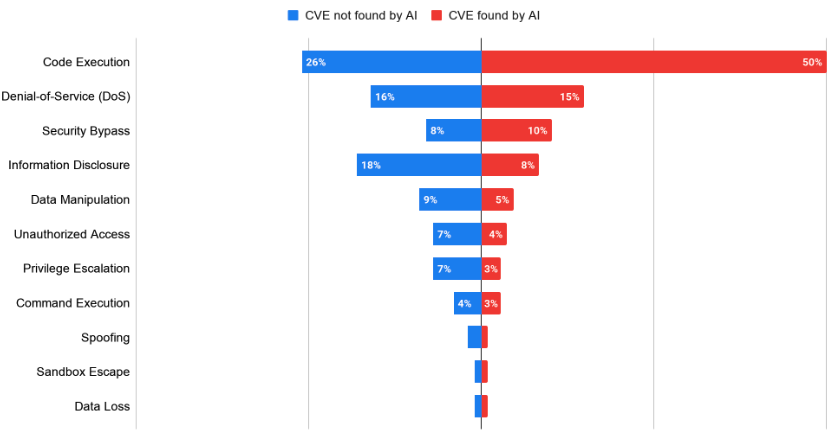
Half of the AI-discovered vulnerabilities result in remote code execution, compared to 26% of non-AI vulnerabilities. According to GTIG, this likely stems from AI models’ ability to find memory corruption and logic flaws that traditional static analyzers miss.
GTIG has also confirmed in-the-wild exploitation of AI-discovered vulnerabilities, though it describes this as an early indicator rather than an established trend.

One example is CVE-2026-1731, an unauthenticated OS command injection flaw in BeyondTrust Privileged Remote Access and Remote Support, discovered autonomously by the Hacktron AI research agent. One threat cluster exploited it within four days of public disclosure, and five more followed within seven days.

Disclosures of vulnerabilities in AI systems themselves are also rising. GTIG tracked 2,076 AI-related CVEs between January 2025 and August 2026, including more than 1,500 this year, roughly half of which affect AI orchestration frameworks.

Only a handful of the 2,076 have been confirmed as exploited in the wild, including flaws in LiteLLM and Langflow. GTIG has not yet observed zero-day exploitation of AI infrastructure.

“GTIG expects that rates of vulnerability discovery and exploitation are likely to continue to increase in the short to medium term,” the report reads.

Related: High-Severity Vulnerabilities Patched in OpenSSL, WolfSSL

Related: WatchGuard Patches Critical Fireware OS Code Injection Vulnerability

Related: Chrome, Firefox Updates Patch Over 100 Vulnerabilities

Share. Facebook Twitter Pinterest LinkedIn Tumblr Email
Previous ArticleSingapore’s Temasek expands in Mideast with Abu Dhabi, Riyadh offices
Next Article PLTR Price Prediction: Momentum Stalls at $188 Resistance — Is a $195–$210 Breakout or a $175 Flush Next?
primereports
  • Website

Related Posts

Cybersecurity

ShinyHunters Extorted Boeing Spin-off Prior to Arrests – Krebs on Security

October 9, 2026
Cybersecurity

Authorities seize sites selling hacked, stolen intimate images of 17,000 women and girls

October 8, 2026
Cybersecurity

SonicWall warns of max severity SSRF flaw in SMA1000 gateways

October 7, 2026
Add A Comment
Leave A Reply Cancel Reply

Top Posts

Threat of further violence looms after Mexican cartel rampage

February 25, 2026116 Views

‘Two-sided risk’ Medicare Advantage plans improve patient outcomes

February 24, 202673 Views

An $18bn settlement – and Zuckerberg barely blinked. The tech titans must be stripped of their power, and soon | Jonathan Freedland

August 28, 202626 Views
Stay In Touch
  • Facebook
  • YouTube
  • TikTok
  • WhatsApp
  • Twitter
  • Instagram
Latest Reviews

Subscribe to Updates

Get the latest tech news from FooBar about tech, design and biz.

PrimeReports.org
Independent global news, analysis & insights.

PrimeReports.org brings you in-depth coverage of geopolitics, markets, technology and risk – with context that helps you understand what really matters.

Editorially independent · Opinions are those of the authors and not investment advice.
Facebook X (Twitter) LinkedIn YouTube
Key Sections
  • World
  • Crypto
  • Cybersecurity
  • Geopolitics
  • Artificial Intelligence
  • Global Markets
All Categories
  • Artificial Intelligence
  • Climate Risks
  • Crypto
  • Cybersecurity
  • Defense
  • Economy
  • Geopolitics
  • Global Markets
  • Healthcare Innovation
  • Politics
  • Popular Now
  • Science
  • Technology
  • World
  • About Us
  • Contact Us
  • Privacy Policy
  • Terms & Conditions
  • Disclaimer
  • Cookie Policy
  • DMCA / Copyright Notice
  • Editorial Policy

Sign up for Prime Reports Briefing – essential stories and analysis in your inbox.

By subscribing you agree to our Privacy Policy. You can opt out anytime.
Latest Stories
  • ShinyHunters Extorted Boeing Spin-off Prior to Arrests – Krebs on Security
  • Ukraine can help Europe counter Russia’s escalating shadow war
  • Why is Applied Optoelectronics stock surging today?
© 2026 PrimeReports.org. All rights reserved.
Privacy Terms Contact

Type above and press Enter to search. Press Esc to cancel.