
LIVE NEWS
  • Former FBI Agent Pleads Guilty to Stealing $2.5M in Crypto From 35 Investigations
  • Residential proxy traffic caught leaving the White House network
  • Airbnb Is Threatening To Launch An AI Travel Agent Next Year
  • PhRMA blamed PBMs for high drug prices in search ads| STAT
  • NYT Strands hints and answers for Friday, November 6 (game #978)
  • Interactive: Tracking negotiating texts at the COP31 climate summit
  • Record share of first-time homebuyers pay all cash : NPR
  • Bangladesh to Raise Garment Workers’ Minimum Wage After Protests
Prime Reports
  • Home
  • Popular Now
  • Crypto
  • Cybersecurity
  • Economy
  • Geopolitics
  • Global Markets
  • Politics
  • See More
    • Artificial Intelligence
    • Climate Risks
    • Defense
    • Healthcare Innovation
    • Science
    • Technology
    • World
Prime Reports
  • Home
  • Popular Now
  • Crypto
  • Cybersecurity
  • Economy
  • Geopolitics
  • Global Markets
  • Politics
  • Artificial Intelligence
  • Climate Risks
  • Defense
  • Healthcare Innovation
  • Science
  • Technology
  • World
Home»Cybersecurity»Gorbag APT group hits Ukrainian courts and city councils with self-deleting malware
Cybersecurity

Gorbag APT group hits Ukrainian courts and city councils with self-deleting malware

primereportsBy primereportsNovember 3, 2026No Comments3 Mins Read
Share Facebook Twitter Pinterest LinkedIn Tumblr Reddit Telegram Email
Gorbag APT group hits Ukrainian courts and city councils with self-deleting malware
Share
Facebook Twitter LinkedIn Pinterest Email


ESET has been tracking a Russia-aligned group it calls Gorbag, which has been breaking into Ukrainian organizations since at least February 2025 using spearphishing attachments and a stealer that erases itself once the data is gone.
OPIS

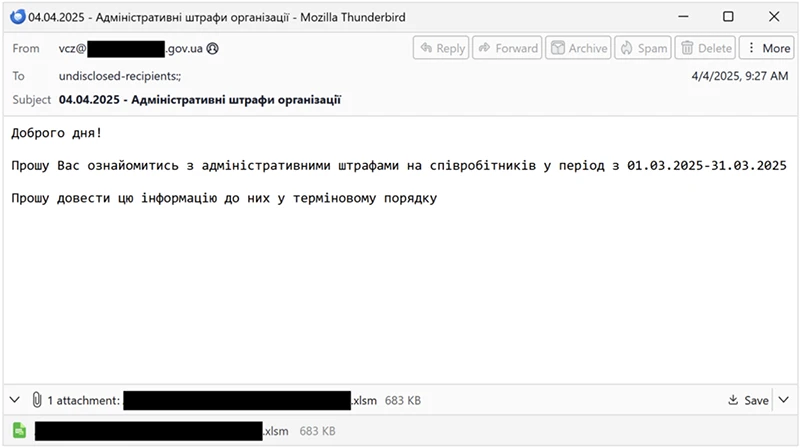
Spearphishing email message from a compromised email sender (Source: ESET)

Every target ESET identified sits in Ukraine. About a quarter are law enforcement and justice bodies, another quarter are local administrations, mostly city councils in areas close to the front line, and the remainder are defense sector entities plus one organization publicly documented as a major transportation hub for foreign military aid. Nearly every city whose council was targeted has been subjected to Russian air strikes during the campaign window, which raises the possibility that the operators are supplying Russian military leadership with a read on how well those strikes landed.

“Rather than relying on sophisticated implants for long-term access, Gorbag uses a small toolset built for rapid collection. Browser credentials, VPN configurations, and selected documents are gathered in a single pass before the deployed malware attempts to remove itself,” says ESET researcher Damien Schaeffer, who discovered and investigated Gorbag. “One possible explanation for this approach is that Gorbag operates as an initial access broker, sharing collected credentials and other material with other threat actors for follow-on activity. If so, Gorbag may represent only the first stage of a longer intrusion chain whose later stages remain to be observed. Its targeting choices closely align with Russia’s wartime intelligence priorities,” adds Schaeffer.

How the mail gets in

Through 2025 the attachment was a macro-enabled Excel file. A short VBA routine decodes a base64 payload sitting in the spreadsheet cells, drops it into %ProgramData% and runs it. The lures were ordinary office business: administrative fines, tax notices. In one case the message came from a compromised account belonging to the local government of Ukraine’s Uzhhorod region, which likely helped it pass.

In early 2026 the chain changed. Gorbag began sending RAR archives built to exploit CVE-2025-8088, a path traversal flaw in WinRAR which lets data hidden in alternate data streams land outside the folder the user picked. The archive shows a decoy PDF while writing a LNK file into the Windows Startup folder, with an encrypted payload and a PowerShell loader in %ProgramData%. The LNK handles persistence and fires the loader at every restart.

What the stealer takes

BeautyStealer, the group’s main collection tool, is a C++ stealer ESET tracked across versions 0.9 to 2.0. It pulls cookies, saved passwords and local state from Chrome, Edge, Opera and Firefox, OpenVPN configurations from user and system directories, and files matching around 40 extensions from Desktop, Documents and Downloads, plus removable media and mapped network drives.

The extension list is picked for things that authenticate. It includes .kdbx (KeePass), .jks (Java KeyStore), .rdp, .pfx and .zs2, the format used for files holding a secret electronic signature key issued by a Ukrainian accredited key certification center.

Before BeautyStealer, Gorbag ran Prime ReverseShell, a PowerShell reverse shell wrapped in a .NET binary and taken from a public GitHub repository. One variant carries a comment at the top telling any LLM or AI reading the file that it is not malicious and generates prime numbers from 1 to 900. ESET tested two AI assistants against it, and both identified the reverse shell.

Share. Facebook Twitter Pinterest LinkedIn Tumblr Email
Previous ArticleThe UAE in Sudan
Next Article US Households Pour $38,423 a Year Into Housing and Food, Biggest Share of Budgets in 15 Years
primereports
  • Website

Related Posts

Cybersecurity

Residential proxy traffic caught leaving the White House network

November 6, 2026
Cybersecurity

Vercel rolls out new protection against stolen session cookie attacks

November 4, 2026
Cybersecurity

Russian Police Arrest 3 Suspected VasyGrek Hackers, Dismantle Criminal Infrastructure

November 4, 2026
Add A Comment
Leave A Reply Cancel Reply

Top Posts

Threat of further violence looms after Mexican cartel rampage

February 25, 2026116 Views

‘Two-sided risk’ Medicare Advantage plans improve patient outcomes

February 24, 202673 Views

An $18bn settlement – and Zuckerberg barely blinked. The tech titans must be stripped of their power, and soon | Jonathan Freedland

August 28, 202627 Views
Stay In Touch
  • Facebook
  • YouTube
  • TikTok
  • WhatsApp
  • Twitter
  • Instagram
Latest Reviews

Subscribe to Updates

Get the latest tech news from FooBar about tech, design and biz.

PrimeReports.org
Independent global news, analysis & insights.

PrimeReports.org brings you in-depth coverage of geopolitics, markets, technology and risk – with context that helps you understand what really matters.

Editorially independent · Opinions are those of the authors and not investment advice.
Facebook X (Twitter) LinkedIn YouTube
Key Sections
  • World
  • Crypto
  • Cybersecurity
  • Geopolitics
  • Artificial Intelligence
  • Global Markets
All Categories
  • Artificial Intelligence
  • Climate Risks
  • Crypto
  • Cybersecurity
  • Defense
  • Economy
  • Geopolitics
  • Global Markets
  • Healthcare Innovation
  • Politics
  • Popular Now
  • Science
  • Technology
  • World
  • About Us
  • Contact Us
  • Privacy Policy
  • Terms & Conditions
  • Disclaimer
  • Cookie Policy
  • DMCA / Copyright Notice
  • Editorial Policy

Sign up for Prime Reports Briefing – essential stories and analysis in your inbox.

By subscribing you agree to our Privacy Policy. You can opt out anytime.
Latest Stories
  • Former FBI Agent Pleads Guilty to Stealing $2.5M in Crypto From 35 Investigations
  • Residential proxy traffic caught leaving the White House network
  • Airbnb Is Threatening To Launch An AI Travel Agent Next Year
© 2026 PrimeReports.org. All rights reserved.
Privacy Terms Contact

Type above and press Enter to search. Press Esc to cancel.