

LIVE NEWS
  • Calley Means says WH insiders, industry lobbyists foiled MAHA plans
  • Google just made Googlebooks faster, more stable, and less crash-prone
  • ZachXBT revisits Ansem warnings amid Sahil payment claims
  • Fed’s Mary Daly says higher interest rates ‘are likely to be needed’ in inflation fight
  • Claude Code’s “Don’t Ask Again” File Exposes Passwords and Keys in 1,122 Public Copies on GitHub
  • Sudan war and climate change see parents struggle to feed their children | Features News
  • Environmental groups embrace AI, even as they warn of data center impacts
  • An unexpected activist helped block a $5 billion data center : NPR
Prime Reports
  • Home
  • Popular Now
  • Crypto
  • Cybersecurity
  • Economy
  • Geopolitics
  • Global Markets
  • Politics
  • See More
    • Artificial Intelligence
    • Climate Risks
    • Defense
    • Healthcare Innovation
    • Science
    • Technology
    • World
Prime Reports
  • Home
  • Popular Now
  • Crypto
  • Cybersecurity
  • Economy
  • Geopolitics
  • Global Markets
  • Politics
  • Artificial Intelligence
  • Climate Risks
  • Defense
  • Healthcare Innovation
  • Science
  • Technology
  • World
Home»Cybersecurity»Hackers abuse Google Ads, Bing redirects to push Claude ClickFix attacks
Cybersecurity

Hackers abuse Google Ads, Bing redirects to push Claude ClickFix attacks

primereportsBy primereportsOctober 10, 2026No Comments3 Mins Read
Share Facebook Twitter Pinterest LinkedIn Tumblr Reddit Telegram Email
Hackers abuse Google Ads, Bing redirects to push Claude ClickFix attacks
Share
Facebook Twitter LinkedIn Pinterest Email


Claude

Hackers are abusing legitimate Bing search-result redirects as click URLs in Google search ads to direct users to fake Claude installers that deliver ClickFix attacks.

The technique, dubbed “Adception” by security researchers at Push Security, appears designed to evade advertising security checks by using Bing’s trusted domain as the ad destination, before redirecting victims through a compromised website to the malicious download page.

The attack also uses multiple layers of cloaking to prevent security scanners and visitors who access the malicious URLs directly from seeing the payload.

According to a report published by Push Security, the campaign was discovered after researchers detected a malicious Google ad targeting users searching for “claude mac.”

Google search ad ultimately redirecting to a fake Claude download page
Source: Push Security

Unlike typical malvertising campaigns that direct victims to attacker-controlled domains, the sponsored result displayed the legitimate bing.com domain, making the advertisement appear less suspicious.

When clicked, Push says the ad first passed through Google’s advertising redirect before reaching Bing’s bing.com/ck/a click-tracking endpoint, which forwarded the browser to a legitimate but compromised WordPress website belonging to a South American retailer.

The compromised website then redirected the visitor to claude-desk-code[.]com, a fake Claude download page designed to trick macOS users into executing malicious commands.

Bing’s click-tracking redirects use JavaScript to send visitors to their destination, allowing attackers to redirect users to malicious websites while making the traffic appear to originate from Bing.

The campaign also uses two layers of cloaking to prevent unwanted visitors from reaching the payload.

The compromised WordPress website checks for a Bing referrer and specific browser headers before redirecting visitors, while the fake Claude website uses JavaScript to verify that visitors arrived from Google or Bing.

Visitors who try to access the malicious site directly are redirected to a 404 error page, making it harder for automated security scanners to analyze the attack.

Fake Claude installer hides malicious commands

The final destination is a convincing imitation of a Claude download page that offers a macOS installer using an installation command entered into the Terminal.
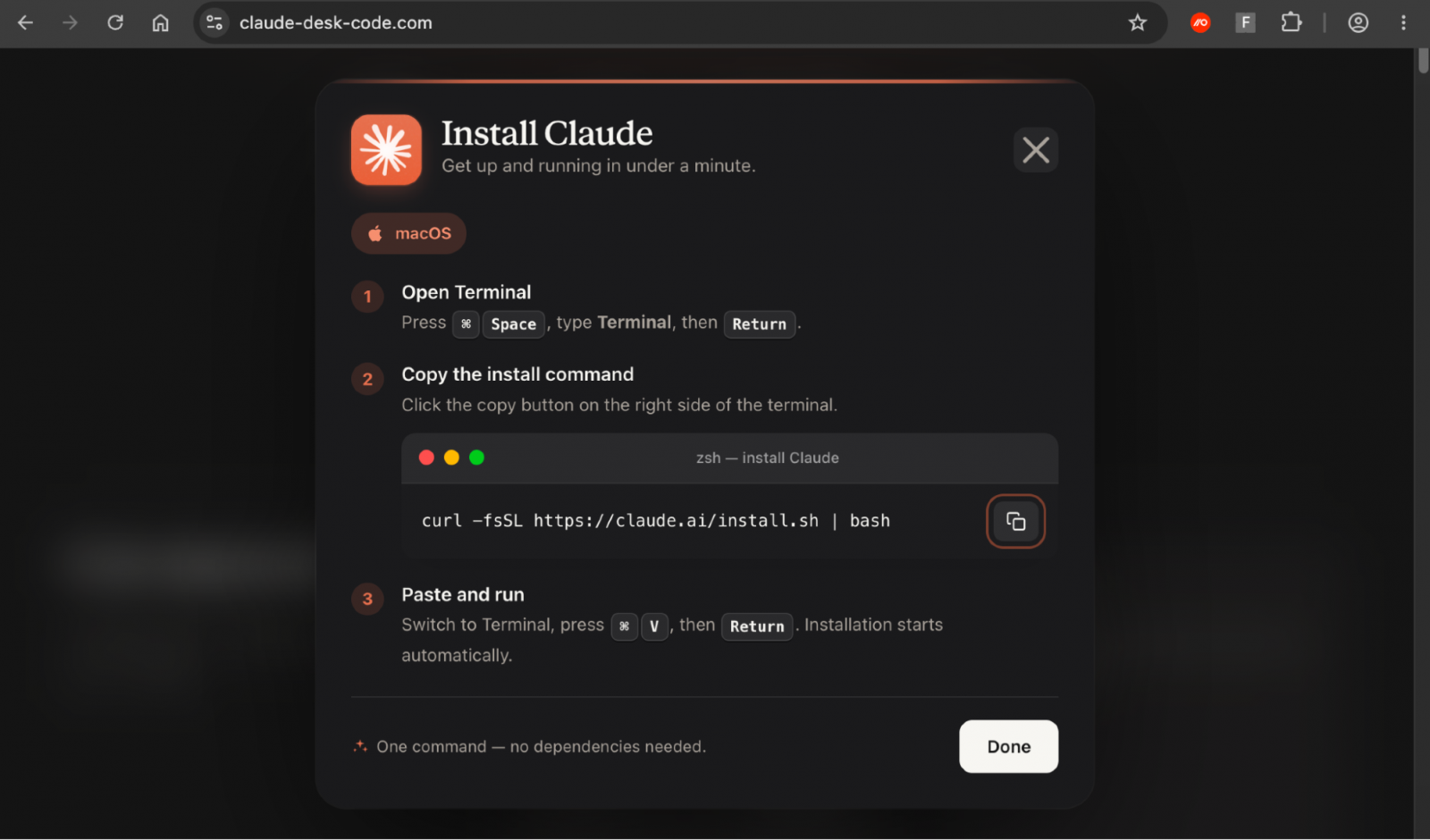
ClickFix prompt disguised as installation steps for Claude for macOS 
Source: Push Security

However, while the page displays Anthropic’s legitimate installation command, curl -fsSL https://claude.ai/install.sh | bash, clicking the copy button places a malicious command in the clipboard.

The substituted command first prints a message claiming to download Claude from Anthropic’s official website, but actually decodes a Base64-encoded URL pointing to lake-90[.]com.

It then uses curl to silently download a .dat file from the attacker-controlled server and pipes its contents directly into the macOS Z shell (zsh) for execution.

This means victims see the legitimate Claude installation URL both on the download page and in the terminal, even though an entirely different script is being executed.

The final payload delivered by the attack remains unknown, so it unclear what malware, if any, is being installed.

Push Security says it identified several domains associated with the same ClickFix toolkit, which it tracks internally as AcSig, that use an identical macOS installation command, payload URL structure, and installer interface.


article image

Join Mikko Hyppönen and security leaders from the NFL, CHANEL, and Atlassian for a two-hour digital summit on what AI-speed attacks change, what defenders should stop doing, and how to validate, decide, fix, and re-validate at machine speed.

Save your seat

Share. Facebook Twitter Pinterest LinkedIn Tumblr Email
Previous ArticleMicrosoft AI Releases Microsoft-Decision-1: A Qwen3.5-9B Decision-Scoring Model
Next Article ‘Unknown’ sailors and Marines from the battleship Arizona to be disinterred Dec. 7
primereports
  • Website

Related Posts

Cybersecurity

Claude Code’s “Don’t Ask Again” File Exposes Passwords and Keys in 1,122 Public Copies on GitHub

November 7, 2026
Cybersecurity

Want to Rent an Internet Address at the White House? – Krebs on Security

November 7, 2026
Cybersecurity

Residential proxy traffic caught leaving the White House network

November 6, 2026
Add A Comment
Leave A Reply Cancel Reply

Top Posts

Threat of further violence looms after Mexican cartel rampage

February 25, 2026116 Views

‘Two-sided risk’ Medicare Advantage plans improve patient outcomes

February 24, 202673 Views

An $18bn settlement – and Zuckerberg barely blinked. The tech titans must be stripped of their power, and soon | Jonathan Freedland

August 28, 202627 Views
Stay In Touch
  • Facebook
  • YouTube
  • TikTok
  • WhatsApp
  • Twitter
  • Instagram
Latest Reviews

Subscribe to Updates

Get the latest tech news from FooBar about tech, design and biz.

PrimeReports.org
Independent global news, analysis & insights.

PrimeReports.org brings you in-depth coverage of geopolitics, markets, technology and risk – with context that helps you understand what really matters.

Editorially independent · Opinions are those of the authors and not investment advice.
Facebook X (Twitter) LinkedIn YouTube
Key Sections
  • World
  • Crypto
  • Cybersecurity
  • Geopolitics
  • Global Markets
  • Artificial Intelligence
All Categories
  • Artificial Intelligence
  • Climate Risks
  • Crypto
  • Cybersecurity
  • Defense
  • Economy
  • Geopolitics
  • Global Markets
  • Healthcare Innovation
  • Politics
  • Popular Now
  • Science
  • Technology
  • World
  • About Us
  • Contact Us
  • Privacy Policy
  • Terms & Conditions
  • Disclaimer
  • Cookie Policy
  • DMCA / Copyright Notice
  • Editorial Policy

Sign up for Prime Reports Briefing – essential stories and analysis in your inbox.

By subscribing you agree to our Privacy Policy. You can opt out anytime.
Latest Stories
  • Calley Means says WH insiders, industry lobbyists foiled MAHA plans
  • Google just made Googlebooks faster, more stable, and less crash-prone
  • ZachXBT revisits Ansem warnings amid Sahil payment claims
© 2026 PrimeReports.org. All rights reserved.
Privacy Terms Contact

Type above and press Enter to search. Press Esc to cancel.