
LIVE NEWS
  • Don’t just fight fraud, hunt it
  • Why high oil prices are good for oil companies — until they aren’t : NPR
  • Petrol and diesel prices continue to rise as concerns grow over US-Iran ceasefire
  • 20 Richest People Gain $90 Billion As Stocks Surge on US-Iran Ceasefire
  • Former Army employee charged with leaking classified information to journalist
  • AMOC: Key ocean current is slowing at locations around the Atlantic
  • Al Jazeera condemns killing of journalist in Israeli strike in Gaza
  • Morning Minute: Iran Wants Bitcoin to Let Oil Tankers Through the Strait
Prime Reports
  • Home
  • Popular Now
  • Crypto
  • Cybersecurity
  • Economy
  • Geopolitics
  • Global Markets
  • Politics
  • See More
    • Artificial Intelligence
    • Climate Risks
    • Defense
    • Healthcare Innovation
    • Science
    • Technology
    • World
Prime Reports
  • Home
  • Popular Now
  • Crypto
  • Cybersecurity
  • Economy
  • Geopolitics
  • Global Markets
  • Politics
  • Artificial Intelligence
  • Climate Risks
  • Defense
  • Healthcare Innovation
  • Science
  • Technology
  • World
Home»Science»Hawaii is turning ocean plastic into roads to fight pollution
Science

Hawaii is turning ocean plastic into roads to fight pollution

primereportsBy primereportsApril 8, 2026No Comments4 Mins Read
Share Facebook Twitter Pinterest LinkedIn Tumblr Reddit Telegram Email
Hawaii is turning ocean plastic into roads to fight pollution
Share
Facebook Twitter LinkedIn Pinterest Email

In Hawaii, researchers are literally paving the roads with good intentions. They have come up with an innovative method for putting the island’s plastic pollution to work, covering its roads with asphalt mixed with plastic waste and old fishing nets.

While plastic paving initiatives are happening in places like Missouri and Texas, the project in Hawaii is the first to use marine debris. It is designed to solve the islands’ unique exposure to discarded fishing gear, tourist waste and the Great Pacific Garbage Patch, which engulfs the island chain every few years. To date, 90 metric tons of plastic trash have been removed from the Pacific Ocean, and more than a metric ton of fishing nets alone have been paved into Hawaiian roads.

Sign up for our newsletter

We summarize the week’s scientific breakthroughs every Thursday.

One key question is whether wear and tear on that pavement might shed microplastics into the environment. Preliminary results show that the asphalt remains largely intact, researchers reported March 22 at the American Chemical Society meeting in Atlanta.

“We’re extremely concerned about the shedding of plastics or other chemicals into the environment,” because this can expose humans and animals to toxic plastic additives, leading to hormone disruption, chronic inflammation and reproductive problems, says chemist Jennifer Lynch. She heads the Center for Marine Debris Research at Hawaii Pacific University in Honolulu.

The center runs the Nets-to-Roads program in which marine biologist Mafalda de Freitas and colleagues collect and sort marine debris and plastic gathered from beaches, picking out waste made with a durable plastic called polyethylene found in milk jugs, yogurt containers and fishing nets.

The waste and nets are sent to the U.S. mainland, where they are shredded and ground, then returned to an Oahu-based pavement production facility, where they are mixed with other ingredients to make asphalt. The hot mix is loaded onto trucks and used to pave a length of road on Ewa Beach on the southwestern side of the island, Lynch says.

In the first phase of the research in 2022, three experimental pavement strips were laid: A section with a traditional asphalt mixture and a rubber called styrene-butadiene-styrene, which adds durability and flexibility to the mixture; another with the ground marine waste and the rubber; and a third with the waste and asphalt without the rubber.
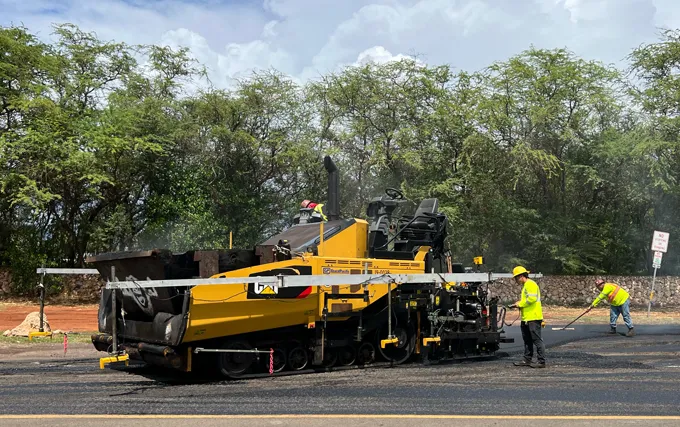
Hawaii is turning ocean plastic into roads to fight pollution
A crew works on paving a section of road along Ewa Beach to test different plastic-asphalt mixtures in an attempt to recycle waste collected around the Hawaiian Islands.Courtesy of the Center for Marine Debris Research

Eleven months later, researchers collected road samples to test for microplastic leaching. “We want to empirically test for [leaching] before this would ever be scaled up,” Lynch says.

The team used a variety of methods to simulate how microplastics would normally be released into the ecosystem, for example, mimicking stormwater by dumping water that was filtered multiple times and sanitized onto the road, then testing it for individual plastic polymers as well as sweeping the roads to collect gravel dust to look for polymers.

There wasn’t significant microplastic release compared with the strip of road with no plastic mixed into the asphalt,  says Jeremy Axworthy, a marine biologist and lab manager who worked on the program for CMDR and presented the results at the meeting.

The researchers began a second phase of the program in 2024, with five experimental pavement strips. The first strip was paved with ground fishing nets and the rubber styrene-butadiene-styrene. Another portion was paved in plastic from consumer trash and that same rubber, and the third contained a traditional asphalt mixture and the rubber, again the experimental control. A fourth contained fishing nets and no rubber, and a fifth used plastic waste and no rubber.

Sponsor Message

The team is now using an industrial solvent called dichlorobenzene to extract the plastic polymers out of the mixed dust to more accurately quantify how many were being released. These results are forthcoming.

Bill Buttlar, director of the Mizzou Asphalt Pavement and Innovation Lab at the University of Missouri in Columbia, says he’s impressed with the program but notes that the challenges with road performance in Hawaii are different from those in the mainland United States. The tropical climate with its heavy rains and volcanism faces underground volatility, and when the ground is constantly shifting, it can cause road cracking.

“The main challenge to scaling this is getting the recipe right with the asphalt because what works in Hawaii may be a little different than what works in the Midwest,” Buttlar says.


Share. Facebook Twitter Pinterest LinkedIn Tumblr Email
Previous ArticleUS ‘third-country’ deportees deal sparks backlash in DRC | Al Jazeera
Next Article Defense Business Brief: Doubling down on C-UAS; Hypersonic flight; Could AI help the Navy build hulls faster?
primereports
  • Website

Related Posts

Science

AMOC: Key ocean current is slowing at locations around the Atlantic

April 9, 2026
Science

‘No one knows what they are’: Researchers discover new type of cell that’s seen only during pregnancy

April 8, 2026
Science

Scientists discover reversible male birth control that stops sperm production

April 8, 2026
Add A Comment
Leave A Reply Cancel Reply

Top Posts

Global Resources Outlook 2024 | UNEP

December 6, 20258 Views

The D Brief: DHS shutdown likely; US troops leave al-Tanf; CNO’s plea to industry; Crowded robot-boat market; And a bit more.

February 14, 20264 Views

German Chancellor Merz faces difficult mission to Israel – DW – 12/06/2025

December 6, 20254 Views
Stay In Touch
  • Facebook
  • YouTube
  • TikTok
  • WhatsApp
  • Twitter
  • Instagram
Latest Reviews

Subscribe to Updates

Get the latest tech news from FooBar about tech, design and biz.

PrimeReports.org
Independent global news, analysis & insights.

PrimeReports.org brings you in-depth coverage of geopolitics, markets, technology and risk – with context that helps you understand what really matters.

Editorially independent · Opinions are those of the authors and not investment advice.
Facebook X (Twitter) LinkedIn YouTube
Key Sections
  • World
  • Geopolitics
  • Popular Now
  • Artificial Intelligence
  • Cybersecurity
  • Crypto
All Categories
  • Artificial Intelligence
  • Climate Risks
  • Crypto
  • Cybersecurity
  • Defense
  • Economy
  • Geopolitics
  • Global Markets
  • Healthcare Innovation
  • Politics
  • Popular Now
  • Science
  • Technology
  • World
  • About Us
  • Contact Us
  • Privacy Policy
  • Terms & Conditions
  • Disclaimer
  • Cookie Policy
  • DMCA / Copyright Notice
  • Editorial Policy

Sign up for Prime Reports Briefing – essential stories and analysis in your inbox.

By subscribing you agree to our Privacy Policy. You can opt out anytime.
Latest Stories
  • Don’t just fight fraud, hunt it
  • Why high oil prices are good for oil companies — until they aren’t : NPR
  • Petrol and diesel prices continue to rise as concerns grow over US-Iran ceasefire
© 2026 PrimeReports.org. All rights reserved.
Privacy Terms Contact

Type above and press Enter to search. Press Esc to cancel.