

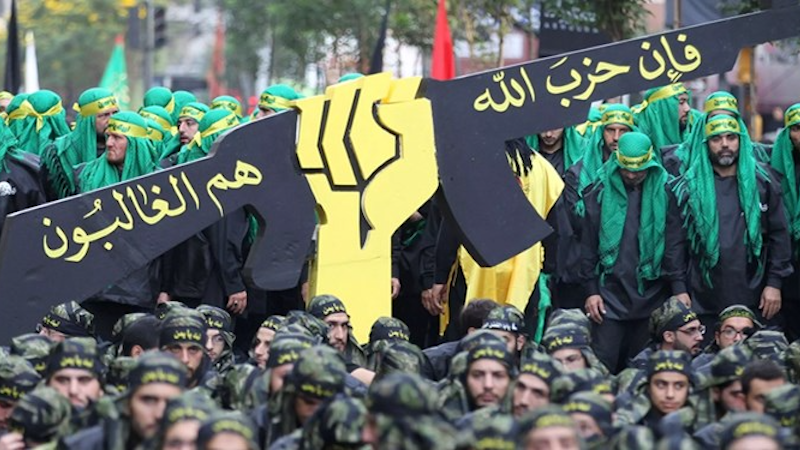
Back in September Lebanon’s army chief Rodolphe Haykal presented the government with a plan to ensure that, by the end of 2025, Hezbollah would be fully disarmed and military hardware would be held exclusively by Lebanon’s state forces. The cabinet authorized the army to begin implementing it immediately.
Various leaks to the media gradually revealed that the army’s plan is called “Homeland Shield”, and that its strategy is to confiscate Hezbollah’s weapons in five phases, starting south of the Litani River.
It also emerged that President Joseph Aoun has rejected the idea of replicating Iraq’s Popular Mobilization Forces, where Iran-backed paramilitary groups have been integrated into Iraq’s security forces. He is opposed to creating a distinct Hezbollah entity within the army. He wants Hezbollah fighters to be recruited into Lebanon’s armed forces only if they meet the same criteria as all other applicants – academic qualifications, entrance exams, and training.
According to the US military, the Lebanese Army has cleared away nearly 10,000 Hezbollah rockets and 400 missiles since the ceasefire in late November 2024. Aoun has claimed that up to 85% of the area south of the Litani River is now free of Hezbollah weapons.
On October 22, 2025, prime minister Nawaf Salam said that ultimately Hezbollah “will need to return to being a regular political party without a military arm.” Hezbollah leaders, however, have made it clear that they oppose being wholly disarmed. Assuming that Lebanon will be permanently in conflict with Israel, they regard themselves as essential to the national effort.
The Meir Amit intelligence and Terrorism Information Center (ITIC) was founded in 2001 to specialize in matters related to terrorism and intelligence. In a report published on October 30, ITIC said it believed the Lebanese Army will aim to complete its operations south of the Litani by the end of 2025, but that in Hezbollah’s strongholds north of the Litani, in the Beqaa and Beirut, it will be hindered from acting because the government is shying away from a confrontation with Hezbollah that could escalate into civil war.
In short, ITIC believes that the original army plan was far too ambitious in assessing that Hezbollah’s disarmament could be accomplished by the year’s end, and that instead of all five phases, only phase one is likely to have been achieved.
ITIC believes Hezbollah may agree in principle to partial disarmament, mainly in the region south of the Litani, but in exchange for guarantees. These would include protection against Israeli targeted assassinations, and the integration of the organization’s operatives into the security functions of the state. The ITIC says it believes the Lebanese government, in an effort to show flexibility, will indeed try to persuade the international community, especially the US, to increase pressure on Israel to reduce its attacks and withdraw its forces from positions in southern Lebanon.
Rumors abound in the Arab media about the uneasy standoff between Lebanon’s leaders and Hezbollah. “Sources” assert that although the Army knows about many Hezbollah military stockpiles, it desists from raiding them because the offices of the President, the Prime Minister, and the Speaker of Parliament have agreed that any direct confrontation with Hezbollah could plunge the country into civil war.
The US has shown growing impatience with the Lebanese government’s velvet glove approach to carrying through Hezbollah’s disarmament. General Haykal was scheduled to travel to Washington on November 18 for high-level meetings with US officials regarding military assistance, border security, and efforts to bring all armed groups in Lebanon under state authority. Just before Haykal’s planned departure, the trip was abruptly canceled.
The immediate trigger was a public statement by the Lebanese army on November 16 condemning Israeli attacks near the southern border. Notably avoiding any reference to Hezbollah’s significant armed presence independent of the state, the statement referred to Israel as “the enemy.”
Understandably, US officials interpreted the army statement as aligning with Hezbollah’s narrative. US policymakers and members of Congress criticized the Lebanese army. Senator Lindsey Graham publicly condemning Haykal’s leadership, calling the rhetoric a setback for efforts at regional stabilization.
This episode seems to have galvanized President Aoun and prime minister Salam into action. On November 20 Salam said at a governmental press briefing at the presidential palace in Baabda, Lebanon: “Lebanon is currently open to engaging with Israel in a partnership for disempowering Hezbollah.” He added that Lebanon would seek US help in advancing negotiations in the context of escalating Israeli strikes on Hezbollah positions.
The next day in a televised speech, President Aoun is reported by international media as saying that Lebanon is “ready for negotiations” with Israel, focused on “ending Israeli strikes” and “Israeli withdrawal from five outposts in Lebanese territory”.
So what is the current position?
Open-source maps show that parts of southern Lebanon previously strongly associated with Hezbollah are now increasingly coming under the Lebanese Army’s control. According to one source, out of some 265 identified Hezbollah positions in that zone, around 190 have been ceded to the Lebanese Army.
Meanwhile Hezbollah’s infrastructure has been significantly degraded. In particular, Hezbollah’s elite unit, the Radwan Force, has taken a serious hit: reports indicate that up to 80% of its weapons systems and tunnel infrastructure have been damaged or lost. Moreover it is estimated that some 4,500 of its operatives have been killed and about 9,000 wounded. representing a very large chunk of its active force.
And yet, despite losses, Hezbollah is not defunct. Analysts argue that though it is undoubtedly weaker, it remains resilient. Its survival depends on achieving a balance between the pressure to disarm, financial constraints, and its role in Lebanese politics.
To do so, it is attempting a “reset”. By acceding to a partial disarmament, it may be able to retain a reduced but still meaningful arsenal — enough to deter, survive, and remain politically relevant.
On the other hand Israel is not letting up. Israel continues targeting Hezbollah’s attempts to rebuild, and on November 23 eliminated its senior commander, Haytham Tabatabai.
The English poet Alexander Pope catches the position of the Lebanese government in a nutshell: “Willing to wound, yet afraid to strike.” Its equivocation means that Hezbollah could yet survive in perhaps a more limited, but still highly dangerous, form.
