

Characteristics of high-capture CCS technology
In our study, to examine the role of advances in CCS technology and their impact on the energy transition, we considered two types of CCS-based generators. The first is the standard CCS generator, which typically captures 90% of the CO2 produced during combustion. The second is the high-capture CCS generator, referred to in this paper as CCS-high, which is designed to capture 100% of fossil CO2 emissions. In practice, CCS-high generators capture all the fossil CO2 produced during combustion; the only CO2 emitted is that naturally present in the air supplied for combustion.
From a fuel perspective, we consider three CCS-high variants: coal, lignite, and gas. The capture rates are 99.7% for coal and lignite, and 99.1% for gas. Because the residual stack CO2 originates only from the incoming air, these plants are net-zero with respect to fossil CO2. In this study, we report direct post-combustion (stack) emissions only and exclude upstream fuel-cycle emissions.
To calculate the costs of CCS-high generators, we start with the cost of standard CCS as the baseline. Investment and O&M costs for standard CCS generators are based on EU Reference Scenario 2020 data, a long-term energy and climate outlook published by the European Commission51. When transitioning from standard CCS to CCS-high for different types, the costs increase as follows25:
Capital cost:
– Coal CCS-high: 1.4% increase compared to standard coal CCS
– Lignite CCS-high: 1.4% increase compared to standard lignite CCS
– Gas CCS-high: 2.3% increase compared to standard gas CCS
Fixed O&M costs:
– Coal CCS-high: 1.2% increase compared to standard coal CCS
– Lignite CCS-high: 1.2% increase compared to standard lignite CCS
– Gas CCS-high: 2% increase compared to standard gas CCS
Variable O&M costs:
– Coal CCS-high: 20% increase compared to standard coal CCS
– Lignite CCS-high: 20% increase compared to standard lignite CCS
– Gas CCS-high: 8% increase compared to standard gas CCS
In terms of efficiency, switching from standard CCS to CCS-high reduces the efficiency of converting fuel into electricity. The efficiency reductions, based on fuel types, are as follows25:
Coal CCS-high: 1.5% decrease in efficiency compared to standard coal CCS
Lignite CCS-high: 1.5% decrease in efficiency compared to standard lignite CCS
Gas CCS-high: 2.2% decrease in efficiency compared to standard gas CCS
Table 2 presents the key techno-economic parameters for CCS-high generators over time. Both the capital costs and fixed O&M cost decline across periods, as projected in the EU Reference Scenario 2020 due to assumed learning-driven cost reductions. Variable O&M costs remain constant over periods, while efficiency improves slightly but stays below that of standard CCS because of the additional energy required to capture more than 99% of CO2.
We also do not impose an explicit annual maximum build-rate for CCS-high. Instead, the model endogenously determines how much capacity is added in each period as part of the cost-minimizing solution under the tightening emission cap. This approach allows us to reveal the build-out pace required to meet decarbonization goals under each scenario.
Each CCS-high technology is also assigned a generator-type availability factor that limits the maximum share of installed capacity that can be dispatched in any hour: 75% for coal CCS-high, 80% for lignite CCS-high, and 85% for gas CCS-high.
Scenario design
Solar, wind, hydropower, nuclear, biomass, coal, lignite, natural gas, and oil are included in the energy mix when investigating the optimal way to achieve the European net-zero target. Power plants with CCS integration are considered for carbon-based fuel sources (fossil fuels and biomass). Four CCS scenarios are examined in this work to understand the impact of CCS on power sector dynamics, as outlined below:
Base: In this scenario, fossil-based power plants can be built with and without CCS. Power plants equipped with CCS can be built with either a standard capture rate (90% capture rate) or an ultra-high capture rate (above 99% capture rate) that ensures net-zero power production. This scenario reflects the possibility of investing in net-zero power plants from fossil fuels.
Conventional: This scenario is the same as the base scenario, except that ultra-high capture rates are not considered. This scenario thus reflects the conventional representation of CCS in integrated assessment modeling.
No-fossil-2040: It is the same as the base scenario, except that investments in new fossil-based power generation (with or without CCS) are not allowed from 2040. This scenario reflects some of the current discussions around banning the production and use of fossil fuels from 204052,53,54,55.
Limited-CCS: This scenario is the same as the base case scenario, except that fossil-based power generation with CCS is allowed only in Denmark, Great Britain, the Netherlands, and Norway. This scenario reflects the potential challenges in deploying a European CO2 transport infrastructure, hence allowing CCS to be deployed only in the four European countries with large offshore CO2 storage potential56.
Table 3 summarizes the four scenarios. In these scenarios, the total annual electricity demand in 2050 is assumed to increase by 75% compared to 202557. Moreover, the targeted 2050 emission reduction for the power sector is set to 99% compared to 1990 levels, meaning that the remaining 1% is assumed to be compensated by CDR58. Notably, EMPIRE is a cost-minimization model subject to a tightening CO2 cap. We do not include dedicated policy instruments (such as subsidies or tax credits) to promote specific technology; decarbonization is driven by the cap, and technology choices (including CCS) arise endogenously when they are cost-effective. The results, therefore, show a cost-optimal pathway under stated assumptions rather than predictions of future policy choices.
EMPIRE model description
In this paper, we have used the EMPIRE model for our analysis. The EMPIRE model is a capacity expansion model designed for the European power sector, covering a planning horizon from 2020 to 2060. The model minimizes the total cost of the power system while decarbonizing it. It considers a wide range of power generation technologies, including renewables, fossil fuels (with and without CCS), and nuclear. EMPIRE captures both long-term and short-term aspects of the power system, optimizing decisions across these different time scales. The time scales are as follows:
The long-term time scale operates in 5-year intervals, during which strategic decisions are made, such as investments in generation, storage, and transmission capacity.
The short-term time scale operates on an hourly basis, where operational decisions are made, such as hourly dispatch of each generator type and charge/discharge of storage systems.
The EMPIRE model also captures short-term uncertainty in the availability of renewable energy (wind, solar, hydropower) and in the electricity demand profile. To handle these uncertainties, a multi-horizon stochastic programming approach59,60 is used. This method reduces the computational complexity by assuming that operational decisions and short-term uncertainties within a given long-term interval only affect that interval. In other words, the operational decisions and uncertainties within one long-term interval do not impact the operational and strategic decisions in the next long-term interval. This assumption reduces the computational burden by reducing the size of the scenario tree. Moreover, EMPIRE does not model all 8760 hours of the year. Instead, it selects representative hours for each season, which are then scaled up to represent the full year. The model considers four regular seasons—winter, spring, summer, and fall— each represented by 168 hours (1 week). Additionally, it includes two peak seasons to account for extreme demand conditions, with each peak season represented by 24 hours.
Short-term uncertainties in renewable availability and electricity demand are incorporated by generating multiple stochastic operational scenarios. These stochastic scenarios are generated randomly based on historical data from 2015 to 2019. For each scenario, a random year is selected from this data for each long-term interval. Then, for each node and for each season within that interval, a random starting hour is selected, followed by 167 consecutive hours for the regular seasons. For the Peak 1 season, the hour with the highest total demand across all nodes is selected. A 24-hour window around this hour, with the peak hour in the middle, is considered for each node to represent the Peak 1 season, capturing the conditions for each node during that time. For the Peak 2 season, a similar process is followed, but the selected hour for each node is the one with the highest demand in that node. The 24-hour window for each node is centered around its peak demand hour, capturing local peak demand conditions.
In total, for each scenario, the model uses 720 representative hours per year, which are then scaled up to approximate the entire year. In this study, five stochastic scenarios were generated, resulting in a total of 720 × 5 modeled hours. See Supplementary Note 2 for the rationale behind the chosen temporal resolution, including comparisons with commonly used energy models.
For clarification, the term scenario used to refer to the base, conventional, no-fossil-2040, and limited-ccs scenarios corresponds to different decarbonization pathways and is distinct from the stochastic operational scenarios. To ensure comparability across these decarbonization pathways, the same five stochastic scenarios are used for all pathways.
Electric demand in the EMPIRE model is represented by an exogenous annual total for each node and period, together with an intra-annual hourly profile. Annual total demands follow established projections57, which inherently reflect future climate conditions. The hourly profile is derived from historical load by sampling from representative hours for each season (including peak seasons) to obtain a realistic shape; this shape is then scaled so that its annual sum matches the projected total for each node and period. In other words, the hourly shape comes from the observed patterns, while the overall magnitude follows the future projections.
Model formulation
The mathematical formulation of the EMPIRE model is described in a previous study61. A detailed description of the model implementation is provided in the literature36. The model code and documentation are publicly available via GitHub62.
The objective function of the EMPIRE model is to minimize the expected discounted cost of the power sector in European countries over the planning horizon across all scenarios. This includes the following components:
Investment costs in generation, storage (energy storage capacity and energy storage power capacity), and transmission
Operational costs of generation
Penalty costs for load shedding
The constraints of the model are as follows:
• Operational generation constraints:
– Power balance: The sum of electricity generated, stored, discharged, transmitted, and shed in a node, at each hour, must equal the demand at that hour.
– Maximum generation limit: The hourly generation by each generator type in each node must be lower than or equal to the available installed capacity for that generator type.
– Ramp-up: For thermal generators, the change in generation from 1 h to the next must not be greater than the ramp-up capacity of that generator.
• Operational energy storage constraints:
– Energy storage balance: For each storage type, the stored energy from the previous hour, adjusted by the energy added through charging and subtracted by discharging in the current hour, must equal the stored energy at the current hour.
– Energy storage seasonal cycle: It is assumed that the storage system runs a full cycle to avoid the accumulation or depletion of storage within a season. Therefore, the stored energy at the end of a season for each storage type in each node must equal the storage level at the beginning of the season.
– Maximum energy storage limit: The hourly stored energy in each node cannot exceed the installed energy storage capacity.
• Operational energy storage power constraints:
– Energy storage discharge capacity: In each hour and for each node, the energy discharged from a storage unit must not exceed a fraction of the installed power capacity, as determined by the discharge-to-charge ratio.
– Energy storage charge capacity: In each hour and for each node, the charged energy for each storage unit cannot exceed the installed power capacity.
• Storage power-energy ratio constraints:
– For battery storage systems, the installed power capacity must be proportional to the installed energy capacity based on a predefined ratio.
• Hydropower constraints:
– Regulated hydro seasonal generation limit: The seasonal generation by regulated hydropower in each node must not exceed the maximum seasonal generation limit set for that node.
– Total hydro generation limit: In each node, for each period, and for each hour, the combined generation from both regulated and run-of-the-river hydropower must not exceed the total hydropower generation potential for that node.
• Operational transmission constraints:
– The hourly transmission flow between two nodes must not exceed the installed transmission capacity between those nodes.
• Emission cap constraints:
– In each period, the annual emissions from all generators, summed across all nodes and over all hours of the year, must not exceed the specified yearly emission cap.
• Lifetime constraints:
– For each type of asset and in each node, the installed capacity in the current period is equal to the sum of aggregated investments from previous periods that are still within their operational lifetime, any new investments made in the current period, and the remaining portion of the initial capacity that is still operational.
• Investment capacity constraints:
– For each type of asset, in each node, and during each period, the invested capacity cannot exceed the maximum allowable capacity for that asset.
• Installed capacity constraints:
– The total installed capacity for each asset in a node during each period must not exceed the maximum limit set for that asset.
Input data
This subsection provides an overview of the key types of data required for the EMPIRE model. All input data for the EMPIRE model, along with explanations of the data sources, can be freely accessed on the GitHub repository62.
• Sets:
– Nodes: The dataset includes 31 European countries, covering all EU27 countries except Cyprus and Malta. Additionally, it includes Bosnia and Herzegovina, Switzerland, Great Britain, North Macedonia, Serbia, and Norway. Notably, Norway is represented at a regional level, encompassing five distinct regions. The nodes also include 14 North Sea offshore wind areas. Moreover, in this study, each country’s onshore and offshore wind capacities are considered individually, and offshore wind areas in the North Sea are treated separately; however, in practice, these capacities could be connected to different countries and counted as part of their national offshore wind capacities.
– Horizon: EMPIRE is modeled over the period from 2020 to 2060. Each investment period spans 5 years, resulting in a total of eight periods.
– Storage types: There are two types of storage: hydro pumped storage and Lithium-Ion battery energy storage system.
– Generator types: It includes all the generator types used in the model, organized into several subgroups: hydro generators, which encompass regulated hydropower and run-of-the-river hydropower; hydro with reservoir, which refers to regulated hydropower; and thermal generators, which are generators that convert heat into electricity.
– Technology types: It focuses on the classification of generators based on the resource or technology group, primarily for applying resource constraints.
– Line types: It shows the different transmission line types.
– Hour of season: Out of the 720 hours, this set indicates which hour corresponds to which season.
– Storage of nodes: It specifies which storage type is assigned to each node.
– Directional lines: This section indicates between which nodes there are two-directional transmission lines.
– Line type of directional lines: It outlines the types of transmission lines.
– Generators of technology: This set describes which generator type is associated with each technology type.
• Parameters:
– General parameters:
◇ Seasonal scale: This factor scales data from representative hours to estimate totals for each season, leading to a projection for the entire year.
◇ CO2 cap: The maximum annual amount of CO2 that can be emitted from all nodes during each period is limited.
– Node-related parameters:
◇ Electric annual demand: The electricity demand at each node for each period over the year.
◇ Loadshed cost: The penalty cost incurred for each 1 MWh of unserved load.
◇ Hydro maximum annual generation: The maximum allowable annual generation for hydro generators.
– Generator parameters:
◇ Capital costs and O&M (operations and maintenance) costs: The initial investment required to build generators, as well as the fixed and variable costs associated with their operations and maintenance.
◇ Fuel costs: The expenses related to the fuel required for the operation of generators.
◇ Variable transport and storage costs for CCS generators: The costs associated with transporting and storing CO2 captured by CCS generators.
◇ Efficiency: The ratio of electricity generated compared to the total energy input for each generator type.
◇ Initial capacity: The capacity of each type of generator at the beginning of the planning horizon.
◇ Retired share of initial capacity: The proportion of the initial capacity that will be retired over each period.
◇ Maximum invested capacity: The maximum additional capacity that can be invested during each period and at each node for each technology type.
◇ Maximum installed capacity: The upper limit on the total capacity that can be installed for each technology type.
◇ Ramp rate for thermal generators: The rate at which thermal generators can increase their output per hour.
◇ Availability of installed capacity: The percentage of installed capacity that is available for use, considering maintenance.
◇ CO2 content: The amount of CO2 emitted per unit of energy input for each type of generator.
◇ CO2 removal fraction for CCS generators: The fraction of CO2 that CCS generators can capture.
◇ Operational lifetime: The expected operational lifespan of each generator type.
– Storage parameters:
◇ Capital costs and O&M costs: The initial investment for energy storage capacity and energy storage power capacity, as well as fixed operational and maintenance expenses.
◇ Initial capacity: The starting installed capacity for storage systems.
◇ Maximum invested capacity: The maximum additional capacity that can be added each period for storage.
◇ Maximum installed capacity: The upper limit on the total installed storage capacity.
◇ Initial energy storage level: The percentage of storage capacity available at the start of each season.
◇ Storage charge/discharge efficiency: The efficiency of energy conversion during storage and retrieval.
◇ Power to energy ratio: The ratio between power capacity and energy storage capacity.
◇ Storage lifetime: The expected operational duration of storage systems.
– Transmission parameters:
◇ Capital cost: The initial cost required to build the transmission infrastructure.
◇ Initial capacity: The transmission capacity available at the start of the planning period.
◇ Maximum invested capacity: The maximum additional transmission capacity that can be developed in each period.
◇ Maximum installed capacity: The total upper limit on the transmission capacity that can be installed.
◇ Line efficiency: The percentage of energy transmitted to the demand node.
◇ Length: The physical length of the transmission line, used to calculate investment costs.
◇ Line lifetime: The expected operational lifespan of the transmission line.
Differences from the original EMPIRE model
In the EMPIRE model, several updates and changes have been made compared to its original version63. First, we updated key data for generators—including capital and O&M costs, as well as efficiency and lifetime—and revised the transport and storage costs for CCS generators. All these updates were made based on the EU Reference Scenario 202051. All data can be found on GitHub62.
Moreover, the Max Installed Capacity parameter, which indicates the maximum generation capacity that can be installed in each node, has been updated. Most changes apply to solar and wind generators and are based on published data64,65. A comprehensive overview of the sources used for these updates is provided in the Generator.xlsx file, which is available via GitHub62.
The main update in our version of EMPIRE is the addition of new types of CCS generators. To study the role of advancements in CCS technology and their impact on the energy transition, we introduced CCS generators with a higher capture rate, referred to in the paper as CCS-high generators.
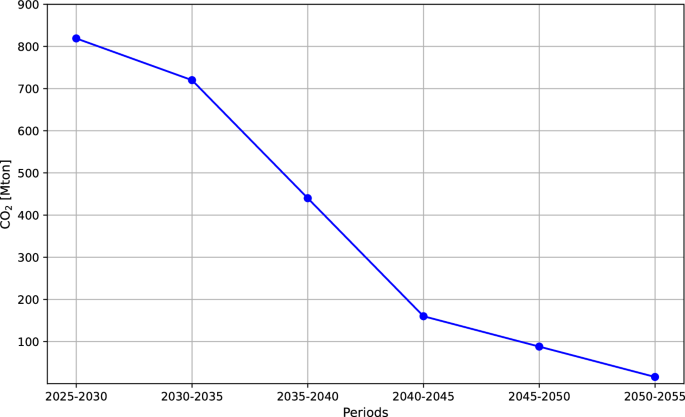
We have also updated the emission cap based on the latest targets for emission reduction across different periods. According to the European Commission, emissions should be reduced at least 55% by 2030, followed by a 90% reduction in 2040, and fully eliminated in 2050, all compared to 1990 emission levels. Using these targets, we updated the emission cap in the EMPIRE model as shown in Fig. 5. In this figure, we set the emission cap for 2030 to reflect a 55% reduction compared to 1990 levels, and for 2040, a 90% reduction. However, for 2050, we assumed a 99% reduction instead of 100%. This is because the EMPIRE model only considers renewables and CCS technologies, and achieving net-zero emissions only with these technologies would be very expensive. Besides, as shown in Fig. 6, the CO2 price rises exponentially beyond a 99% reduction. Therefore, we leave room for the application of other technologies, such as negative emission technologies. Additionally, we conducted a sensitivity analysis on the 2050 emission target to determine the most efficient percentage of emission reduction achievable by renewables and CCS, and to evaluate the role of other technologies. The results of this analysis are discussed in section “Optimal decarbonization level and the role of carbon dioxide removal”.

Annual carbon dioxide emission cap applied in the EMPIRE model for each planning period. Emissions are expressed in million tonnes of carbon dioxide.

The figure shows how the carbon price in the final model period (2050–2055) responds to increasingly stringent emission reduction targets defined for 2050. Results are shown for the base and conventional scenarios. Solid red lines indicate results for the base scenario, while dashed red lines indicate results for the conventional scenario. The purple line (right axis) shows the allowed carbon dioxide emissions in 2050 corresponding to each emission reduction target. Carbon prices are expressed in euros per tonne of carbon dioxide, and emissions are expressed in million tonnes of carbon dioxide.
Grouping of generator types for result presentation
Figure 7 illustrates the various generator types—referring to individual electricity generators—included in the EMPIRE model. These generator types have been categorized into generation technology groups, where each group consists of one or multiple generator types based on their energy sources and technologies. These groups are presented in Fig. 7.

Schematic representation of how individual generator types are grouped into generation technology categories in the model. Colors indicate technology groups: wind (green), solar (yellow), hydropower (blue), nuclear (orange), fossil (gray), fossil-based generators equipped with standard carbon capture and storage (light pink), fossil-based generators equipped with high-capture-rate carbon capture and storage (magenta), and other renewable technologies (red).
In this paper, we have presented the results using these grouped generators (including Figs. 1–3 and Supplementary Figs. 5 and 8–16) to provide a clearer and more comprehensible overview. Detailed results for each specific generator type are provided in the Supplementary Information file (Supplementary Figs. 1–4 and Supplementary Data 1, 2). The generator types and their corresponding generation technology groups are as follows:
• Wind:
– Onshore wind: Wind turbines located on land.
– Grounded offshore wind: Wind turbines located offshore, anchored to the sea floor.
– Floating offshore wind: Wind turbines located offshore on floating platforms.
• Solar:
– Solar: Solar power generators that use photovoltaic cells.
• Hydropower:
– Regulated hydropower: Hydropower plants equipped with reservoirs that allow storing water and controlling its release for electricity generation.
– Run-of-the-river hydropower: Hydropower plants that generate electricity from the natural flow of rivers.
• Nuclear:
– Nuclear: Nuclear power plants using nuclear fission.
• Fossil:
– Existing coal and lignite: Existing capacity of coal and lignite at the beginning of the planning horizon.
– Coal and lignite: Newly installed coal and lignite power plants.
– Supercritical coal and lignite: Coal and lignite power plants with advanced combustion technology that operate at higher pressures, resulting in greater efficiency compared to traditional coal and lignite plants.
– Existing gas: Existing gas-fired plants at the beginning of the planning horizon.
– OCGT gas: Open-cycle gas turbines that release exhaust gases directly into the atmosphere.
– CCGT gas: Combined-cycle gas turbines that capture and reuse exhaust gases, improving efficiency.
– Existing oil: Existing oil-fired power plants at the beginning of the planning horizon.
– Biomass-10 co-firing: Plants that co-fire biomass with fossil fuels, where biomass makes up 10% of the fuel mix.
– Waste: Waste-to-energy power plants.
• Fossil + CCS:
This category includes newly installed fossil fuel power plants equipped with CCS, which capture 90% of CO2 emissions. Retrofitting of existing fossil fuel plants with CCS is not considered in this study. The CCS generators include:
– Coal CCS and supercritical coal CCS
– Lignite CCS and supercritical lignite CCS
– Gas CCS
– Biomass-10 co-firing CCS
• Fossil + CCS-high:
This group includes newly installed fossil fuel plants with advanced CCS technology, capturing all the CO2 produced during combustion. Retrofitting of existing fossil fuel plants with CCS-high is not considered in this study. The CCS-high generators include:
– Supercritical coal CCS high
– Supercritical lignite CCS high
– Gas CCS high
• Other Renewables:
– Bioenergy: Power generation from biomass.
– Wave: Power generation from ocean waves.
– Geothermal: Power generation from Earth’s underground heat.
Regarding the generator selection, we selected our generator types from the EU Reference Scenario 2020 technology options51 and built a subset of 37 types, including our high-CCS variants, to keep the EU-wide optimization tractable. The aim is to balance the computational burden without losing system-level insight; where several technologies belong to the same family, we use a representative option (typically the medium/central case, so the burden of the closely related variants is captured by the selected generator.
Although this study focuses on CCS technologies, BECCS is not included in the analysis. The potential contribution of BECCS depends on achieving net-negative emissions, which requires accounting for all life-cycle emissions of biomass production, collection, processing, transport, and CO2 storage. Such a life-cycle assessment is beyond the operational emission accounting framework used in this study, which considers only stack emissions after capture. Instead, we include biomass co-firing with CCS in fossil power plants, a practical way that reduces CO2 within our current scope; IEAGHG25 reports that co-firing about 10% biomass with post-combustion capture can achieve near-zero emissions at relatively low cost.
Another key point is that sustainable biomass is limited66,67. Based on the ENSPRESO dataset64,68, Europe’s sustainable biomass potential across all sectors under the commonly used reference scenario (ENS_Med_ForestBaU) is estimated to be 8027 PJ, equivalent to 2230 TWh in 2050. Based on our results, in the base and conventional scenarios, biomass co-firing with CCS generates 637 TWh and 1308 TWh of electricity, respectively. Since the 2230 TWh represents the total sustainable potential across all sectors, greater power-sector use would intensify competition for limited biomass resources. Furthermore, large-scale BECCS deployment in Europe faces additional constraints, including the cost and logistics of biomass supply and storage69, and incomplete CO2 transport and storage infrastructure near many biomass sites70. Taken together, we do not include BECCS in the present analysis, and we leave a full life-cycle BECCS treatment to future work.
Model outputs
EMPIRE provides valuable outputs after solving, with the most important results as follows:
Generation:
– Invested generation capacity in each period and at each node for each generator type
– Installed generation capacity in each period and at each node for each generator type
– Hourly dispatch for each generator type and node in each period
Storage:
– Invested capacity for energy storage and power at each node and for each storage type in each period
– Installed capacity for energy storage and power at each node and for each storage type in each period
– Hourly storage charge/discharge at each node in each period
Transmission:
– Invested transmission capacity between nodes in each period
– Installed transmission capacity between nodes in each period
– Hourly transmission between nodes in each period
System balancing:
Using these outputs, various graphical analyses can be created. For example, Fig. 1 shows the electricity mix, which is derived from hourly dispatch data. Figure 3 illustrates the geographical distribution of electricity generation by different generator types. In addition to these direct results, the model can also produce results indirectly, such as the CO2 price shown in Fig. 4, which is derived from the dual of the emission cap constraint. Further illustrations and results can be found in the Supplementary Information file and Supplementary Data 1, 2.
Reporting summary
Further information on research design is available in the Nature Research Reporting Summary linked to this article.
