


Quantum Elements is a three-year-old startup known for developing AI-based digital twins that developers used to model and simulate quantum computing systems. The company’s Constellation platform combines AI agents, natural language capabilities, and its simulation products for a range of jobs, from creating and test quantum software and algorithms to generating code to creating digital twins – or prototypes – of quantum systems.
Such digital twins allow organizations to see how their systems can look, evolve, and behave as they scale without the enormous costs that comes with running such tests on hardware and chips or the challenge of using multiple modalities.
As Izhar Medalsy, co-founder and chief executive officer of Quantum Elements, told us earlier this year, “you need the ability to look at the system in the same way that flow simulators are simulating the flow of air on the wing of an airplane, or in the same way that Cadence and Ansys or Synopsis are simulating transistors in order to be able to virtualize those huge GPUs and CPUs and be able to predict how the next generation is going to look.”
In July, Quantum Elements introduced Orbit, a quantum error-suppression tool, and made it available through IBM’s Qiskit Functions Catalog, a platform that includes pe-built and managed cloud software services for streamlining quantum research.
The release of Orbit in Qiskit gives “researchers, developers and enterprise quantum teams a new way to improve quantum circuit performance while reducing the time, cost and workflow friction often associated with error mitigation and suppression methods,” Quantum Elements wrote at the time, adding that Orbit lets organizations use “advanced error suppression techniques without requiring deep specialization, while improving circuit execution, and avoiding added processing overhead and extended compiling time.”
More recently, Orbit played a central role in research that could impact both the march to fault-tolerant quantum computers and enabling greater flexibility in designing these systems. In a paper published this month in Nature, researchers with Quantum Elements and the University of Southern California showed that the surface code – a topological quantum error-correction code laid out in a two-dimensional grid and considered among the more practical avenues to large-scale, fault-tolerant systems – can scale error correction even when used with a quantum processing unit (QPU) that doesn’t share a similar grid.
According to Quantum Element executives, running hybrid code on QPUs for error gives engineers breathing room in how they design the computers. It means that there are more options they can look at rather than being hemmed in their designs by having to match a chip’s physical layout with the code. Quantum Elements’ Medalsy said in a statement that the research “shows the power of hybrid approaches to move us towards fault tolerant quantum computing.”
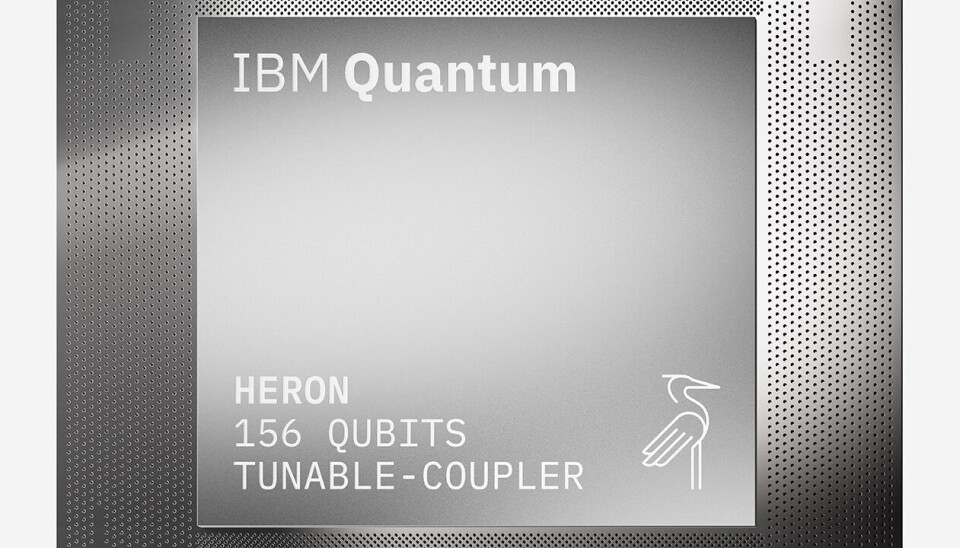
The research used the surface code with the heavy-hex architecture of IBM’s Heron quantum processor, which was first released in 2023 and comes in 133-qubit and 156-qubit (below) configurations. It is used in IBM System 2 and upgraded System One quantum systems.
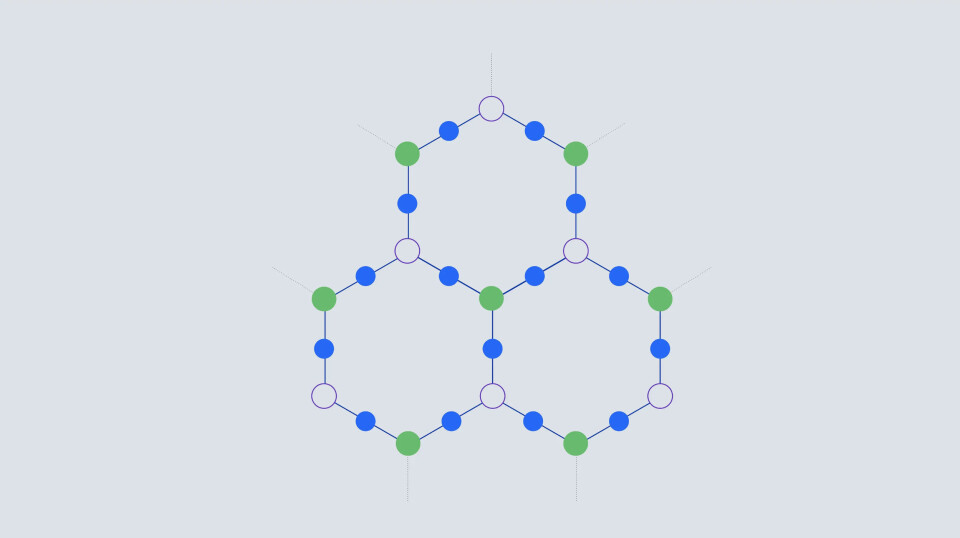
The heavy-hex architecture is a qubit layout on a hexagonal – honeycomb-like – lattice, which among other features prevents crowded connections to reduce collisions between neighboring qubits. Like this:
“Implementing the surface code on other QPUs with different fixed connectivities is a problem of both fundamental interest and practical importance,” the researchers wrote in their paper. “In light of applications, QPU design may be driven by considerations other than optimal surface code performance, for example to avoid frequency crowding affecting crosstalk and gate performance and to reduce the density of circuit elements, easing thermal management in lithographic fabrication.”
A key challenge was overcoming the reduced connectivity between the two architectures that could lead to delays in the state transfer between non-neighboring qubits and the exposure to noise – which was cause qubits to break up and lost their quantum natures – during such “idle times” meant that the number of errors could grow as the code expands.
Mapping the surface code onto IBM’s architecture also required more routing, another challenge.
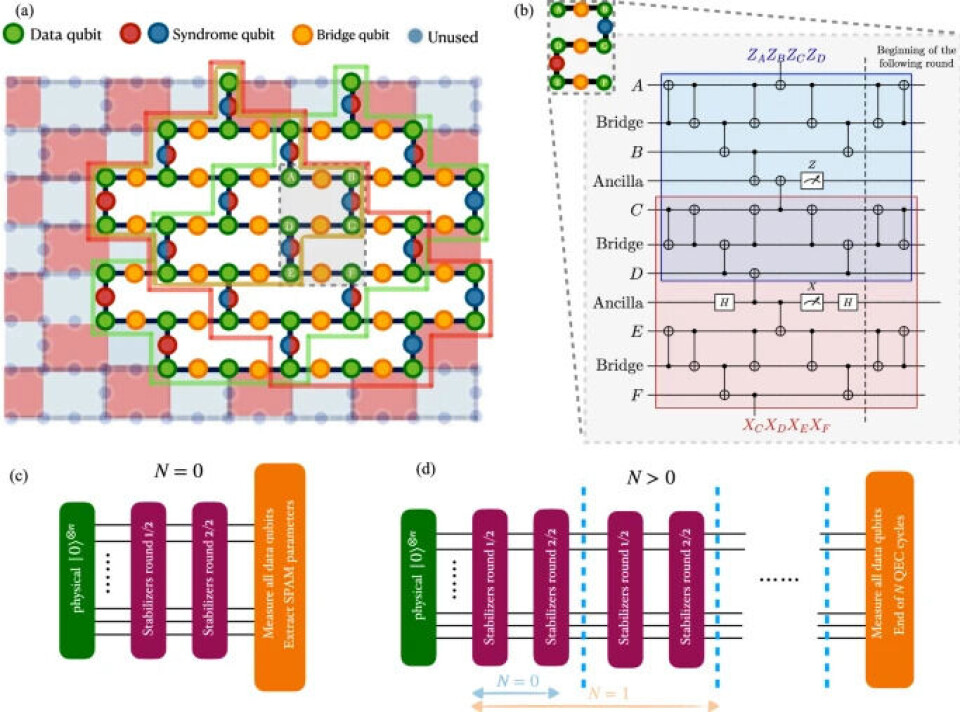
The researchers made a number of decisions to make this apparent mismatch work. One of using a depth-efficient error correction code. Surface code, like other error-correction codes, can involve lengthy chains of sequential gates or measurements that introduce the idle time that result in noise that can lead to errors. Depth-efficient codes reduce the number of sequential layers.
They also used the dynamical decoupling – which protects qubits from noise – in Quantum Elements’ Orbit Qiskit function with SWAP-based embedding on the Heron QPU to map logical qubits onto physical hardware. SWAP-based embedding uses SWAP gates, which exchange the quantum states of two qubits.
This led to directional subthreshold scaling, a key step in error correction. It increases the size of the code in a particular direction and reducing a corresponding type of error.
Successfully using the surface code with IBM’s heavy-hex architecture is something Big Blue suggested five years when, when it first announced that heavy-hex would be the foundational topology for all of its quantum devices. IBM researchers laid out their reasoning behind adopting the architecture in a lengthy report that also touched on surface code as an example of the work at the time being done to develop error-correction codes.
“The connectivity of other lattices, such as the square lattice, can be simulated on the heavy-hex lattice with constant overhead by introducing swap operations within a suitably chosen unit cell,” they wrote. “The vertices of the desired virtual lattice can be associated to subsets of vertices in the heavy-hex lattice such that nearest-neighbor gates in the virtual lattice can be simulated with additional two-qubit gates. The connectivity of the heavy-hex lattice can be mapped onto other canonical lattices such as the square lattice with constant cost overhead; it is negligible compared to encoding costs.”
