


For all the work being done to get to fault-tolerant, scalable quantum computing – system architectures, the development of software and algorithms, mapping out workflows for classical-quantum hybrid environments – a key bottleneck continues to be error detection and correction. Without it, quantum systems will remain too unreliable – will create too many errors – for practical use.
Strides are being made in this area, with logical qubits playing a central role, comprising myriad noisy physical qubits and acting as the reliable building blocks for quantum systems. That said, another significant part of error correction is decoding, the process of analyzing error signals – or syndromes – generated during error correction to determine the specific errors affecting the system.
Quantum computers can’t directly measure qubits without destroying them. Qubits are extremely fragile and can be easily broken by surround noise – light, vibration, and other qubits, for example, and lose their quantum nature and the data they hold. Instead, they measure surround data points to produce syndromes that indicate an error has occurred and turn the information over to decoders.
“A key challenge in decoding is managing the computational complexity involved, particularly as the size of the quantum system grows,” according to scientists with QuEra, a quantum computing company that uses neutral atoms to build its qubits. “Efficient decoders must balance speed and accuracy, ensuring real-time performance without sacrificing the ability to correctly interpret complex error patterns.”
Decoding is a process that relies heavily on classical computing algorithms and historically has consumed a lot of processing power, which increases as the quantum systems – and the number of qubits – grow. It also has to be tailored to the specific error correction code – like surface code or color codes – that is being used.
Advancements are being made. GPU acceleration, such as through Nvidia’s CUDA-Q platform, is coming into play, as is the use of AI. Recent examples include IBM using a large language model (LLM) framework to sort through thousands of code variations to determine the right one for a particular environment. Google two years ago created AlphaQubit, which uses a transformer-based neural network for decoding and fixing errors, and this year detailed an AI-based reinforcement learning technique that runs the encoded information collected by a quantum computer through an AI system that can learn from the errors found and make adjustments in the system. It would mean operators could run the superconducting quantum computers for long periods of times without having to stop to adjust calibrations when errors are found.
This week, scientists with IonQ, which is building its quantum systems based on the trapped-ion modality, said they’ve developed a decoder that can handle the complex job in real time using a single standard CPU, and can do it in the background, allowing the quantum computer – similar to Google’s reinforcement learning method – to continue running.
“The realization of a MegaQuOp quantum computer, that is a device capable of executing millions of operations on hundreds of logical qubits, represents a major milestone for the quantum computing community and would provide a new tool for scientific exploration,” the scientists wrote in a research paper on arXiv. “However, real-time decoding of hundreds of logical qubits throughout a quantum computation comprising millions of logical operations remains a major challenge.”
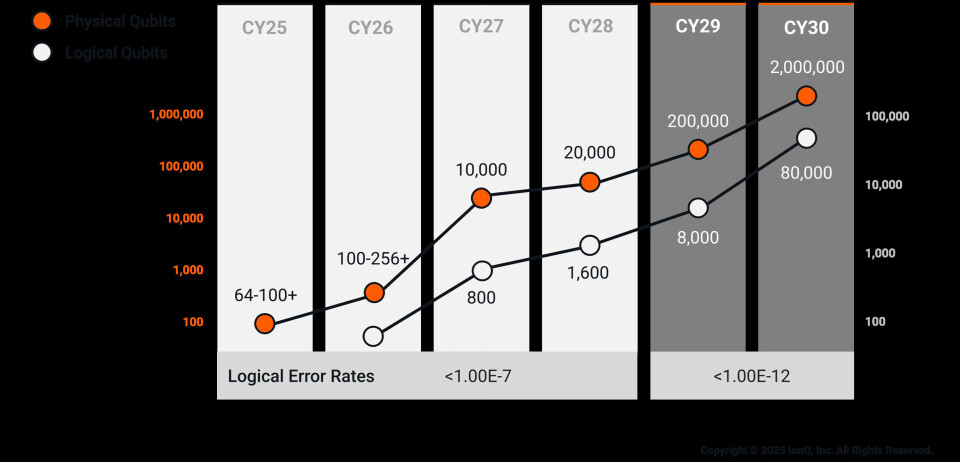
IonQ executives said the research shows that organizations don’t need to exponentially scale their classical hardware even as the quantum computers grow their numbers of logical qubits. They added that being able to run error decoding on a classical computer powered by a single CPU is a central to its roadmap (below) that extends well beyond the 256 physical qubits on its Superion system, which it introduced earlier this month.
The vendor announced this week that Florida International University is buying a Superion system (below). It will be installed in late 2027 at a specialized facility on the school’s campus.
In the paper, the scientists wrote that they created benchmark circuits that simulated up to 408 logical qubits across 88 memory blocks and magic factories, or subsystems in fault-tolerant systems that produce the environment needed for universal quantum computing. The circuits ran more than 31.5 million individual quantum operations at the MegaQuOp scale while introducing as little as 0.02 percent stretch time.
Essentially, there was very little delay added to the overall quantum computation, according to the scientists.
They noted other research efforts to accelerate the speed and throughput of surface code – an error-correcting code that protects the quantum information by encoding a single logical qubit across a two-dimensional square grid of physical qubits – and quantum low-density parity-check (LDPC) memory decoders through software and hardware, including GPUs, ASICs, FPGAs, and TPUs, to reach the latency needed for superconducting quantum systems.
The IonQ scientists wrote that their decoding system spanned 68 LDPC memory blocks and 20 magic state factories that were created using 11,680 physical qubits. It’s based on a dual sliding-window decoder built around the beam search decoder, an error-correction algorithm for decoding LDPC by ensuring a fixed number of the most promising error pathways – the beam width – at each step. The process creates detector error models (DEMs) in real time and includes memory optimizations that let many decoder instances to execute at the same time on a single CPU.
DEMs are mathematical descriptions that map how gate errors or noise cause particular error detectors in an error-correction circuit.
A key to the CPU-only process is IonQ’s Walking Cat architecture for trapped-ion quantum systems, which the vendor introduced in a detailed blueprint in April. The architecture includes a compiler, error-correction protocols, a microarchitecture, complete simulations, and a fast decoder, all based on an the LDPC error-correction codes. Foundational to the architecture is a “cat factory” that creates cat states – superpositions of distinct states at the same time – that are distributed throughout a system to perform logical operations.
The scientists noted the simplicity of the architecture, writing that “logical computation does not require merging or deforming qLDPC memory blocks or changing their syndrome-extraction circuits.”
Instead, they wrote, “cat-based measurements are inserted into an otherwise regular stream of syndrome extraction, while a large class of Clifford operations (quantum gates that map Pauli operators – X, Y, Z – to other Pauli operators under conjugation) is handled through software frame tracking, making the entire classical decoding pipeline, from online DEM generation to decoding, feasible at MegaQuOp scale using only 12 cores of a single commodity CPU.”
