

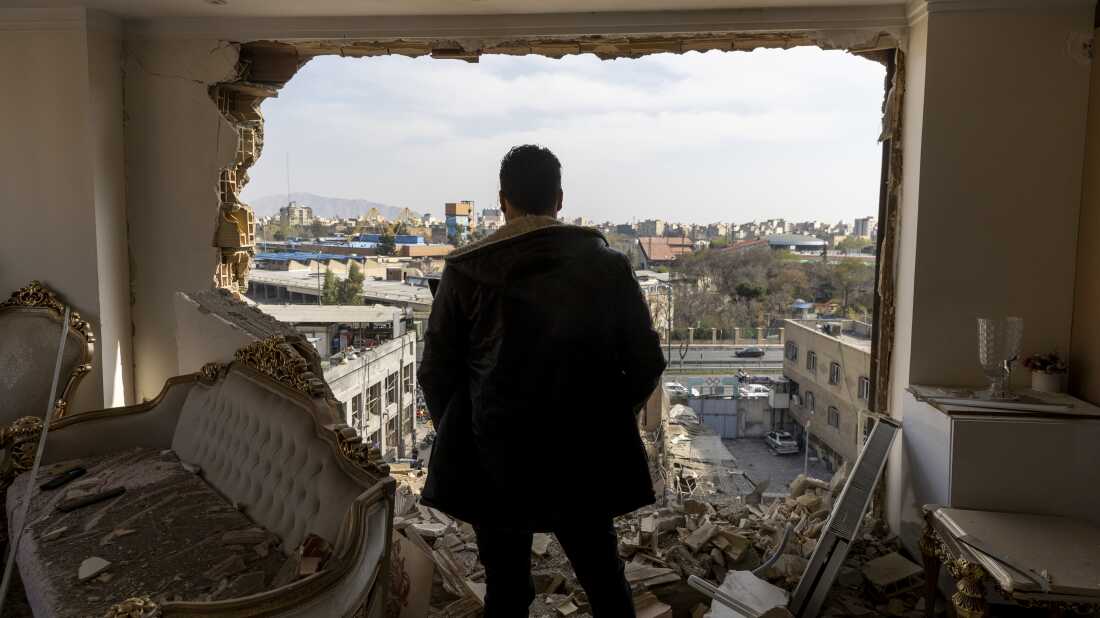

A man stands in a damaged residence in Tehran on March 14.
Majid Saeedi/Getty Images Europe
hide caption
toggle caption
Majid Saeedi/Getty Images Europe
Three weeks into the U.S. and Israel’s war with Iran, it remains unclear how or when the conflict might end. When asked by a reporter on Sunday if he was ready to declare victory, President Trump responded, “no, I don’t want to do that. There’s no reason to.”
Karim Sadjadpour, a senior fellow at the Carnegie Endowment for International Peace, says the president seems to have underestimated Iran’s response to the war. Sadjadpour notes that Iran telegraphed from the beginning that it planned to regionalize the conflict. But, he says, “President Trump said that that took him by surprise when Iran started to attack the Persian Gulf countries or close down the Strait of Hormuz.”
“I don’t think President Trump, in his own words frankly, understood what he was getting into,” he adds.

Sadjadpour says the war with Iran began as what he calls a “war of choice” — meaning there was no imminent threat that Iran was about to acquire nuclear weapons or launch missile strikes on the U.S. or its partners. But the calculus has since changed. The Iranian government has effectively closed the Strait of Hormuz, a vital waterway through which approximately 20% of the world’s crude oil and natural gas typically passes.
In addition, it’s unclear how much power Iran’s newly appointed supreme leader, Mojtaba Khamenei, actually holds. Earlier today, Israel announced that it had killed Ali Larijani, the head of Iran’s Supreme National Security Council. Larijani was expected to be a close adviser to Khamenei.
“At a time when the regime’s survival is at stake, Larijani’s decades of domestic and foreign policy experience make his loss a significant blow,” Sadjadpour reflects. “For a revolutionary regime whose political ideology is premised on martyrdom, the central question is whether these assassinations will ultimately extinguish the ideology or help revive it.”
Sadjadpour likens the inner functioning of the Iranian regime to a black box: “It’s inaccessible to us,” he says. “What began as a war choice, in my view, has actually morphed into a war of necessity. I don’t think that President Trump is going to simply be able to end the war and claim victory.”
Interview highlights
On the American government’s priorities in this conflict
We’re in a predicament. And I think that there really are four main priorities when it comes to our potential negotiations with Iran. One is obviously nuclear, and that highly enriched uranium, which is ostensibly under rubble now — after the bombings of last June — that needs to be accounted for. … Second point now … we need a deal which also addresses their use of missiles and drones. A third issue are their proxies — the support for groups like Hezbollah in Lebanon, the Houthis in Yemen, the Iraqi Shiite militias. Now, these proxies have been degraded, but they still do pose a real threat to regional stability.
And then the fourth issue is the reason why we’re even in this situation, which is Iran’s brutality toward its own population. If you remember, last January, Trump … warned the Iranian government that if they kill protesters, the United States would intervene. And that was his red-line he issued, … and Iran tore up that red line. And that’s what actually motivated him to start this military buildup in the Persian Gulf.
What we’ve seen is that the president has kind of been all over the place when he’s asked what his goal is. Some days he says it’s just to get a nuclear deal. Some days, he says he wants a Venezuela deal. Some days it wants to implode the regime. And that lack of clarity, in my view, has been deeply detrimental because if you don’t know what it is that you’re trying to achieve, then you’re putting both the U.S. military and our partners in very difficult positions.
On the likelihood of the war in Iran expanding to include nuclear weapons and additional superpowers
Fortunately, I don’t think that is a high likelihood, and I’ll tell you why. The countries that Iran has been attacking most over the last few weeks are, as I said, these Persian Gulf countries, Saudi Arabia, the United Arab Emirates, in particular. … When you look at those countries, they actually have probably more robust relations with China and Russia than Iran does, and so it’s not the case that Iran is this country with very strong allies who have its back and those Gulf countries are only allied with America and Israel.
In fact, the Islamic Republic of Iran is probably the top one or two most strategically lonely countries in the world. It really has very few reliable allies in the world. And so I think that the Chinese are not going to come and fight on Iran’s behalf against Gulf countries with whom they have even closer energy relations. And Vladimir Putin actually has strong relations with the leadership inside Arabia … so I’m not concerned that this will deteriorate into a World War III, but … this has just set a very dangerous precedent and I don’t think that the world or especially the Middle East is going to feel like a stable place for the foreseeable future.
On what he deems as the best-case scenario
Best-case scenario, obviously, would be we have a different government that comes to power in Iran in which it’s either Iran transitions to a democracy or a government whose organizing principle is the national interests of Iran — “long live Iran” rather than “death to America.” I don’t think that that is a short-term prospect.

And in the near term, I think the best-case outcome is that we liberate the Strait of Hormuz from Iranian interference and you reestablish the safe passage of trade and ships through the Strait of Hormuz. And obviously, Iran has ceased all of its attacks on its neighbors and on Israel. That would require the United States and Israel to also cease those attacks. But even then, there’s gonna be some outstanding things which we can’t afford to ignore, which is what happens with that highly enriched uranium inside Iran? How is that going to be accounted for? What about Iran’s ballistic missiles and drones? That’s been proven to be a real menace to regional security. How are we going to address that? What if Iran starts to rebuild and refinance its regional proxies? That’s a challenge we have to address.
And then finally … the whole reason that this conflict has begun, which was the Iranian regime’s brutality toward its own people. … I fear that this regime is so deeply unpopular that the only way that they’ll continue to manage to stay in power is by being even more brutal than before. Do we have a strategy for addressing that? I think the president was hoping for something seemingly quick and easy like Venezuela appeared to be for him, but this is anything but.
On why he sees Iran as a tragedy
I think there’s a bottom line which I feel — I know most people in the U.S. and Europeans governments feel and tens of millions of Iranians feel — which is this is a country which isn’t where it should be. This is one of the world’s oldest civilizations. It has enormous human capital, it has enormous natural resources, this rich history, it should be a G20 nation. … And so modern-day Iran is really a tragedy. And it’s a tragedy above all for Iranians, both inside Iran and in the diaspora. But it’s also been a tragedy for the United States, because in my view, America and Iran actually should be natural partners and instead Iran is one of our worst adversaries. And unfortunately, I don’t see that dynamic changing in the near future.
Monique Nazareth and Thea Chaloner produced and edited this interview for broadcast. Bridget Bentz, Molly Seavy-Nesper and tk adapted it for the web.
