


No matter how much money anyone throws at it, the GenAI boom can only continue to grow as fast as datacenters are built and powered up to accept machinery.
No amount of political, social, or economic pressure can speed up how power generation equipment is installed at datacenters or at utilities. No one was expecting this AI boom to skyrocket so, and supply chains from chip manufacturing equipment to chip makers to those who make all of the equipment that goes into power distribution in the electric grids and within the datacenters were not ready to ramp as quickly as the industry seems to require.
For now at least, it takes people to build all of these datacenters and indeed anything else we want to provide shelter for ourselves, our businesses, and our public facilities. And it is convenient, perhaps, that there are high interest rates for mortgages at a time when datacenter builders want more people working on their projects instead of building homes or offices. (Yes, people still go to the office, and thankfully I have not had to do that since 1996.)
Jason Furman, an economics professor at Harvard University, posted this neat chart on X that shows the growth rates of construction projects thus far in 2026 up through August:
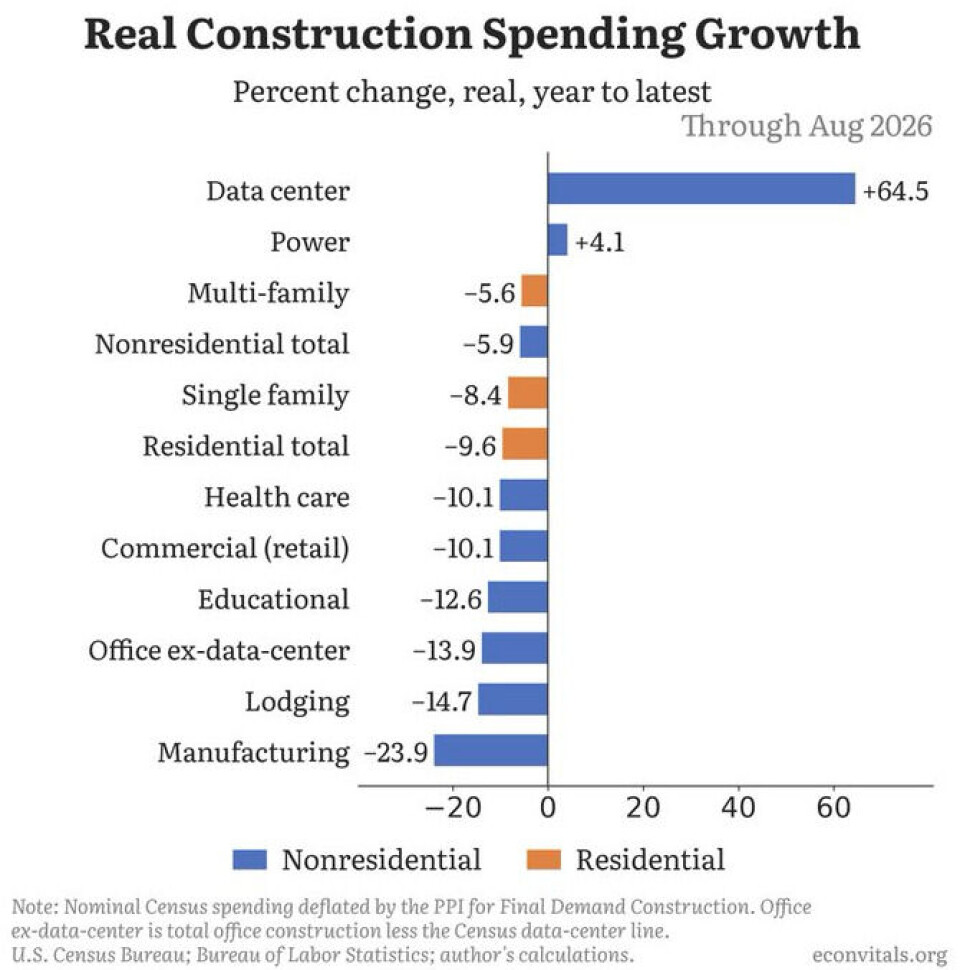
This is yet another data point that shows just how much datacenter construction and power utility construction are helping to prop up the economy in the United States. And just to be clear, this data from the US Census Bureau and the US Bureau of Labor Statistics, and it includes the cost of construction materials and the labor on construction projects. It explicitly does not include any compute, storage, or networking gear inside of those datacenters, but it does include the cost of power distribution and energy backup equipment in datacenter facilities.
As you can see, datacenter capacity construction increases, and to a certain extent for power utilities as well, are counter-balancing the declines seen in commercial and residential construction in the United States.
It is tough to get a sense of the spending levels for datacenters from this chart, and so we poked around and found a monthly chart that runs from January 2014 through August 2026 from the US Census Bureau, which was put together by the Our World In Data project at Oxford University. Take a look:
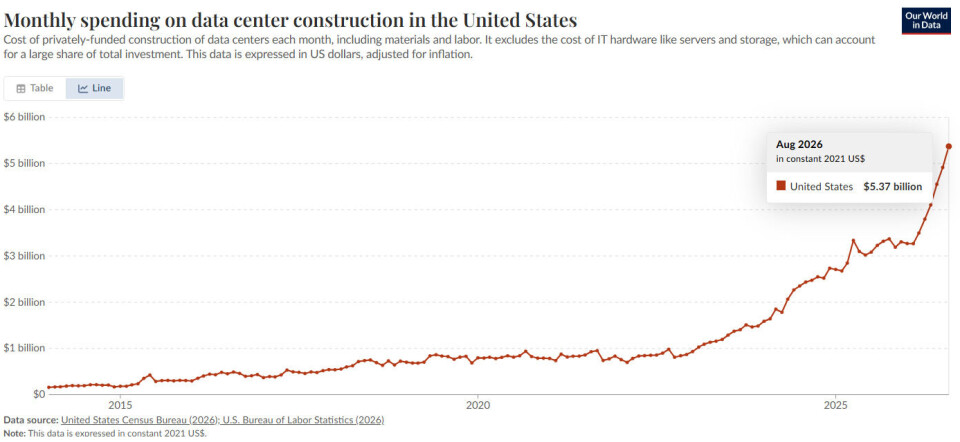
This chart is based on inflation-adjusted spending pegged to 2021 US dollars.
You can really see how the GenAI boom, which is driving datacenter construction spending increases in the United States, started in November 2022. Since that time, we are in a very different market – up and to the right, and accelerating.
This data from the Census Bureau does not include datacenter spending by federal, state, or local governments, buy the way. Not that this is very large compared to what the hyperscalers, cloud builders, and AI model builders are ponying up. Government datacenter spending would be a tiny part of the signal that would not change its shape by much.
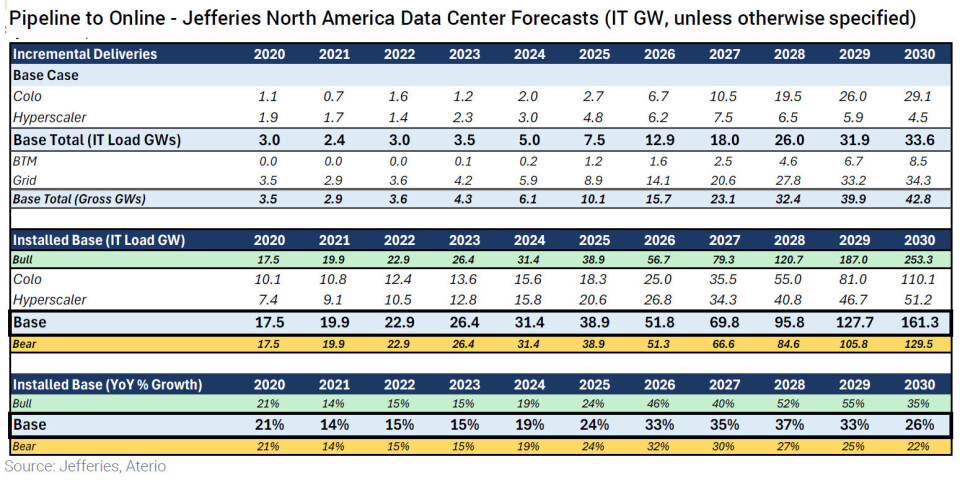
Which brings me to a very detailed and interesting forecast of datacenter spending that the analysts at Jeffries put together with the help of Aterio, a market researcher specialized in datacenter forecasts among many other sectors.
Aterio provided the historical context, and Jonathan Petersen, managing director at Jeffries, put together a base forecast with a bull and a bear variant to that base case to bracket what they expect datacenter spending to be from 2026 through 2030. Here’s the table that gives you the data:
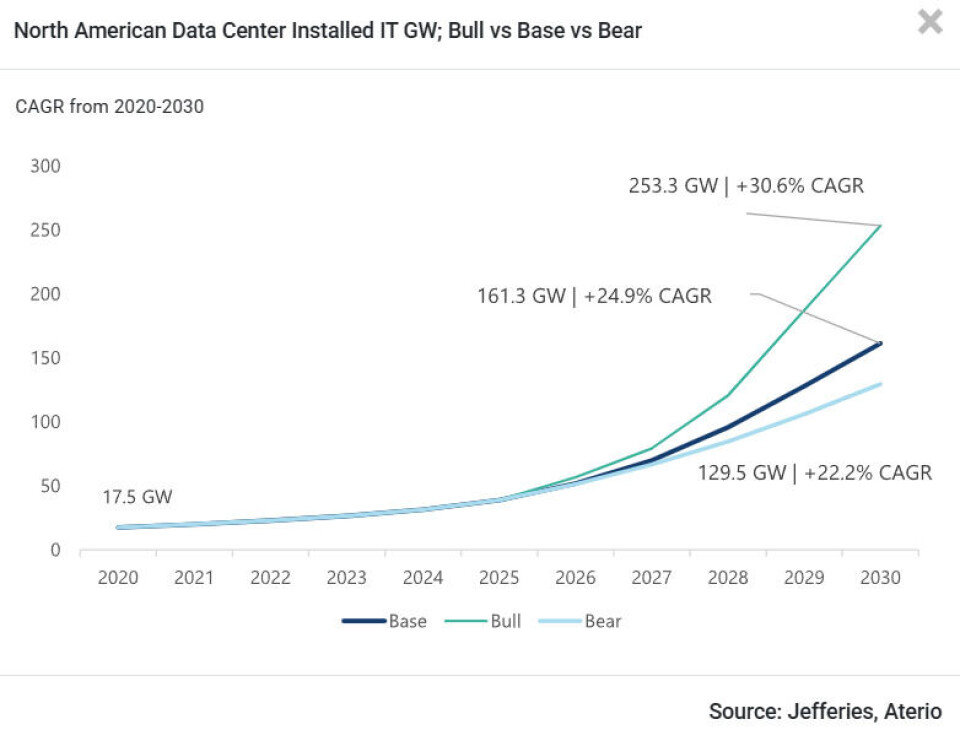
And for those of you who also like to look at data visually, here is the companion chart:
Our thanks to Petersen for permission to share this data with you.
“The AI industry has a datacenter problem,” Petersen writes in a report released on October 9. “Demand for inference and frontier model training is growing faster than developers can bring capacity online. Our dataset tracks ~65 IT GW of DCs under construction (~140 percent of installed capacity), and another ~361 GW of future announced projects (~760 percent). However, it will take time to bring that capacity online, and many projects will be delayed or canceled. We expect 12.9 GWs of new capacity in 2026 and 18 GWs in 2027.”
This model only predicts installed gigawatts in North America for IT gear, not the cost of building those datacenters or putting the gear inside them to make them useful or the power and cooling costs that enliven the facilities and gear. This model does not just take the forecasts by datacenter operators and businesses that run their own datacenters at face value, but looks at the probability that projects will be completed, and to what extend based on intentions.
To say the least, Jeffries is appropriately cynical about how the datacenter buildout will pan out, given the constraints on all of the supply inputs and labor to build datacenters.
“The ability to bring new datacenter capacity online is often reduced to a discussion measuring new grid interconnects or behind-the-meter power generation as primary gating factors,” says Petersen. “Or tracking hyperscaler capex and assuming that spending more capex will create new data centers. Or, measuring chip sales projections from the semiconductor industry. But any of those discussions in isolation misses the bigger picture: it takes all of those inputs, plus available labor, manufacturing of electrical and cooling equipment, and a cooperative political and regulatory environment to move a data center project from the pipeline to online capacity.”
The labor shortage and the increasing political pressure for datacenters to pay their fair share of the cost of electricity generation and a rising skepticism about the financial benefits to the communities that host datacenters is what is driving the bear case. The bull case is more about supply chain issues for datacenter construction easing somewhat, but not enough for everything desired and planned to be built. This latter point is the point. Even the bull case assumes lots of delays and some cancellations.
To show you the gap between planned capacity and the estimates by Jeffries, even the hyperscalers, who have tons of money and very strong balance sheets, are not going to be able to build at the rate they want. The planned and estimated North American hyperscaler datacenter capacity for 2026 is 6.21 gigawatts in 2026. (The year is pretty much done, so this convergence makes sense.) For 2027, the hyperscalers in North America are talking about wanting to do 8.37 gigawatts of datacenter buildout, but Jeffries thinks only 7.53 gigawatts will get built for these companies. In 2028, the aspirations are huge, and the built capacity Jeffries expects will be lower, not higher, with hyperscalers planning for 10.13 gigawatts of buildout and Petersen and crew expecting only 6.54 gigawatts to be completed. The 2029 plans are for just under 18 gigawatts among the hyperscalers in North America, but Jeffries thinks only 5.86 gigawatts will get done. And in 2030, the aspirations will shrink to 13.82 gigawatts for the hyperscaler facilities in the United States and Canada and the expected build will look more like 4.46 gigawatts.
These are huge gaps. In 2026, labor is the biggest damper on datacenter spending, and in 2027 through 2029, it will be cooling equipment. In 2030, the main constraint will be available power, says Jeffries. All of these constraints are always present, of course.
