

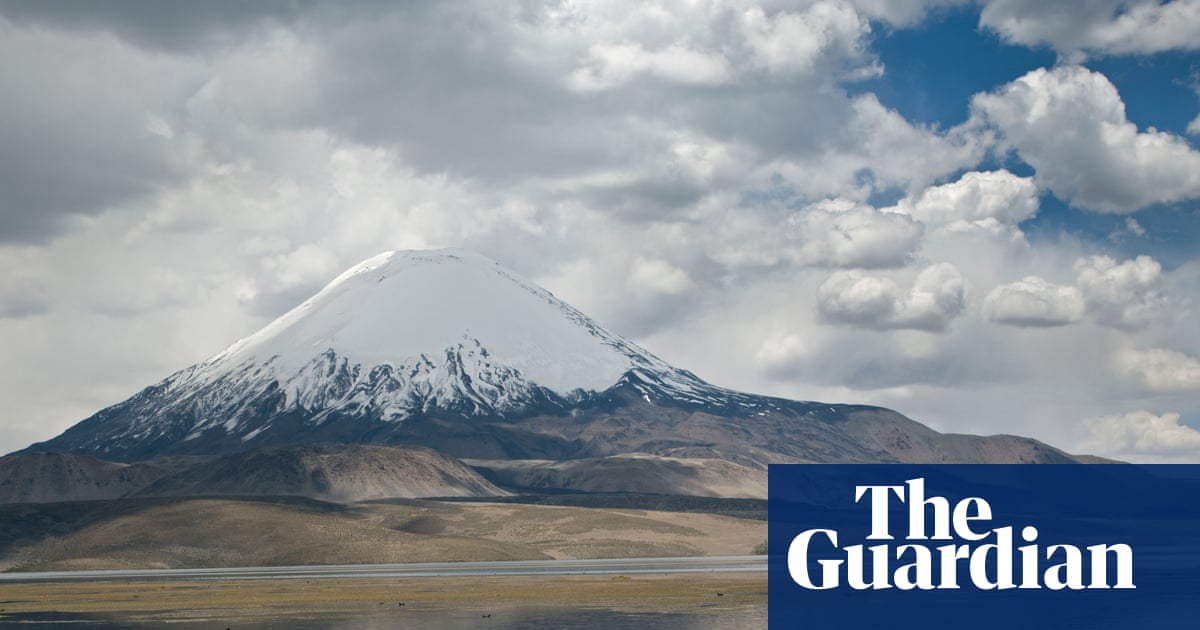
In Chile’s most northerly region, Arica y Parinacota, Andrea Chellew, 62, relies on tourists for her cafe. They usually travel from the coastal city of Arica to the unique biosphere of the Andean highlands, which rise well above 5,000 metres and host nature reserves and wetlands.
At 3,000 metres (9,800ft) above sea level, along Highway 11, she lives by the trade route that brings raw materials and goods between Bolivia and Chile. Yet the cafe remains empty as fewer tourists come, amid more reports of increased mining activity near environmentally protected areas, such as the Lauca national park.
Chellew, a regional councillor, says: “The highlands are the sustenance of life, and all that water comes down from the mountains to the valleys, such as Azapa and Lluta and to the coast. The city of Arica is on the coast. So, we have a very serious problem.
“The mining business in Chile is good for very few people,” she says. “The rest fall into absolute misery.”
The far-right president, José Antonio Kast, won Chile’s recent polls on promises of greater security and a “pro-business” platform under the slogan “fewer permits, more investment”. It was a swipe at what he considers the “excessive bureaucracy” of environmental permits, which he believes harms economic growth.
In the region of Arica y Parinacota, Kast won by a wide margin, receiving more than 62% of the vote. As Kast assumed the presidency on 11 March, many environmental activists were worried about what this presidential term might mean for their efforts, not only for conservation but also for Indigenous rights and access to water.
“The entire north of Chile is contaminated with polymetals,” Chellew says, referring to the highly toxic pollution caused by heavy metals, such as arsenic, lead, cadmium and copper, left by mining.
“Kast is more like Trump,” she says. “We are worried. People here voted for the far right – it is absurd.”
Marcela Gómez Mamani, a representative of the Indigenous community of Umirpa and a member of the regional council of Arica y Parinacota, says activists are concerned about the new government’s impact on the environment. “The greatest concern is water,” she says.
In the south of the region, more than 4,000 metres above sea level, the Indigenous Aymara community of the town in the Vitor-Codpa basin has long been concerned about the impact of mining operations.
Andex Minerals, a Chilean company, has been exploring the area around the small town of Camarones for copper and other resources, and locals are worried they may soon begin mining.
“The company is operating precisely where the water sources are located. They drill one kilometre or two kilometres deep, even if their project documents state 200 metres or 800 metres,” says Gómez Mamani.
“We will not have water – not for agriculture, not for livestock, not for tourism, not for any economic activity we currently depend on,” she says.
Andex Minerals was contacted for comment.
Surrounded by three mountains, known as the Mallku, rainwater flows and is collected on its western slopes, which are used by communities along the basin. The area is an Alto Andino indigenous development area (ADI), designed to support the sustainable development and cultural preservation of Indigenous communities living in the region’s high-altitude ecosystems.
Yet Gómez Mamani says little is being respected. “They blocked ancestral ceremonial paths by placing rocks across them. We filed complaints, and nothing happened,” she says.
“The government speaks of our rich culture, but when it comes to water and land rights, that recognition disappears. That is where Indigenous peoples are portrayed as obstacles to ‘development’.”
The perceived connection between mining companies, local communities’ health and access to clean water involves profits from extractive industries and environmental harm. Mining is one of the main pillars of Chile’s economy, with its taxes accounting for about 20% of state income in 2021. All the mining is in the country’s northern regions and has attracted substantial foreign investment over the decades.
Fernando Cabrales Gómez, an economist and associate professor at the University of Tarapacá, says: “Mining accounts for more than half of Chile’s exports and is the only industrial sector whose productivity is comparable to that of a developed country.”
In the past, large-scale dumping of toxic material by foreign companies in Arica y Parinacota has caused massive health problems, including arsenic and metal poisoning. It is seen as one of the consequences of public health taking a backseat to foreign investment.
“It has been a long and painful struggle,” says Luz Ramírez, president of the Mamitas del Plomo (“Mothers of Lead”) Foundation, which she helped found after high arsenic levels were discovered in her children’s blood.
She is one of more than 700 Chileans who filed a claim for compensation in 2013 after allegedly suffering health problems from living near waste left by a Swedish mining company in the 1980s.
“We need a government committed to environmental protection,” says Ramírez. “We are deeply contaminated, and 50 years later, the damage remains unresolved.”
Last month, an accident involving a cargo truck driving between the Bolivian and Chilean borders spilt more than 20,000 litres of soya bean oil into the waters of Lake Chungará in the Lauca national park, as the main road skirts the lake’s shore. This was the sixth accident this year and sparked protests in Arica demanding that the government do more to protect the environment.
Nationally, the two-year deadline of the previous leftist government of Gabriel Boric to set up the newly created Biodiversity and Protected Areas Service (SBAP) passed without the legislation being enacted, meaning it could be scrapped by the new government. This delay could block environmental protection.
Now conservation organisations are on high alert, trying to hold on to existing environmental safeguards. Lorena Arce, coordinator of the biodiversity and development alternatives programme at Chile’s Citizen Observatory, commented that political activism “will be focused more on defence than on promotion”.
The Atacama desert is one of the driest places on Earth, making water an extremely political issue. Sources range from tributaries of the Lluta and San José Rivers, which irrigate the important agricultural valleys of Azapa and Lluta, to groundwater and high-altitude wetlands, the peatlands known locally as bofedales and vegales.
The Azapa valley, one of the region’s main agricultural centres, is known as “Chile’s refrigerator”, producing tomatoes, olives and other vegetables all year. Yet the Azapa aquifer has been facing shortages.
The situation is exacerbated by worsening climate conditions. A report by the environment ministry’s office of climate change suggests that highland temperatures are set to rise by 2-6C (3.6-10.8F) by 2080, and precipitation is projected to decline by up to 30%, which could greatly affect these major sources of water.
Chile has one of the world’s most privatised water systems, which creates problems at the local level. It is based on the water code introduced in 1981 by the Pinochet dictatorship.
The law granted permanent water rights to private companies and individuals, who could buy, sell and inherit them. This allowed mining companies to buy large amounts of water, causing tension with Indigenous communities relying on the same sources for farming, livestock and the wetlands.
Gloria Lillo Ortega, development and policy coordinator at the National Irrigation Commission, says: “The main problem in the north is less about infrastructure and more about governance: the rules of the game, the legal framework, the water code, land-use planning and long-term planning.
“These governance issues are more critical. The Boric administration has prioritised small-scale agriculture and Indigenous communities. A future administration could shift that focus towards large-scale individual users.”
In 2022, the law was reformed to limit water rights to 30 years instead of indefinitely, with greater priority given to human consumption and environmental protection. Yet the reform has been criticised for not doing enough to address historic inequalities in water rights.
In the town of Putre, capital of Parinacota province, Sebastián Vidal Díaz, co-founder of the Aka Pacha Foundation, an environmental and social organisation operating in the lower highlands, is also concerned about the new Kast administration.
“We are afraid that this productive vision will cause some extreme change in the north because this region is not fully covered with mining companies,” Vidal Díaz says. “This is one of the regions with the fewest approved mining projects. Kast just wants more foreign investment.”
