

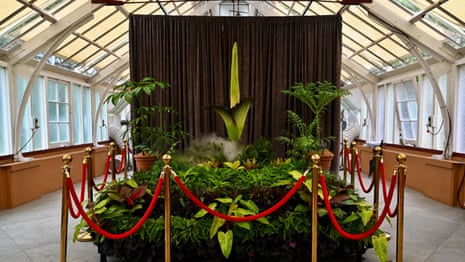
From little things glorious fetid things grow. Corpse flower blooms, once vanishingly rare, are becoming more commonplace in Australia.
More than a dozen bloomed across the country in 2025, including the infamous Putricia in Sydney, Morpheus in Canberra, Big Betty in Cooktown, and Spud and co in Cairns. But with plants kept in gardens across the country, and blooming more frequently after their first flower, you could catch a whiff of one soon.
“Australia has one of the highest flowering events in the world,” said Matt Coulter, senior horticulture curator at the Botanic Gardens of South Australia. The country was among the top three places for the number of corpse flowers blooming, he said, with plants coming to an age where they were likely to flower more often.
Adelaide, known for its hot, dry summers, has become an unlikely capital for propagating these endangered plants from the equatorial rainforests of Sumatra, Indonesia.
There, Smellanie, one of three original plants grown from seeds acquired in 2006, had just finished its second flowering. Coulter has propagated many more from both leaf cuttings and pollination. The state’s corpse flower collection now holds in excess of 250 plants across different generations – the largest in Australia, and possibly the world.
Smellanie “turned out to be a perfect flower”, he said, with a deep crimson outer layer and powerful stench. At 2.13m tall it was the largest the garden had shown to the public – its aroma reminiscent of “fermenting cabbage”, “strong blue cheese” or “old sweaty socks”.
Corpse flowers are notoriously unpredictable. Most plants take 10-12 years to be able to produce their first flower, he said. Afterwards they could flower at intervals of three to five years, although in some cases it could be longer.
There were no guarantees. In order to produce their extravagant display, corpse plants needed to store up enough energy in underground tubers, or “corms” which could grow up to 75kg. When there’s a bud, you never know if it will be a leaf or a flower until it’s about 10-15 cm long, Coulter said. Even then, he was aware of incidents where the tuber hadn’t been strong enough to enable the flower to open.
“They’re not an easy plant to grow because at certain times of the year they need lots of water and lots of nutrition. Other times of year they just need to rest and have nothing.”
After its first flower in 2015, Adelaide now has corpse flowers blossoming every year, but not all are placed on public display. Transporting these precious plants from their climate-controlled glasshouse to the Adelaide botanic gardens was “quite a stressful event for the plant”.
Geelong was on tenterhooks. The botanic gardens currently has four titan arums in its collection. The plant, affectionately known as Betsy, bloomed in November 2024 – producing a pungent fragrance of decaying possum with overtones of parmesan cheese – and there’s another corm of similar age and size. That plant has a nickname too, which the garden was yet to reveal.
John Siemon, horticulture director at the Botanic Gardens of Sydney, where three flowers bloomed last year – Putricia, Baby Stink and Stinkerella – said the plant personas helped people overcome “plant blindness”. Although attributing a gender wasn’t quite right, he said, given the plants had both male and female organs.
The public’s curiosity for corpse flowers appeared to be insatiable. Nearly 27,000 people turned up to get a whiff of Putricia’s fragrance, “like the rich stench of a public bin on a 40 degree day”. The vibe was “akin to having the Olympics back in town”, Siemon said.
Sydneysiders may not have to wait long for the next performance.
Putricia has three other siblings, all made from leaf cuttings that were genetically identical. Three have flowered, he said. “So there’s every chance that fourth clone – the quadruplet – might come into bloom in the next 12 months.”
As well as becoming a hub for the Amorphophallus titanum, Australia has its own native corpse varieties – the elephant yam and cheeky yam – native to northern Australia.
Carol Davis, acting nursery general manager at the Australian National Botanic Gardens in Canberra, said while their flowers were smaller and different in shape, the native varieties shared a similar structure, including the central column, or “spadix”, and the distinctive rotting aroma.
“The smell is a highly evolved strategy designed to attract pollinators like beetles and flies that are drawn to decaying organic matter,” she said.
The ANBG has one titan arum in its collection, known as Morphy – short for Morpheus, the god of sleep and dreams – which was among those that flowered in 2025. Morpheus was known for appearing in different forms, Davis said. “We think this is a fitting reflection of the flower’s dormancy period and also the different forms it takes when it’s actively growing in either its leaf stage or its flower stage.”
“The core collection that’s being held in conservation facilities is now of a mature age where we will see quite a few individuals flower,” Siemon said.
When or where will the next corpse flower bloom? “There’s a bit of crystal ball, a bit of science and horticulture, and a lot of good luck.”
