


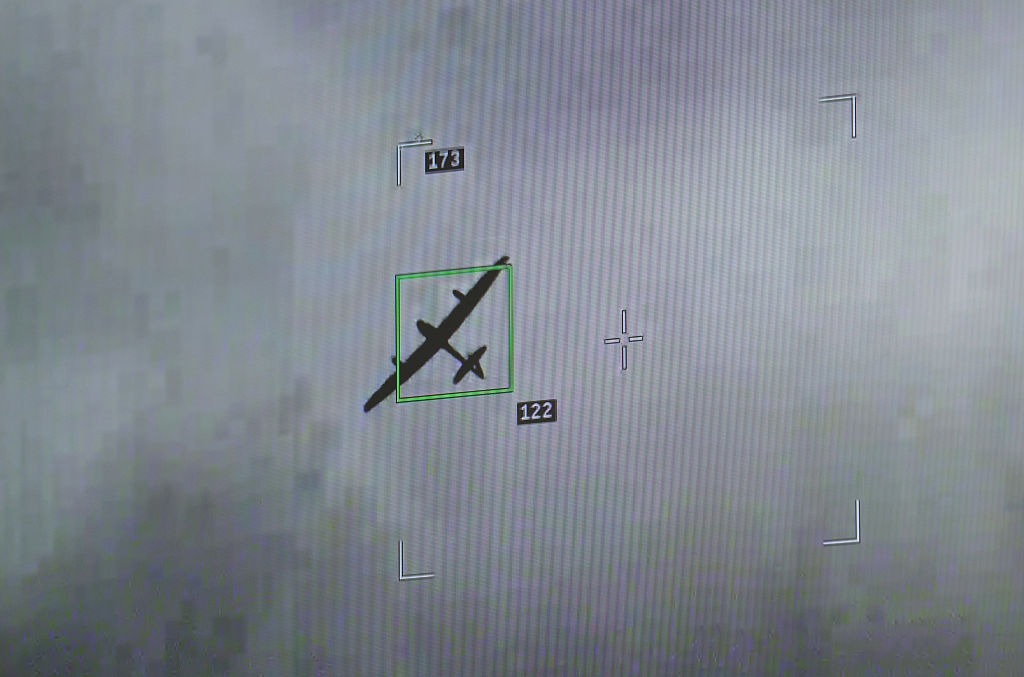
AI-powered autonomous weapons, operating with little or no human supervision, offer speed, scale and lower costs, but they also raise hard questions about who stays in control.
In this selection of Strategist articles, authors look at how autonomous systems are being used on the battlefield and in the Australian Defence Force and at how they might shape the future of warfare.
Autonomous drones are already on the front lines of the Russia–Ukraine war, and both sides are locked in an arms race to make them more capable, writes David Kirichenko.
Ukraine is equipping its uncrewed ground vehicles with AI-powered targeting, letting them spot enemy forces from farther away and more accurately. Also, Ukraine’s mid-range drones, such as the Hornet, Darts and RAM-2X, use autonomous terminal lock guidance, making them more resistant to electromagnetic warfare.
Russia is following suit. Its Geran Seeker and Molniya strike drones are equipped with mesh networking and onboard AI for autonomous terminal guidance, and they’re already widely deployed. Now ‘robot versus robot battles are common’, Kirichenko says. Ukraine’s response? More robots.
In the near future, Ukrainian military planners envision autonomous robots leading assaults by clearing enemy positions before troops advance. Soldiers would rapidly deploy drones at a moment’s notice to hunt Russian targets. Naval drones would lie in wait at sea, activated remotely before autonomously striking their targets. In long-range strikes, AI would fuse battlefield data, identify targets and calculate optimal flight paths, increasing the success of deep strikes inside Russia.
We in the Indo-Pacific can learn from some of this, writes Malcolm Davis.
Reflecting on a panel at ASPI’s June Defence Conference, Davis argues that the ADF’s reliance on small numbers of costly crewed platforms is ‘out of step’ with the rapid innovation cycles of uncrewed systems. Rather than full autonomy, he makes the case for semi-autonomous systems that, if bought ‘at low cost, in volume and at a rapid pace’, could help the ADF build combat mass across the region’s vast distances.
To keep pace with fast-moving operations where communications could be cut, the ADF may need to shift from keeping humans ‘in the loop’ to keeping them ‘on the loop’. Rather than remotely piloting drones, operators would only oversee what the machines do, leaving more decisions to AI.
For AUKUS, autonomy is also heading underwater. Writing with Justin Bassi, Davis says that a project announced by Australia, Britain and the United States in May will give autonomous submarines such as Anduril’s Ghost Shark the sensors and weapons they need to navigate, detect and attack. If the partners meet their 2027 delivery target – ‘a big if’ – AUKUS Pillar Two will move from research to operational military capability.
And that capability is badly needed. Australia must protect its subsea critical infrastructure – such as the 15 cables that carry almost all of its internet traffic.
The best way to do this is to patrol submarine cables with swarms of uncrewed autonomous vessels, freeing up crewed submarines to operate forward in our maritime approaches and beyond.
But the ADF must be careful not to integrate AI faster than it can govern it. ‘AI is now financed across almost every line of the Australian defence budget,’ writes Aina Turillazzi. ‘It is not, however, governed across them.’
‘AI integration needs to happen,’ she says. But Canberra should build in pauses for human review at key escalation points, audit AI’s role in high-stakes choices, and commit publicly that AI won’t be given final authority over the most consequential decisions. Without these safeguards, the people meant to oversee AI systems risk becoming little more than a rubber stamp.
AI systems are probabilistic and often opaque, and operators working under pressure tend to defer to their outputs – a dynamic known as automation bias. The human role drifts from assessing evidence to confirming a recommendation. That tendency sits awkwardly against the legal requirement for informed human judgement in targeting … and is exacerbated by the operational pressure to take humans out of the loop in pursuit of speed.
Even if Australia gets its own rules right, its partners might not share them, writes Samuel White. As AI becomes embedded in military decision-making, White asks, ‘do Indo-Pacific partners understand the legal and operational limits of AI-enabled warfare in sufficiently similar ways to make decisions together?’
He imagines a future coalition operation where an AI system identifies a target and recommends engagement. One partner wants to act on that recommendation, another wants a human to verify the underlying intelligence first and a third needs the AI to explain how it reached its conclusion.
The militaries may have compatible communications, platforms and data or even be using the same AI-enabled system, yet they are not interoperable. Although AI is intended to accelerate decision-making, incompatible approaches to law and human judgement can slow a coalition down or, worse, produce disagreement only after a decision has been made.
Ayeza Areej warns that these issues get harder when the AI itself keeps changing.
While most AI systems learn from fixed training data, future systems may use continual learning to keep updating with new data after they’re deployed. That would let them adapt to changing conditions but also make their behaviour harder to predict, especially when adversaries can feed them misleading data through camouflage, deception or electronic warfare.
Military AI does not need to become conscious to outpace human control. It only needs to become sufficiently autonomous, adaptive and opaque such that humans cannot confidently predict how it will behave when conditions change.
Areej also identifies an issue with accountability. She invites us to consider a weapon that, after adapting to new data on the battlefield, mistakes a civilian vehicle for a military target.
Responsibility could become difficult to locate among the commander who authorised its use, the operator who activated it, the developer who designed it, the engineers who trained its model and the authority that certified it. The machine may have made the immediate decision, but it cannot bear legal or moral responsibility for the consequences.
