
LIVE NEWS
  • Calls for Global Digital Estate Standard as Fraud Risk Grows
  • An ode to craftsmanship in software development
  • Global economy must stop pandering to ‘frivolous desires of ultra-rich’, says UN expert | Environment
  • Some Middle East Flights Resume but Confusion Reigns From Iran Strikes
  • Clinton Deposition Videos Released in Epstein Investigation
  • Elevance stock tumbles as CMS may halt Medicare enrollment
  • Wild spaces for butterflies to be created in Glasgow
  • You can now adjust how your caller card looks for calls on Android phones
Prime Reports
  • Home
  • Popular Now
  • Crypto
  • Cybersecurity
  • Economy
  • Geopolitics
  • Global Markets
  • Politics
  • See More
    • Artificial Intelligence
    • Climate Risks
    • Defense
    • Healthcare Innovation
    • Science
    • Technology
    • World
Prime Reports
  • Home
  • Popular Now
  • Crypto
  • Cybersecurity
  • Economy
  • Geopolitics
  • Global Markets
  • Politics
  • Artificial Intelligence
  • Climate Risks
  • Defense
  • Healthcare Innovation
  • Science
  • Technology
  • World
Home»Cybersecurity»More evidence your AI agents can be turned against you
Cybersecurity

More evidence your AI agents can be turned against you

primereportsBy primereportsDecember 6, 2025No Comments4 Mins Read
Share Facebook Twitter Pinterest LinkedIn Tumblr Reddit Telegram Email
More evidence your AI agents can be turned against you
Share
Facebook Twitter LinkedIn Pinterest Email


Agentic AI tools are being pushed into software development pipelines, IT networks and other business workflows. But using these tools can quickly turn into a supply chain nightmare for organizations, introducing untrusted or malicious content into their workstream that are then regularly treated as instructions by the underlying large language models powering the tools.

Researchers at Aikido said this week that they have discovered a new vulnerability that affects most major commercial AI coding apps, including Google Gemini, Claude Code, OpenAI’s Codex, as well as GitHub’s AI Inference tool.

The flaw, which happens when AI tools are integrated into software development automation workflows like GitHub Actions and GitLab, allows maintainers (and in some cases external parties) to send prompts to an LLM that also contain commit messages, pull requests and other software development related commands. And because these messages were delivered as prompts, the underlying LLM will regularly remember them later and interpret them as straightforward instructions.

Although previous research has shown that agentic AI tools can use external data from the internet and other sources as prompting instructions, Aikido bug bounty hunter Rein Daelman claims this is the first evidence that the problem can affect real software development projects on platforms like GitHub.

“This is one of the first verified instances that shows…AI prompt injection can directly compromise GitHub Actions workflows,” wrote Daelman. It also “confirms the risk beyond theoretical discussion: This attack chain is practical, exploitable, and already present in real workflows.”

Because many of these models had high-level privileges within their GitHub repositories, they also had broad authority to act on those malicious instructions, including executing shell commands, editing issues or pull requests and publishing content on GitHub. While some projects only allowed trusted human maintainers to execute major tasks, others could be triggered by external users filing an issue.

Daelman notes that the vulnerability takes advantage of a core weakness within many LLM systems: their inability at times to distinguish between the content that it retrieves or ingests and instructions from its owner to carry out a task.

“The goal is to confuse the model into thinking that the data its meant to be analyzing is actually a prompt,” Daelman wrote. “This is, in essence, the same pathway as being able to prompt inject into a GitHub action.”
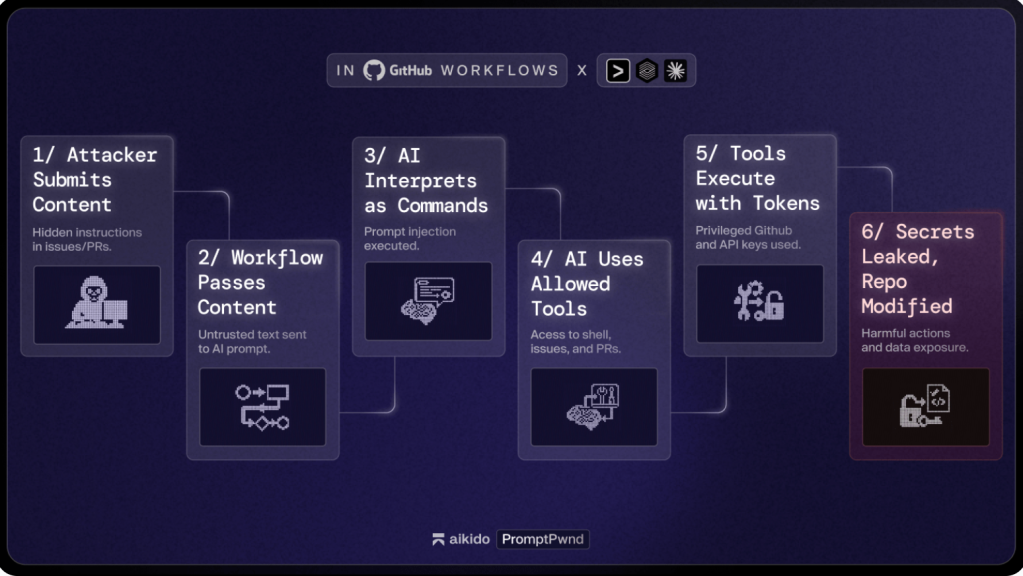
More evidence your AI agents can be turned against you
An illustration of how malicious parties can send commands to LLM in the form of content. (Source: Aikido)

Daelman said Aikido reported the flaw to Google along with a proof of concept for how it could be exploited. This triggered a vulnerability disclosure process, which led to the issue being fixed in Gemini CLI. However, he emphasized that the flaw is rooted in the core architecture of most AI models, and that the issues in Gemini are “not an isolated case.”

While both Claude Code and OpenAI’s Codex require write permissions, Aikido published simple commands that they claim can override those default settings.

“This should be considered extremely dangerous. In our testing, if an attacker is able to trigger a workflow that uses this setting, it is almost always possible to leak a privileged [GitHub token], Daelman wrote about Claude.  “Even if user input is not directly embedded into the prompt, but gathered by Claude itself using its available tools.”

The blog noted that Aikido is withholding some of its evidence as it continues to work with “many other Fortune 500 companies” to address the underlying vulnerability, Daelman said the company has observed similar issues in “many high-profile repositories.”

CyberScoop has contacted OpenAI, Anthropic and GitHub to request additional information and comments on Aikido’s research and findings.

Derek B. Johnson

Written by Derek B. Johnson

Derek B. Johnson is a reporter at CyberScoop, where his beat includes cybersecurity, elections and the federal government. Prior to that, he has provided award-winning coverage of cybersecurity news across the public and private sectors for various publications since 2017. Derek has a bachelor’s degree in print journalism from Hofstra University in New York and a master’s degree in public policy from George Mason University in Virginia.

Share. Facebook Twitter Pinterest LinkedIn Tumblr Email
Previous ArticleAll I want for Christmas is a server-side JavaScript framework
Next Article Elon Musk’s X fined $140 million by European Commission
primereports
  • Website

Related Posts

Cybersecurity

Calls for Global Digital Estate Standard as Fraud Risk Grows

March 4, 2026
Cybersecurity

Samsung Unpacked 2026 live blog: Updates on Galaxy S26 Ultra, preorder deals, and pricing

February 25, 2026
Cybersecurity

Marquis sues SonicWall over backup breach that led to ransomware attack

February 25, 2026
Add A Comment
Leave A Reply Cancel Reply

Top Posts

Global Resources Outlook 2024 | UNEP

December 6, 20255 Views

The D Brief: DHS shutdown likely; US troops leave al-Tanf; CNO’s plea to industry; Crowded robot-boat market; And a bit more.

February 14, 20264 Views

German Chancellor Merz faces difficult mission to Israel – DW – 12/06/2025

December 6, 20254 Views
Stay In Touch
  • Facebook
  • YouTube
  • TikTok
  • WhatsApp
  • Twitter
  • Instagram
Latest Reviews

Subscribe to Updates

Get the latest tech news from FooBar about tech, design and biz.

PrimeReports.org
Independent global news, analysis & insights.

PrimeReports.org brings you in-depth coverage of geopolitics, markets, technology and risk – with context that helps you understand what really matters.

Editorially independent · Opinions are those of the authors and not investment advice.
Facebook X (Twitter) LinkedIn YouTube
Key Sections
  • World
  • Geopolitics
  • Artificial Intelligence
  • Popular Now
  • Cybersecurity
  • Crypto
All Categories
  • Artificial Intelligence
  • Climate Risks
  • Crypto
  • Cybersecurity
  • Defense
  • Economy
  • Geopolitics
  • Global Markets
  • Healthcare Innovation
  • Politics
  • Popular Now
  • Science
  • Technology
  • World
  • About Us
  • Contact Us
  • Privacy Policy
  • Terms & Conditions
  • Disclaimer
  • Cookie Policy
  • DMCA / Copyright Notice
  • Editorial Policy

Sign up for Prime Reports Briefing – essential stories and analysis in your inbox.

By subscribing you agree to our Privacy Policy. You can opt out anytime.
Latest Stories
  • Calls for Global Digital Estate Standard as Fraud Risk Grows
  • An ode to craftsmanship in software development
  • Global economy must stop pandering to ‘frivolous desires of ultra-rich’, says UN expert | Environment
© 2026 PrimeReports.org. All rights reserved.
Privacy Terms Contact

Type above and press Enter to search. Press Esc to cancel.