


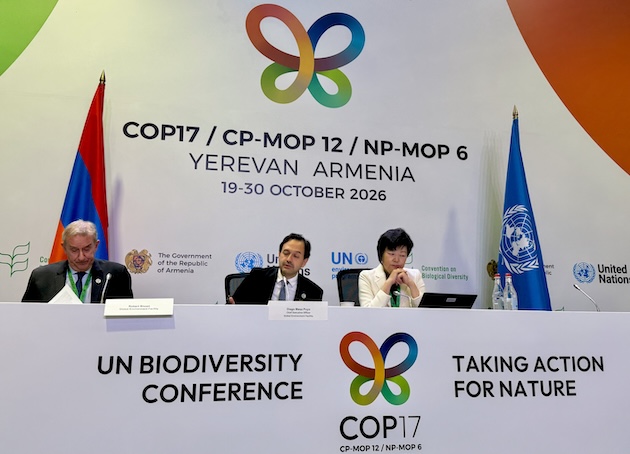
YEREVAN, Armenia, October 30 (IPS) – The second week of COP17 was dominated by discussions on biodiversity finance, with new pledges announced and donor outreach intensifying. Yet as the summit approached its close, the financing gap for implementing the Kunming-Montreal Global Biodiversity Framework (KMGBF) remains largely unchanged.
Prior to COP17, the first global review of progress toward the KMGBF, often called the global biodiversity review, painted an alarming picture: the commitment to mobilise USD 200 billion annually for biodiversity was still far from being achieved. The conference therefore opened amid growing pressure on governments over missed targets, corporate responsibility and Indigenous rights.
Against that backdrop, finance has become one of the most closely watched issues in the negotiations.
“We started the replenishment cycle number 9, for 2026 to 2030, and the initial contributions were announced in June in the General Assembly of the Global Environmental Facility (GEF) in Uzbekistan’s Samarkand. And those initial contributions came at USD 3.9 billion for the next four years,” said Diego Mesa, the recently appointed CEO and Chairperson of the Global Environment Facility, at a press conference.
New and Emerging Donors, Including Cities
Since the adoption of the KMGBF, a notable financing trend has emerged: cities and provinces have begun contributing directly to biodiversity finance mechanisms.
The trend started two years ago when Quebec, the Canadian province that hosted COP15 in 2022, independently donated USD 1.4 million to the GBFF.
At COP17, the trend continued. On Oct 26 – observed as Finance Day, the City of Berlin pledged EUR 50,000 (USD 56,000) to the GBFF, while Quebec announced a second contribution of CAD 1.5 million.
Collectively, national and sub-national governments pledged more than USD 60 million to the GBFF. According to GEF sources, this included contributions from Germany (EUR 50 million), Iceland (ISK 160 million) and Monaco (EUR 1.5 million).
While the expanding donor base is an encouraging sign, the world still needs an estimated USD 200 billion annually by 2030 to halt and reverse biodiversity loss under Target 19. The current pace of finance mobilisation, therefore, remains far slower than what is required.
Mesa acknowledged these concerns about the biodiversity finance gap but argued that GEF funding has a catalytic effect, attracting additional public and private investment. He noted that each dollar committed through the facility typically mobilises several more dollars from other sources, and many donor countries also provide biodiversity finance through bilateral programs outside the GEF system.
“We obviously, you know, are concerned. We’ve read the (global) review report. But what we also need to highlight is that, in addition to the funds that come through the GEF, we have to take into account what I mentioned about being able to mobilise additional funds, whether it’s, you know, a multiplier of 8 or 8.2, on average, if we take GEF 8 as a baseline or blended finance, which is about 18.5,” he said.
Astrid Schomaker, Executive Secretary of the Convention on Biological Diversity, stressed that progress remains insufficient despite some gains.
“We all know that a lot of commitments were made four years ago in Montreal (including) mobilising at least USD 200 billion a year for biodiversity from 2030, from all sources. Reduce harmful incentives by at least USD 500 billion a year and align public and private financial flows with a framework. We have seen biodiversity finance increase quite substantially, but also from very, very low levels. Some figures suggest that we would have achieved USD 19 billion in 2024. That would be close to the 2025 milestone of 20 billion. But we also know that aid budgets are a lot under pressure, so that progress is not yet secure, to say the least,” Schomaker said in an address to the delegates on the Finance Day.
“From the side of the Secretariat, we would point to three questions or priorities that we hope you can discuss at this COP and move forward on. First, bring national biodiversity strategies and action plans into national budgets. Second, reform harmful incentives. And third, make public and development finance go further,” Schomaker said.
New Coalition Targets Harmful Subsidies
While much of the discussion centred on mobilising new biodiversity finance, negotiators also stressed the need to curb environmentally harmful spending. In that context, momentum grew around efforts to reform harmful subsidies with the launch of a new coalition of countries committed to Target 18.
Known as the “Friends of Target 18”, the coalition focuses on the KMGBF target to reduce harmful incentives by at least USD 500 billion per year while scaling up positive incentives for biodiversity.
Led by Colombia and Finland, and supported by the CBD, the coalition also has backing from the International Institute for Sustainable Development (IISD), the Organisation for Economic Co-operation and Development (OECD) and the United Nations Development Programme’s Biodiversity Finance Initiative (UNDP BIOFIN).
“Our work here in Yerevan can influence how natural resources are used, how goods are produced and consumed, and where public and private financial resources are directed,” said Hambardzum Matevosyan, Minister of Environment of the Republic of Armenia and COP17 President.
So far, only five countries have joined the initiative. However, Marina Von Weissenberg, Senior Ministerial Adviser of Finland and co-chair of the Friends of Target 18, expressed confidence that more countries would follow.
“We don’t need to spend more to close the biodiversity funding gap, we need to spend better. Governments have a real opportunity here to reshape public spending with future generations in mind, but they can’t do it alone. International coordination is key to giving governments the confidence to lead change,” she said.
Meanwhile, GEF continues to focus not only on raising new money but also on broadening the donor base.
“This is exactly what we were doing with this pledging session, with the USD 5 million going to the GEF Trust Fund, and with the 60 million going into the GBFF. But also expanding the donor base. And that’s why we were very pleased to announce that we have a total of nine new contributors to the GEF family of funds,” Mesa said to IPS.
GEF Keeps Pledging Window Open
In an effort to attract additional support, GEF has made a significant change to its replenishment process.
Traditionally, pledging windows close when a replenishment cycle ends. Under that system, pledges for the ninth replenishment cycle would have closed earlier in June, when GEF held its Assembly in Samarkand.
This year, however, the window remains open, allowing countries to make contributions throughout the year.
“This is the first time that we kept the window open for pledging. And this is to respond to requests to be more flexible from the donor side. So, we will have, hopefully, one additional pledging session in the UNFCCC COP (COP31) next month,” Mesa told IPS.
“But we also expect additional contributions to take place in the next calendar year. So, the window will remain open,” he added.
IPS UN Bureau Report



© Inter Press Service (20261030130800) — All Rights Reserved. Original source: Inter Press Service
