

Navy Adm. Richard Correll succeeded Air Force Gen. Anthony J. Cotton as head of U.S. Strategic Command on Dec. 5, focusing his remarks on the strategic deterrence mission.
Correll, a career submariner, succeeds Cotton, a career missile officer; he was previously Cotton’s deputy. Air Force Lt. Gen. Michael J. Lutton, another career missileer, takes over as STRATCOM’s No. 2. He was previously deputy commander at Air Force Global Strike Command. Leadership at STRATCOM typically alternates between the Navy and Air Force, the two services responsible for the three legs of the nuclear triad.
In a ceremony at Offutt Air Force Base, Neb., Chairman of the Joint Chiefs of Staff Gen. Dan Caine noted that Correll had spent more than six years of his career underwater on nuclear-powered subs. But Correll noted his joint credentials, highlighting that he’s spent more than half of his time as a flag officer in joint roles at Offutt.
“As I assume command, the number one priority remains the same strategic deterrence,” he said. “That deterrence is much broader than the nuclear portfolio, encompassing all elements of national power for the joint force. It encompasses all of our military capabilities, kinetic and nonkinetic, in coordination with the intelligence community and the interagency to deliver decisive effects from the seabed to cislunar space.”
Correll, Caine, and Cotton all stressed the never-ending demand of deterrence in their remarks, but elements of that deterrence are changing with the emergence of China as a growing nuclear power.
“This is not Cold War 2.0,” Cotton warned. “Unfortunately, it’s much more complex.”
Correll did not mention China or Russia by name is his speech. Instead, he focused on changes in capability that threaten to destabilize the strategic environment.
“We must deter in a tech-saturated operational environment,” Correll said. “In that environment of tomorrow, the battlefield is being reshaped by rapid advancements in technology, and the character of warfare is changing, from unmanned and autonomous capabilities to innovative tools that manipulate the information environment. Engineering has become being possible at far smaller scales, and computing power continues to become exponentially cheaper.”
Citing the example of how far computer chips have come since the advent of the nuclear deterrence, Correll said STRATCOM cannot turn a blind eye to such developments.
“It’s important for this command to understand the implication of these developments so we can leverage data advantage, for decision advantage, for warfighting advantage, together with the joint force,” he said. “While we may not be able to predict the next revolution in military affairs, one thing is certain: we will be challenged, and consistent with this command’s 79-year history, we will be ready.”
Correll’s focus on technology continues a push Cotton began last year when he said that digital tools like artificial intelligence can help STRATCOM make better, faster decisions
“Advanced AI and robust data analytics capabilities provide decision advantage and improve our deterrence posture,” he said in October 2024. “IT and AI superiority allows for more effective integration of conventional and nuclear capabilities, strengthening deterrence.”
Yet Cotton also stressed the need for “a human decision in the loop to maximize the adoption of these capabilities”—a nod to the delicate balance STRATCOM faces in adopting new tech while maintaining the high level of confidence in systems necessary for deterrence to work.
The pursuit of new technologies coincides with the heart of what Correll called a “once every 70-year period of modernization.” The Navy is building new Columbia-class submarines, the Air Force is working on B-21 stealth bombers and Sentinel intercontinental ballistic missiles, and the Space Force and other services are working on new nuclear command, control, and communications systems.
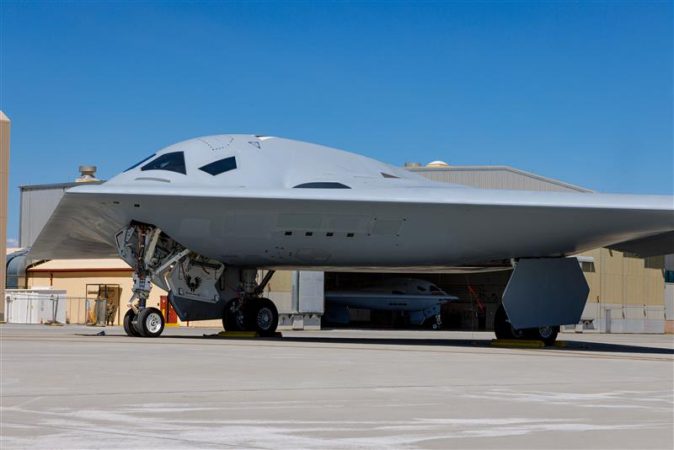
Cotton praised his team for keeping that modernization on track during his tenure. The B-21 entered flight testing in November 2023, and the Sentinel survived a review triggered by cost and schedule overruns when the Secretary of Defense validated it as essential for national security.
“Three years ago, we developed a three-phase approach to our vision and our strategy,” Cotton said. “The first year, we roadmapped our nuclear command control and communication strategy and baselined our triad sufficiency against nuclear peers. In year two, we took decisive action and codified what we found in year one. And in year three, I made the team accelerate all of that. You truly raised the bar and set a new standard of excellence.”
Now, Correll faces the task of continuing that modernization—the first B-21 is expected to be fielded within the next few years, perhaps during his tenure, and the Sentinel will likely finish a program restructuring. At the same time, the current deterrent must hold.
“At its core, this command exists as the ultimate insurance policy to ensure our adversaries say, ‘not today,’” Correll said.
