


The ship left Naval Base San Diego on Nov. 21, 2025, as part of the USS Abraham Lincoln carrier strike group. It remained at sea even after the carrier group moved on and the Lincoln returned to its home port.
As of Oct. 29, the ship has been deployed for 342 days, a time period that far exceeds the Navy’s commonly cited seven-month deployment benchmark for ships based in the United States. It also comes as the service contends with a persistent surface-ship maintenance backlog, delays at private shipyards and warnings from senior Navy leaders that extended operations could create years of additional pressure on the fleet.
For families waiting at home, the uncertainty has become its own burden.
Marie Bailey, whose husband serves aboard Spruance, told Military Times that families have repeatedly been told the ship would return soon, only to see that expectation pushed back.
“We are hearing they’re supposed to come home sometime next month, but we’ve been hearing about ‘next month’ for several months,” Bailey said.
Extended deployments are not new to the Navy, but that offers little comfort to families counting down the days until a homecoming that continues to appear just out of reach. For them, another extension is not simply a change to an operational schedule, but yet another period of uncertainty.
“We don’t know what to expect anymore, but it’s hard getting your hopes up time and time again,” Bailey added. “Most of the families are just worried about their sailors, knowing how long they’ve been gone.”
Some Spruance sailors also say they feel their experience has been overlooked compared with the sweeping national attention given to the USS Abraham Lincoln.
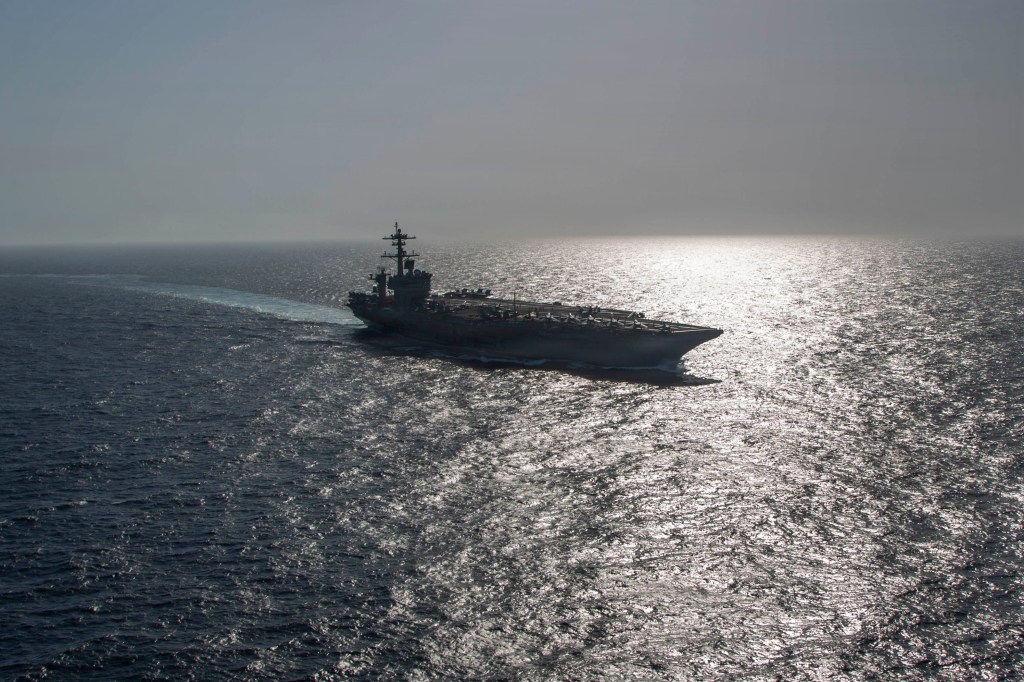
Two of those sailors, who were granted anonymity due to fear of reprisal, noted that life aboard a destroyer brings its own challenges, even when the ship receives less public attention.
“It’s tight, cramped and just as challenging on the destroyers, if not more than bigger ships,” one sailor said.
The other sailor pointed to the families waiting at home, arguing that the size of a ship should not determine how much attention its crew receives.
“Our boat isn’t as big as an aircraft carrier, but our 300+ families matter to us just as much as anyone else’s,” the sailor said.
The frustration reflects a basic reality of carrier strike groups: Destroyers may operate in the shadow of the aircraft carriers they accompany, but their crews endure the same prolonged separation from home.
For families waiting on a return date, the distinction between a carrier and a smaller warship offers little consolation.
Spruance is not the only Navy destroyer facing an unusually long deployment. The USS John Finn, USS Mustin and USS Rafael Peralta have also had expected return dates pushed from 2026 into 2027, with some planned to stretch over 14 months, according to Defense One.
The extensions illustrate the demands facing the surface fleet, although the Navy has not publicly provided a comprehensive count of destroyers that have had deployments extended.
A fleet under sustained pressure
The Navy’s Optimized Fleet Response Plan organizes a 36-month cycle for ships homeported in the United States. The Government Accountability Office describes the cycle as allocating eight months to depot-level maintenance, 10 months to training and 18 months to deployment and sustainment operations.
Extended deployments can disrupt that sequence, pushing scheduled maintenance later and compressing the time available for repairs, training and preparation before a ship is needed again.
GAO has documented longstanding maintenance challenges across the Navy’s surface fleet. Private ship repair companies took nearly 10,000 days longer than planned, cumulatively, to repair destroyers between fiscal years 2015 and 2022, according to a February 2025 GAO report. The Navy’s surface-ship maintenance backlog reached $2.3 billion in deferred work by August 2022, GAO reported.
In a May 2022 report, GAO found a nearly $1.8 billion backlog in depot-level maintenance for Navy ships, including approximately $1.7 billion for surface ships. About $1.2 billion of the backlog was associated with ships the Navy had proposed for early decommissioning. GAO found that maintenance backlogs contributed to decisions to retire nine ships.
A separate GAO analysis of 10 surface-ship classes between fiscal years 2011 and 2021 found increases in maintenance cannibalizations, casualty reports and delays in depot-level maintenance. Steaming hours declined and costs per steaming hour rose for most of the classes examined.
Chief of Naval Operations Adm. Daryl Caudle warned Oct. 26 that the effects of extended deployments could reverberate through the fleet’s maintenance schedule for years. Speaking at the United States Navy Memorial, Caudle said maintenance availabilities, particularly for destroyers, could snowball as ships return from deployments exceeding 300 days.
“You’re talking hundreds of availabilities and millions of dollars. Hundreds of millions of dollars have to be applied to that problem as we start retrograding these destroyers back into their maintenance period,” Caudle said.
“But this is a years-long recovery,” he added. “There is no workaround on that.”
Rear Adm. Kavon Hakimzadeh, commander of Norfolk Naval Shipyard, also warned of capacity constraints as destroyers return from the Middle East. Speaking at a September roundtable hosted by the Center for Maritime Strategy, Hakimzadeh said shipyards would have to manage the volume of returning ships.
“There’s some choke points just based on capacity out there for all the destroyers that are going to be coming back,” Hakimzadeh said. “We’re running the destroyers really hard out there, and I suspect they’re all going to need to go into the same dry dock, and we’re going to have to sequence them in.”
The remarks highlight a constraint beyond identifying the repairs each ship needs: Shipyards must also have the capacity and workforce to complete the work.
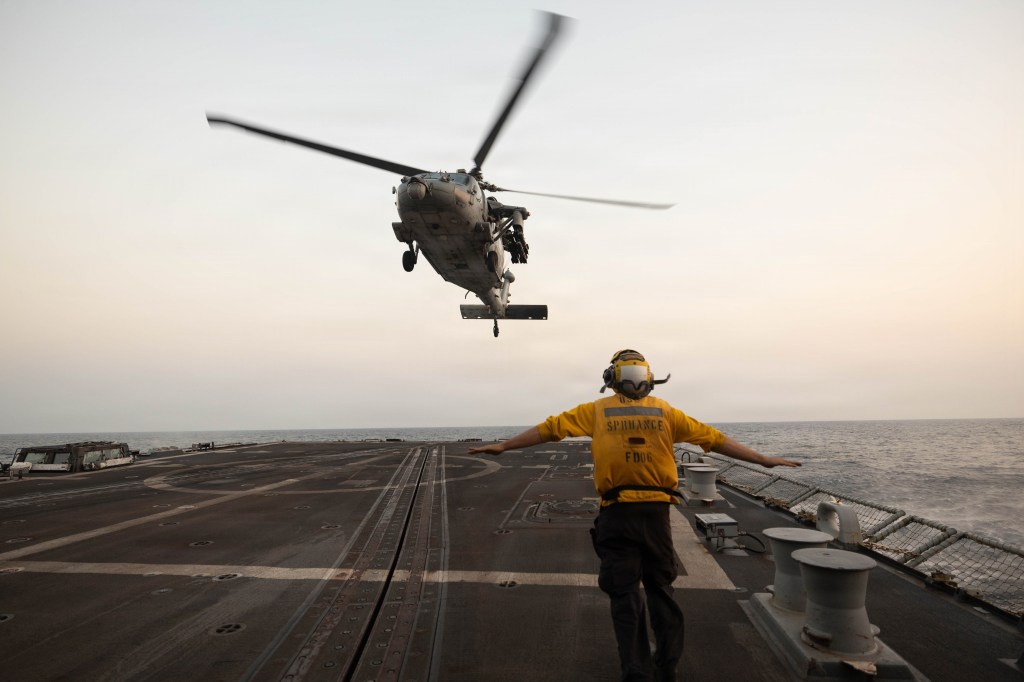
The Navy’s maintenance challenges have persisted despite billions of dollars in repair funding.
A December 2025 Congressional Budget Office analysis found that maintenance for Navy destroyers and amphibious ships takes 20% to 100% longer than the service plans for. The cumulative burden for destroyers is substantial: Roughly nine years of a ship’s planned service life is expected to be spent in maintenance, or about one year out of every four.
GAO found that the Navy received nearly $25.9 billion for combat surface-ship maintenance from fiscal years 2020 through 2023, roughly $1 billion more than it had requested. The service reported obligating 99.7% of those funds by the end of fiscal 2023.
GAO has also identified shortages of spare parts and qualified maintenance personnel, along with deferred work, among the constraints affecting maintenance schedules.
What Spruance’s schedule shows
Navy budget documents show that the planned timing of Spruance’s next maintenance period has shifted.
The Navy’s fiscal 2025 operations and maintenance budget listed a scheduled restricted availability for the destroyer from July 3, 2026, through Feb. 21, 2027. A restricted availability is a period when a ship is taken out of normal operations for maintenance and repairs.
In the fiscal 2027 budget, the planned period had shifted to Jan. 19 through April 28, 2027. Based on those dates, the scheduled start moved 200 days later, while the planned completion was bumped to 66 days later.
The availability of sailors to perform maintenance at sea is another factor in the Navy’s efforts to keep ships ready for operations.
In a September 2024 report, GAO surveyed personnel aboard 232 Navy ships about their ability to carry out maintenance while underway. The survey received a 91% response rate.
Sixty-three percent of responding executive officers said it was moderately to extremely difficult for their crews to complete repairs underway with their assigned sailors; 64% said it was similarly difficult to conduct sailor-led maintenance while also meeting classroom training requirements; and 75% reported that it was moderately to extremely difficult for sailors to complete repairs.
GAO also found that the Navy did not track how many sailors assigned to ships were unavailable for duty.
What comes next for Spruance
GAO has recommended that the Navy compare planned depot-maintenance durations with typical availabilities for ships of the same type, while accounting for factors such as age, condition and maintenance requirements.
Such comparisons, according to GAO, could help establish whether a ship’s maintenance period is unusually long.
Spruance’s post-deployment assessment and actual maintenance schedule will show what work the Navy identifies as necessary and how long the destroyer remains unavailable for operations.
Until those details are established, the effect of its record deployment on its future readiness remains uncertain.
The Navy did not respond to Navy Times’ request for comment by publication.
