

LIVE NEWS
  • Netflix AI Team Just Open-Sourced VOID: an AI Model That Erases Objects From Videos — Physics and All
  • DeBriefed 2 April 2026: Countries ‘revive’ energy-crisis measures | Record UK renewables | Plug-in solar savings
  • Car slams into Louisiana Lao New Year parade, injuring about 15 people | Health News
  • Trump health budget offers investments in MAHA, cuts to HHS, NIH
  • A single mini PC replaced my Raspberry Pi cluster and nearly cut my power use in half
  • Thousands join Paris suburb mayor to protest racism
  • App Privacy Labels Need Better Standards, Tools
  • Fed Governor Miran still backs cuts, says interest rates could be ‘about a point’ lower this year
Prime Reports
  • Home
  • Popular Now
  • Crypto
  • Cybersecurity
  • Economy
  • Geopolitics
  • Global Markets
  • Politics
  • See More
    • Artificial Intelligence
    • Climate Risks
    • Defense
    • Healthcare Innovation
    • Science
    • Technology
    • World
Prime Reports
  • Home
  • Popular Now
  • Crypto
  • Cybersecurity
  • Economy
  • Geopolitics
  • Global Markets
  • Politics
  • Artificial Intelligence
  • Climate Risks
  • Defense
  • Healthcare Innovation
  • Science
  • Technology
  • World
Home»Cybersecurity»Residential proxies evaded IP reputation checks in 78% of 4B sessions
Cybersecurity

Residential proxies evaded IP reputation checks in 78% of 4B sessions

primereportsBy primereportsApril 2, 2026No Comments3 Mins Read
Share Facebook Twitter Pinterest LinkedIn Tumblr Reddit Telegram Email
Residential proxies evaded IP reputation checks in 78% of 4B sessions
Share
Facebook Twitter LinkedIn Pinterest Email


Residential proxies evaded IP reputation checks in 78% of 4B sessions

Researchers warn that residential proxies used to route malicious traffic are a big problem for IP reputation systems, as there is no clear distinction between attackers and legitimate users.

This occurs because residential proxies are too short-lived, uninvolved, or systematically rotated, preventing defense systems from cataloging them in time.

Cybersecurity intelligence platform GreyNoise determined this after examining a massive dataset of 4 billion malicious sessions targeting the edge over a three-month period.

Roughly 39% of those sessions appear to originate from home networks, most certainly part of residential proxies, but 78% of them are invisible to reputation feeds.

“The data reveals a pattern that challenges a core assumption of network defense: that you can tell attackers from legitimate users by where the traffic comes from,” explains GreyNoise.

According to the company, most residential IPs are used once or twice, and then vanish, with attackers rotating them with others, keeping the pace at a level that reputation systems will not flag them.

About 89.7% of residential IPs are active in malicious operations for under a month, with only 8.7% lasting 2 months, and 1.6% persisting for 3 months.

Those that are kept alive for longer seem to carry a specialization according to the researchers, being SSH-focused and using Linux TCP stacks.
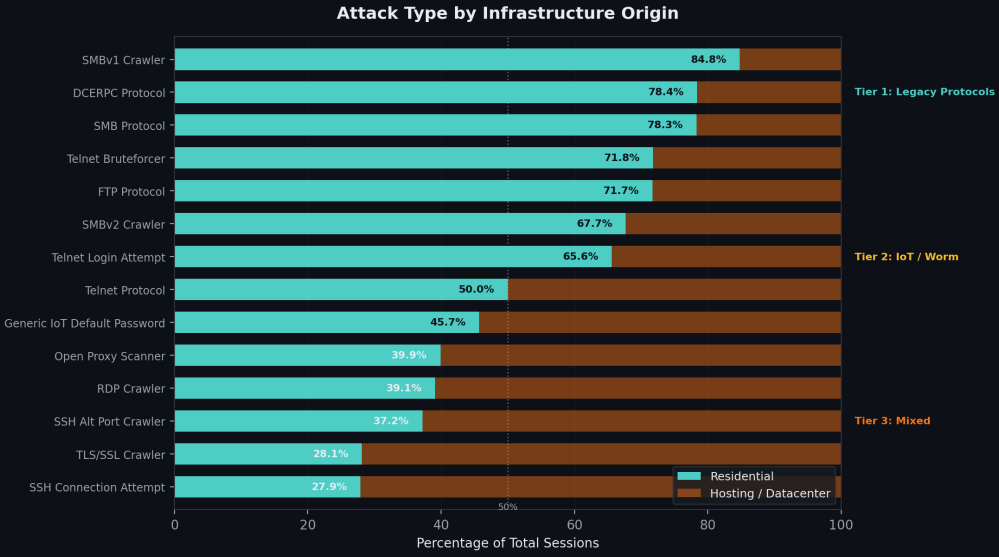
Type of activity
Type of activity per source type
Source: GreyNoise

Diversity is another factor that complicates flagging and blocking, as GreyNoise’s data shows the residential IPs participating in attacks belong to 683 internet service providers.

Another reason for their stealthiness is that they are primarily used for network scanning and reconnaissance, with only 0.1% involved in actual exploits, the researchers say.

A small percentage (1.3%) targeted enterprise VPN login pages, while some limited cases also involved residential IPs to path traversal and credential stuffing attempts.

Regarding the source of the residential proxies, GreyNoise says China, India, and Brazil are major contributors, with traffic from the IPs following human sleep patterns, dropping by a third at night, when most people power off their devices.
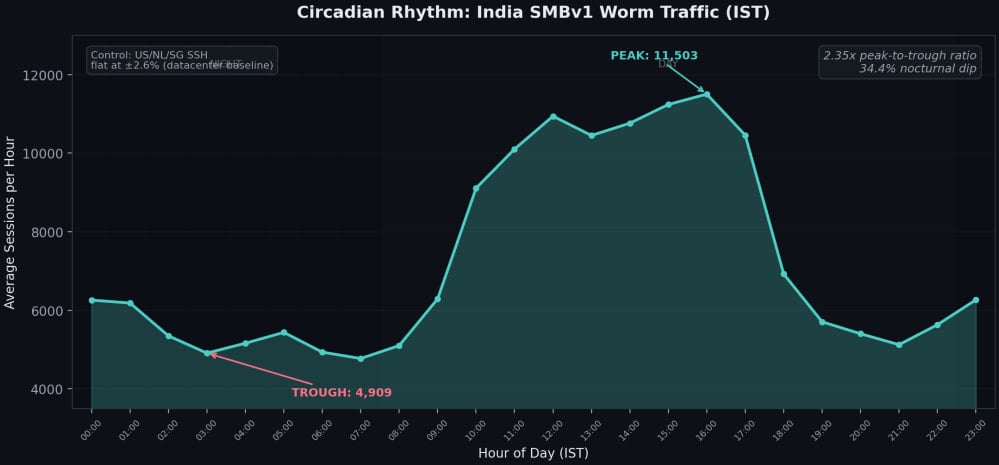
Activity from India-based proxies
Source: GreyNoise

The researchers report that residential proxy traffic is generated by two distinct, non-overlapping ecosystems: IoT botnets and infected computers.

In cases involving the latter, the proxies come from SDKs in free VPNs, ad blockers, and similar apps, which enroll user devices in bandwidth-selling schemes.

GreyNoise has also highlighted the resilience of these networks using the example of IPIDEA, one of the world’s largest residential proxy networks, which was recently disrupted by Google Threat Intelligence Group (GTIG) and partners.

The disruption reduced its proxy pool by roughly 40%, but in the period that followed, datacenter traffic increased, indicating that demand can be absorbed by others when needed and that lost capacity is quickly replaced.
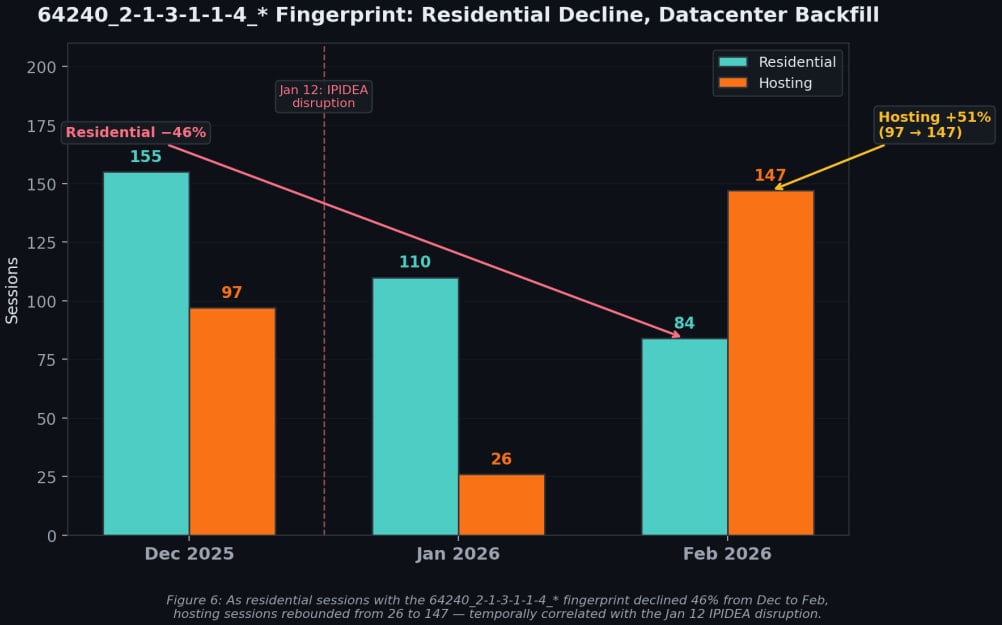
Effect of IPIDEA disruption and ecosystem's response
Effect of IPIDEA disruption and the ecosystem response
Source: GreyNoise

GreyNoise says residential proxying evasion tactics require abandoning IP reputation as a primary signal and focusing instead on behavior.

The researchers suggest detecting sequential probing from rotating residential IPs, blocking clearly illegitimate protocols like SMB from ISP space, and tracking device fingerprints that survive IP rotation.


tines

Automated pentesting proves the path exists. BAS proves whether your controls stop it. Most teams run one without the other.

This whitepaper maps six validation surfaces, shows where coverage ends, and provides practitioners with three diagnostic questions for any tool evaluation.

Share. Facebook Twitter Pinterest LinkedIn Tumblr Email
Previous ArticleWhat Oracle Offered in Severance to Laid-Off US Employees
Next Article Bitcoin Down While Oil Climbs After Trump Signals Continued Iran Strikes
primereports
  • Website

Related Posts

Cybersecurity

App Privacy Labels Need Better Standards, Tools

April 4, 2026
Cybersecurity

China-Linked TA416 Targets European Governments with PlugX and OAuth-Based Phishing

April 4, 2026
Cybersecurity

European Commission Confirms Data Breach Linked to Trivy Supply Chain Attack

April 4, 2026
Add A Comment
Leave A Reply Cancel Reply

Top Posts

Global Resources Outlook 2024 | UNEP

December 6, 20258 Views

The D Brief: DHS shutdown likely; US troops leave al-Tanf; CNO’s plea to industry; Crowded robot-boat market; And a bit more.

February 14, 20264 Views

German Chancellor Merz faces difficult mission to Israel – DW – 12/06/2025

December 6, 20254 Views
Stay In Touch
  • Facebook
  • YouTube
  • TikTok
  • WhatsApp
  • Twitter
  • Instagram
Latest Reviews

Subscribe to Updates

Get the latest tech news from FooBar about tech, design and biz.

PrimeReports.org
Independent global news, analysis & insights.

PrimeReports.org brings you in-depth coverage of geopolitics, markets, technology and risk – with context that helps you understand what really matters.

Editorially independent · Opinions are those of the authors and not investment advice.
Facebook X (Twitter) LinkedIn YouTube
Key Sections
  • World
  • Geopolitics
  • Popular Now
  • Artificial Intelligence
  • Cybersecurity
  • Crypto
All Categories
  • Artificial Intelligence
  • Climate Risks
  • Crypto
  • Cybersecurity
  • Defense
  • Economy
  • Geopolitics
  • Global Markets
  • Healthcare Innovation
  • Politics
  • Popular Now
  • Science
  • Technology
  • World
  • About Us
  • Contact Us
  • Privacy Policy
  • Terms & Conditions
  • Disclaimer
  • Cookie Policy
  • DMCA / Copyright Notice
  • Editorial Policy

Sign up for Prime Reports Briefing – essential stories and analysis in your inbox.

By subscribing you agree to our Privacy Policy. You can opt out anytime.
Latest Stories
  • Netflix AI Team Just Open-Sourced VOID: an AI Model That Erases Objects From Videos — Physics and All
  • DeBriefed 2 April 2026: Countries ‘revive’ energy-crisis measures | Record UK renewables | Plug-in solar savings
  • Car slams into Louisiana Lao New Year parade, injuring about 15 people | Health News
© 2026 PrimeReports.org. All rights reserved.
Privacy Terms Contact

Type above and press Enter to search. Press Esc to cancel.