

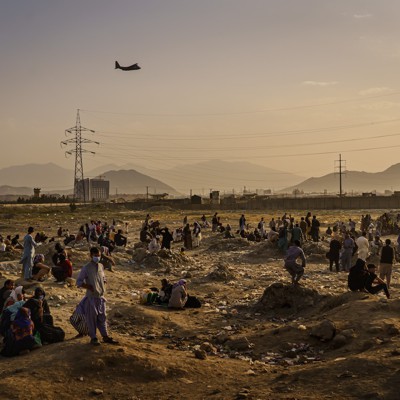
More than $148 billion was spent by the U.S. government in its failed attempt to build a free Afghanistan, according to the final report by the official watchdog office, whose careful documentation of waste and fraud, and its warnings of Taliban resurgence, went largely unheeded.
For 17 years, the Special Inspector General for Afghanistan Reconstruction, or SIGAR, tracked every dollar allocated to the country for security, development, and humanitarian aid. As early as 2012, the office saw signs that the U.S. government and military’s efforts were falling short.
“A lot of people knew this wasn’t working. This war wasn’t working. In our quarterly reports we would report on ‘the number of districts falling to the Taliban is increasing’,” Gene Aloise, SIGAR’s acting inspector general, told reporters at a Defense Writers Group roundtable on Wednesday. “Our quarterly reports laid out what was happening, and you could predict the future based on what we were saying.”
Aloise spoke as SIGAR released its final report, a 125-page “forensic audit” that condenses its thousands of pages of analysis and documentation of the Afghanistan-reconstruction effort, which consumed more money than was sent to Europe under the post-World War II Marshall Plan. Per the 2025 defense authorization act, the office will close Jan. 31.
“The mission promised to bring stability and democracy to Afghanistan, yet ultimately delivered neither,” the report said. “The outcome in Afghanistan should serve as a cautionary tale for policymakers contemplating similar reconstruction efforts in the future.”
“If there is one overarching lesson to be learned from a tragedy that unfolded over 20 years, it is that any U.S. mission similar in context, scale, and ambition must confront the real possibility of failure,” it said.
Aloise said the group’s independent nature and fierce pursuit of information should also inform future watchdogs—but he fears they won’t.
Scrapped aircraft, vacant hotels, and corrupt contracts
Since SIGAR began its investigations in 2008, the watchdog has determined that $26 billion to $29 billion allocated to Afghanistan reconstruction efforts disappeared to waste, fraud, and abuse.
The U.S. government’s counternarcotics missions in Afghanistan accounted for a large chunk of wasted funds. A June 2018 SIGAR report identified that despite spending $7.3 billion on counter-drug efforts, the country was still “the world’s largest opium supplier.” and rampant corruption in the nation’s narcotics industry “made U.S. efforts to stabilize the country challenging, if not impossible.”
In 2015, SIGAR found that a $355 million USAID power plant was operating at “less than one percent of its capacity.” The next year, it found that $85 million in loans meant to build a hotel and apartments across from the U.S. Embassy in Kabul had not been repaid and had produced only “abandoned empty shells.” In 2018, it found that $486 million for 20 G-222 aircraft for the Afghan air force, purchased for $486 million, fell short of operational requirements. Some were collecting dust; others had been scrapped for “six cents per pound.”
Poor quality work by contractors also led to U.S. service member deaths, SIGAR reported. In 2012, two soldiers were killed after an improvised explosive device hidden in a culvert on a frequently used highway route detonated. An Afghan-owned construction company tasked with installing grates over the culverts did not follow contact specifications, which made them “easy to breach,” SIGAR found, adding “the company’s deceit and shoddy work made it possible for insurgents to bypass the grates and plant explosives that killed the two soldiers.”
Through investigations of criminal activity, SIGAR agents helped convict 171 U.S. and Afghan defendants, which resulted in nearly $1.7 billion in fines, restitutions, asset forfeitures, settlements and savings, the report detailed.
Aloise told reporters that the rampant corruption was perhaps the largest factor that undermined the U.S. government’s efforts in Afghanistan.
“The biggest thing throughout the whole 20 years was corruption. Corruption affected everything,” Aloise said. “It turned the population against the government that we were trying to build over there. It weakened the armed forces, it weakened everything we tried to do.”
A farewell to arms and lessons learned
Catherine Lutz, the co-founder of Brown University’s Costs of War project, said SIGAR’s on-the-ground investigations provided insight into areas of Afghanistan that were inaccessible to members of the public.
One of the major revelations from SIGAR, Lutz said, was the overwhelming number of reconstruction funds being spent on security.
“It’s not great that not enough attention has been paid by the general public to what was learned there,” Lutz said. “My main concern is that the whole project of reconstruction was misunderstood by the public as basically humanitarian.”
About 60 percent of the $148 billion went to security initiatives, SIGAR’s report said. Some of that went to buy arms and materiel for the Afghanistan National Defense and Security Forces, included 96,000 ground vehicles, 51,180 general or light tactical vehicles, 23,825 humvees, nearly 900 armored combat vehicles, 427,300 weapons, 17,400 helmet-worn night vision devices, and at least 162 aircraft.
When the United States evacuated in August 2021, it left behind roughly $7.1 billion in equipment it had given the ANDSF, the Defense Department concluded. All of it fell into the hands of the Taliban.
“As noted above, due to the Taliban takeover, SIGAR was unable to inspect any of the equipment provided to, or facilities constructed for, the ANDSF following the Afghan government’s collapse,” the report read. “These U.S. taxpayer-funded equipment, weapons, and facilities have formed the core of the Taliban security apparatus.”
SIGAR interviewed numerous senior U.S. officials to glean lessons from the two decades of involvement in Afghanistan. Several officials pointed to the 2020 Doha Agreement—the peace deal negotiated by the Taliban and the first Trump administration—saying it “ultimately sealed Afghanistan’s fate by undermining the Afghan government’s legitimacy and emboldening the Taliban,” the report read.
Similar to SIGAR’s quarterly reports, former U.S. officials pointed to likely failures a decade ahead of the withdrawal.
“My sense was that by 2012, very few people thought the insurgency could be defeated and that we could leave the Afghan government fully in control of things,” Carter Malkasian, a former special assistant to the chairman of the Joint Chiefs of Staff, told SIGAR in December 2021.
In May, Defense Secretary Pete Hegseth ordered a review of the U.S. military’s withdrawal from Afghanistan. Aloise told reporters that SIGAR had not been asked to support that probe.
Aloise said future efforts to create a watchdog for conflicts should look to SIGAR’s independent authority as an example, but he remains doubtful it would be recreated.
“Use SIGAR’s authorizing legislation as a model, because we were totally independent. We were not under another agency or department,” Aloise said. “We were not shy about saying anything. We reported everything that we found. We weren’t watered down, we weren’t toned down. You can use SIGAR’s authorizing legislation as the basis for creating it. I don’t know if you’ll ever see that again.”
