


Democrats are poised to achieve trifectas—control of the governor’s office and both legislative chambers—in at least three states in this year’s midterm elections, and maybe even more.
This matters because states play an outsize role in climate and energy policy. And when Democrats control state government, they often take substantial action.
This isn’t a partisan statement. It reflects recent history in Illinois, Maine, Michigan, Minnesota, New York, New Mexico and Virginia, which passed climate and energy legislation after Democrats gained control. The states now have laws designed to cut carbon emissions and increase the use of renewable energy.
Each state has its own story, and I spoke this week with people monitoring the races.
Headed into the election, Republicans have trifectas in 23 states, Democrats have them in 16 states and 11 states are split. Democrats have momentum, entering election season with a Republican president whose approval ratings are low and Democrats have polling advantages on major issues, including concerns about consumer prices and access to healthcare.
One leading factor is “grassroots anger” about many topics, said Bill Kramer, vice president and counsel at MultiState, a lobbying firm that tracks state issues and elections.
The anger is “not particularly partisan,” he said. “But if you’re the incumbent party, that’s who [gets blamed], and right now Republicans control a lot more of the states than the Democrats do.”
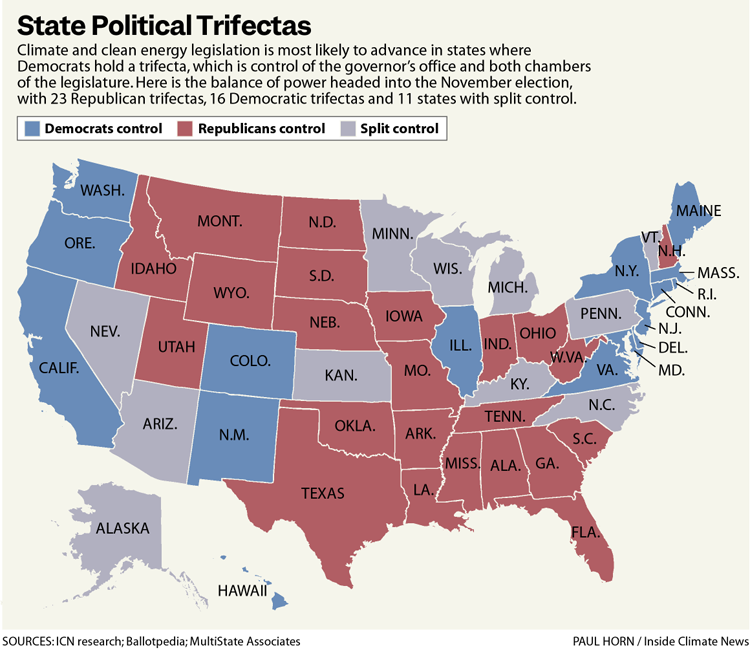
This landscape creates opportunities to advance climate and clean energy policy, said Caroline Spears, executive director of Climate Cabinet, an advocacy group that focuses on state-level issues and elections.
State trifectas “are the most powerful tool for 2027 policy outcomes on clean energy,” she said.
The outcome depends on the results of just a few races, Spears said. Fewer than 25 races out of more than 7,000 legislative seats could determine whether Democrats gain five new trifectas, or none at all, she said.
Here are those five states, plus some others to watch.
The First Three: Michigan, Minnesota and Wisconsin
Michigan, Minnesota and Wisconsin are the most likely to shift from split control to Democratic trifectas. Since they’re in close proximity on the map, let’s call them the Northern Three.
To regain a trifecta in Michigan after two years of split control, Democrats need to add four seats in the House, maintain a majority in the Senate and win the governor’s race. Secretary of State Jocelyn Benson, a Democrat, is polling ahead of U.S. Rep. John James, a Republican, in the contest for governor. Democratic Gov. Gretchen Whitmer cannot seek another term because of the state’s term limits.
In Minnesota, Democrats control the governor’s office and Senate and are in a 67-67 tie in the House. U.S. Sen. Amy Klobuchar, a Democrat, is likely to prevail in the race for governor against House Speaker Lisa Demuth, a Republican. The winner will replace Gov. Tim Walz, a Democrat, who decided not to seek re-election. The party had a trifecta until losing it when the 2024 elections led to a tie in the House.
This story is funded by readers like you.
Our nonprofit newsroom provides award-winning climate coverage free of charge and advertising. We rely on donations from readers like you to keep going. Please donate now to support our work.
Wisconsin has new legislative maps following a state Supreme Court ruling that found the previous maps improperly favored Republicans. The new districts give Democrats a decent chance of gaining majorities in the House and Senate, where Republicans now hold majorities of 54-45 and 18-15, respectively. Democrat David Crowley holds a narrow polling lead in the governor’s race over Republican U.S. Rep. Tom Tiffany. Incumbent Gov. Tony Evers, a Democrat, chose not to run.
Of the three states, Wisconsin has the most potential for rapid progress on climate and clean energy. The state hasn’t had a Democratic trifecta since 2010 under Gov. Jim Doyle and there is pent-up enthusiasm to take action. Wisconsin has plentiful wind power but has underachieved relative to its neighboring states in passing legislation that would encourage utility-scale and customer-owned renewable energy and battery energy storage.
The Next Two: Arizona and Pennsylvania
In basketball terms, Democrats picking up trifectas in Michigan, Minnesota and Wisconsin would be like making free throws. Doing the same in Arizona and Pennsylvania would be like making three-pointers.
For years, Arizona and Pennsylvania have been just out of reach for Democrats. The party has elected governors, but didn’t get full control of the legislature, which has constrained them.
Arizona Gov. Katie Hobbs, a Democrat, is running for re-election and leads in polls over Republican U.S. Rep. Andy Biggs. Republicans hold majorities of 33-27 and 17-13 in the House and Senate, respectively. An outside observer may look at those narrow majorities and national fundamentals and think it’s easy to flip both chambers in Arizona, but people who follow the state say the path ahead for Democrats, especially in the Senate, is far from smooth.
“I feel like every year the Democrats are saying they’re going to try to flip that Legislature, and they just never do,” Kramer said about Arizona.
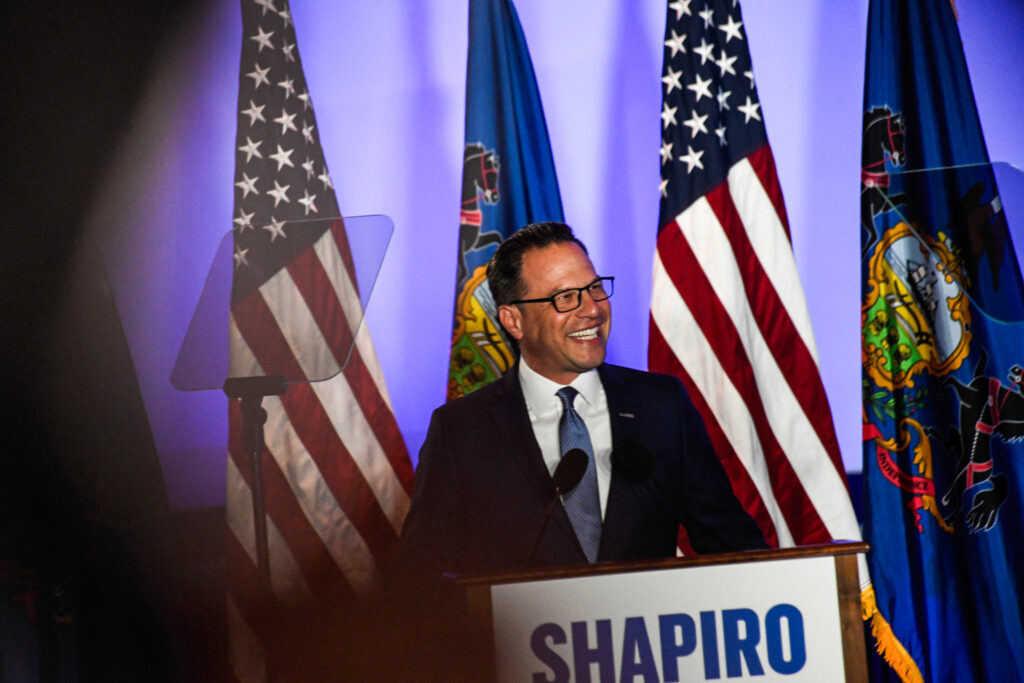
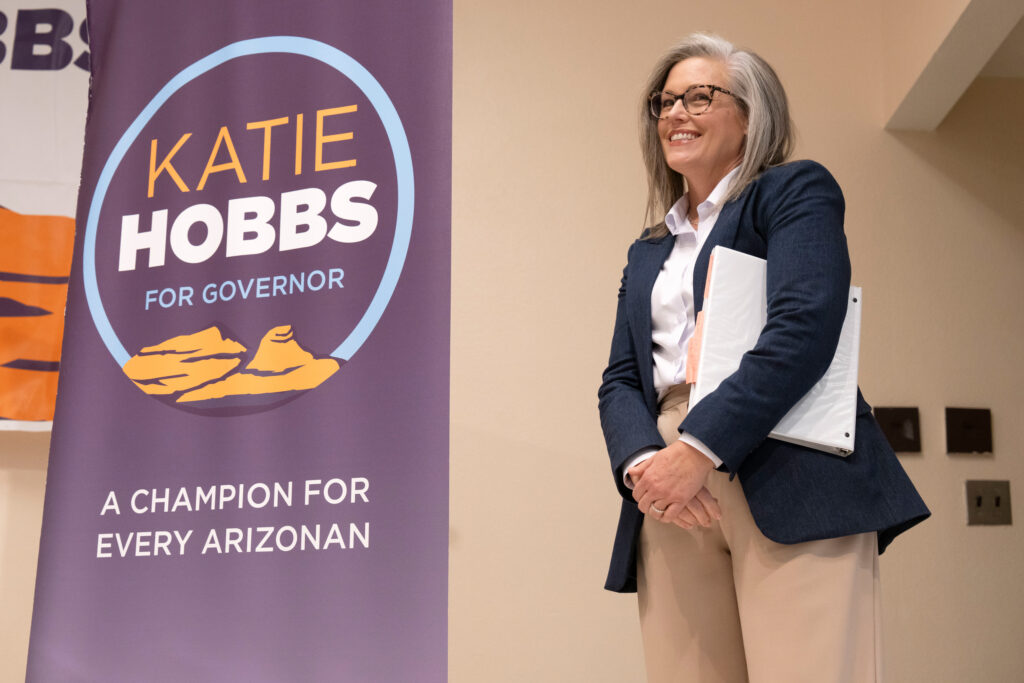
Pennsylvania Gov. Josh Shapiro (left) and Arizona Gov. Katie Hobbs are both Democrats for re-election this year. Credits: Matthew Hatcher and Rebecca Noble/Getty Images
In Pennsylvania, Gov. Josh Shapiro, a Democrat, is running for re-election and likely to win. His Republican opponent is Stacy Garrity, the state treasurer. Democrats hold a 103-100 majority in the House and Republicans have a 27-23 majority in the Senate. Like Arizona, the path to a trifecta in Pennsylvania looks simple, but Republicans have a strong position in Senate district races and are fighting to regain their majority in the House.
“Those final couple of seats are really hard to flip,” Kramer said of Democrats’ chances in the Pennsylvania Senate.
That said, plenty of people said the same thing about the Pennsylvania House before Democrats won a narrow majority in 2022 and then held onto it. The main difference is that Republicans have run the Senate since the 1994 election, which is a much longer run than the 12 years of House Republican control that preceded the shift in 2022.
If Election Day turns out to be a rout for Democrats across the country, then it’s plausible that Arizona and Pennsylvania would be part of the national trend, giving the party hard-fought trifectas in each state.
The policy opportunities are substantial.
Arizona is rich in solar power, and clean energy advocates have long lamented that the state has underachieved when it comes to harnessing the economic and environmental opportunity of this resource.
Pennsylvania is a leading natural gas producer and has a powerful fossil fuel lobby. The state has low levels of renewable energy development. Even modest changes to state policy could open the door to more diverse power sources, with new solar and battery projects.
A Category of Its Own: Nevada
This one comes down to the race for governor, with Gov. Joe Lombardo, a Republican, running for re-election against Attorney General Aaron Ford, a Democrat. Democrats have majorities in the House and Senate.
The only reason I didn’t put Nevada in the same category as Arizona and Pennsylvania is that Lombardo has the advantage of incumbency and has been ahead, or within the margin of error, in polls. The state has a history of surprising results, including Lombardo’s 2022 win over incumbent Democrat Steve Sisolak.
Neither Kramer nor Spears had a strong sense of which way the governor’s race is tilting.
The states that fall short of being trifecta opportunities for Democrats include Georgia, New Hampshire, North Carolina and Texas. If the party has a win for the ages, and Republicans suffer an apocalyptic defeat, then there’s a chance in one or more of those states, but the probability is low.
Republicans’ Best Opportunity: Kansas
Kansas is the one state where Republicans are likely to win a new trifecta. In the governor’s race, state Senate President Ty Masterson, a Republican, is leading in polls over state Sen. Cindy Holscher, a Democrat. Gov. Laura Kelly, a Democrat, cannot run because of term limits.
Kansas has a robust clean energy economy, with ample wind energy generation, but the state has shown little interest in passing laws to reduce emissions and support renewable energy.
Republicans also hope to attain trifectas in many of the same states that are in Democrats’ sights. If Republicans have a better-than-expected election nationwide, Arizona, Michigan and Wisconsin could become new trifectas for the party.
But at this point in the election season, the big picture is that Democrats are poised to gain ground. The main question is simply how much.
Other stories about the energy transition to take note of this week:
Trump Doubles Down on Climate Denial With Repeal of Power Plant Rules: In a move long expected, the Trump administration announced the final plan to repeal most of a Biden-era rule designed to reduce emissions from power plants, as my colleague Liza Gross reports for ICN. This is the latest in a series of actions that reduce the federal government’s authority and effort related to the causes of climate change. Since power plant owners knew this was coming, there is likely to be little effect in the short term.
Gavin Newsom Has Complicated Legacy on Climate and Energy: California Gov. Gavin Newsom, a Democrat, has disappointed some environmental and clean energy advocates, despite notable accomplishments, as Jeff St. John reports for Canary Media. As Newsom nears the end of his eight-year tenure, a review of his record shows some bold moves, such as a commitment to phase out gasoline-powered cars by 2035, and also a tendency to accommodate fossil fuel interests on a variety of issues.
Court Rules Against Trump Order to Keep Costly Michigan Coal Plant Running: A federal appeals court panel has said the Trump administration is misusing its emergency powers by forcing a Michigan coal-fired power plant to remain open, as I report for ICN along with colleagues Keerti Gopal and Marianne Lavelle. The order covers the J.H. Campbell Generating Station in Michigan and is the first of several cases challenging the coal plant orders. I wrote in April about legal issues with the coal orders and the idea that blocking coal plants from closing impedes building new resources.
CATL Has a New Battery for Heavy Trucks: CATL, the Chinese company that is the world’s leading battery manufacturer, has given the public a first look at Tectrans II, a battery system designed for medium- and heavy-duty trucks, as Rob Stumpf reports for InsideEVs. The modular battery system has a range of up to 620 miles in its largest configuration and it would be able to recharge to 80 percent in about 20 minutes using a heavy-duty charger. The battery will help accelerate the trucking industry’s shift to electric motors, which have already gained a foothold in China but make up less than 1 percent of the market in the United States.
Inside Clean Energy is ICN’s weekly bulletin of news and analysis about the energy transition. Send news tips and questions to [email protected].
About This Story
Perhaps you noticed: This story, like all the news we publish, is free to read. That’s because Inside Climate News is a 501c3 nonprofit organization. We do not charge a subscription fee, lock our news behind a paywall, or clutter our website with ads. We make our news on climate and the environment freely available to you and anyone who wants it.
That’s not all. We also share our news for free with scores of other media organizations around the country. Many of them can’t afford to do environmental journalism of their own. We’ve built bureaus from coast to coast to report local stories, collaborate with local newsrooms and co-publish articles so that this vital work is shared as widely as possible.
Two of us launched ICN in 2007. Six years later we earned a Pulitzer Prize for National Reporting, and now we run the oldest and largest dedicated climate newsroom in the nation. We tell the story in all its complexity. We hold polluters accountable. We expose environmental injustice. We debunk misinformation. We scrutinize solutions and inspire action.
Donations from readers like you fund every aspect of what we do. If you don’t already, will you support our ongoing work, our reporting on the biggest crisis facing our planet, and help us reach even more readers in more places?
Please take a moment to make a tax-deductible donation. Every one of them makes a difference.
Thank you,

Reporter, Clean Energy
Dan Gearino covers the business and policy of renewable energy and utilities, often with an emphasis on the midwestern United States. He is the main author of ICN’s Inside Clean Energy newsletter. He came to ICN in 2018 after a nine-year tenure at The Columbus Dispatch, where he covered the business of energy. Before that, he covered politics and business in Iowa and in New Hampshire. He grew up in Warren County, Iowa, just south of Des Moines, and lives in Columbus, Ohio.
