


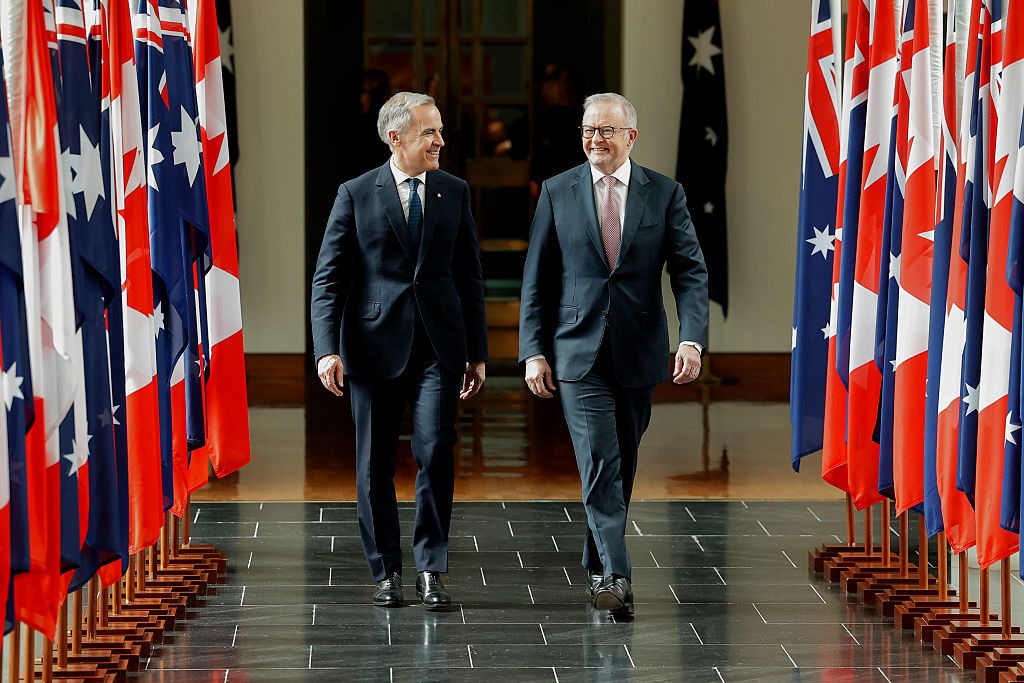
At Davos this year, Canadian Prime Minister Mark Carney said ‘middle powers must act together because if you are not at the table, you are on the menu.’
Nowhere is the case stronger than in AI. Access to frontier AI – the most advanced AI systems – is a prerequisite for prosperity, and with no frontier model of its own, Australia is structurally dependent on the United States. But this dependence need not be passive.
Instead of accepting whatever access arrangements the market and alliance deliver by default, Australia needs to move to deliberate managed dependence within the US orbit. This means investment in strategic assets to ensure a significant enough stake across enough layers of the AI supply chain to negotiate ongoing, secure access to frontier AI.
However, neither Australia nor any other middle power can alone occupy enough of the supply chain to hold a sufficiently strong negotiating hand. Australia therefore needs to do more to coordinate with like-minded partners, to form a coalition that pools complementary and scalable assets across the AI supply chain, building shared leverage to secure frontier AI access.
The good news is that middle powers already hold, or have the capacity to hold, real assets across the AI supply chain.
At the base of the chain, in the raw inputs AI hardware needs, Australia and Canada have important deposits of critical minerals outside China’s control.
Further up the supply chain, in chipmaking, the Netherlands’ ASML is the world’s only supplier of extreme ultraviolet lithography machines (needed to make the world’s most advanced chips), with Germany’s Zeiss the sole supplier of their optics and Trumpf providing their lasers. Japanese firms make half the world’s silicon wafers and the specialised chemicals used to print circuits onto them. South Korea’s Samsung and SK Hynix make about two-thirds of the world’s memory chips and more than 80 percent of the high-bandwidth memory. And British semiconductor company Arm, which is majority-owned by Japan’s SoftBank, designs the blueprints for the supporting processors that work alongside Nvidia’s most powerful AI chips.
As for computing power, Australia’s vast land, abundant renewable energy and record of hosting trusted infrastructure such as Pine Gap give it the potential to host data centres big enough to train frontier AI models. Canada and European countries could also host a significant share of the world’s AI data centres.
On assurance, Britain’s AI Security Institute is a global leader in pre-deployment evaluations of frontier models, bolstered by comparable institutes across several other partners. Middle powers could also build up independent third-party evaluators, diversifying testing capacity beyond the handful of US organisations that dominate the field.
The task for Australia now is to realise the potential of its national assets, and to coordinate a trusted group of like-minded countries to build coalition leverage. This bolsters the resilience of the US-led AI project while spreading ownership of the frontier AI supply chain across more players, so that dependence is less concentrated and allies hold a greater collective stake in the technology.
In practice, such a coalition would primarily be a coordination mechanism, rather than a formal alliance. Coordination would centre on the terms that partners negotiated with the US, including establishing a common baseline for compute-for-access deals – that is, deals where middle powers condition fast-tracked data-centre approvals on model access terms. A common baseline would ensure no partner settled for less than access on par with US customers, rather than each negotiating alone and undercutting others on access conditions to compete for investment. Partners could also align positions in negotiating wider agreements with the US, such as the series of US bilateral Technology Prosperity Deals, which set terms for technology cooperation with priority US allies.
The coalition would also maintain a shared assessment of the supply chain positions that partners already held – where they were vulnerable and where joint or individual investment would complement or scale the group’s collective share of the AI supply chain.
The obvious objection is how Washington would read such a coalition. President Donald Trump called a proposal this month for Canadian associate membership of the EU a ‘hostile act’. He threatened tariffs if he judged it to be directed against the US. Any AI coalition Australia joined could draw similar suspicion, so its purpose must be unmistakable from the outset.
This means making clear that the coalition’s goal would be managed dependence under the US umbrella – sharing the burden of building the allied supply chain, reducing vulnerabilities in it, and securing allies’ ongoing access to the technology that their own assets help produce. Australia’s alignment with the US is already settled, and that alignment, far from costing sovereignty, is what gives Australia’s assets their value.
