

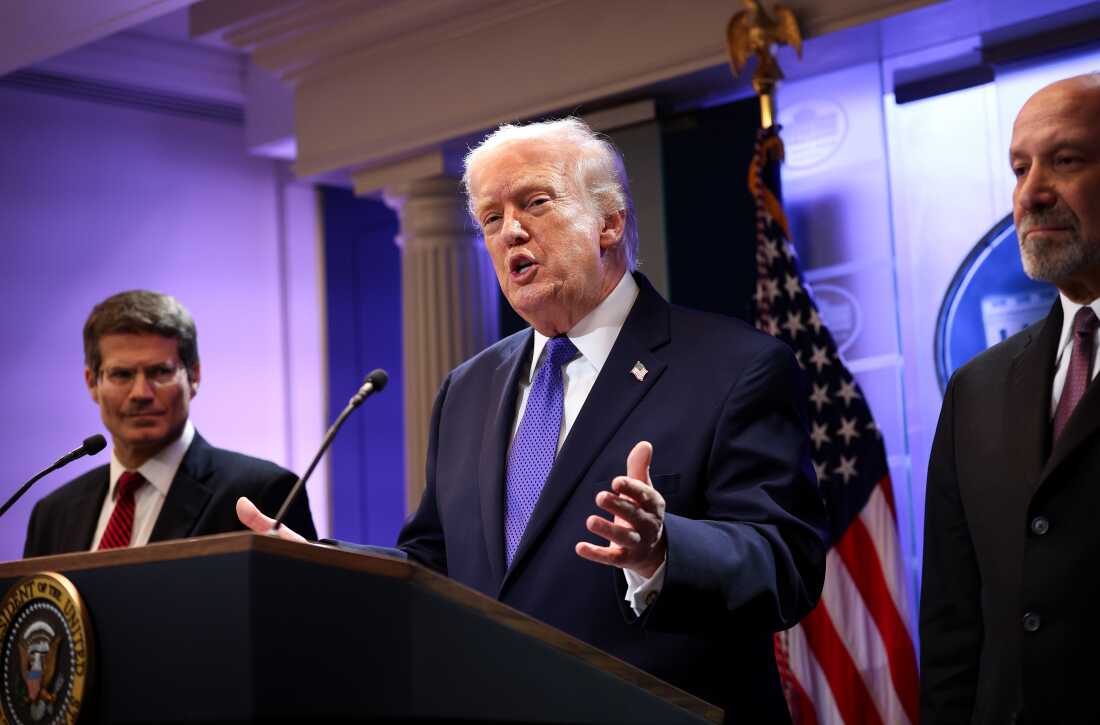

President Trump excoriated the Supreme Court majority that struck down his use of emergency powers to implement international trade tariffs.
Kevin Dietsch/Getty Images
hide caption
toggle caption
Kevin Dietsch/Getty Images
At this time last year, President Trump warmly shook hands with Chief Justice John Roberts at the State of the Union address, thanking him for the opinion he authored granting Trump and other presidents in the future expansive immunity from prosecution for their official acts after leaving office. But on Friday, after the Supreme Court invalidated Trump’s tariffs, the president was singing a decidedly different tune.

At a hastily called press conference, an agitated Trump railed against the conservative Roberts and two of the courts other conservatives, Justices Neil Gorsuch and Amy Coney Barrett, both Trump appointees.
“They’re just being fools and lapdogs for the RINOs and the radical left Democrats,” Trump said, using the apparently derisive acronym for “Republicans in name only.”
And that was hardly all. Trump called the three conservatives “disloyal, unpatriotic,” and at one point he launched into a rant about how the court should have invalidated the election results in 2020, which Trump lost to Joe Biden.
The origin of legal battle
The battle over the tariffs began on day one of Trump’s second term when he signed an executive order that allowed him to impose a wide range of tariffs on virtually every U.S. trading partner, with the tariffs being paid for mostly by U.S. businesses.
On Friday, however, Trump suffered a massive defeat at the Supreme Court. Writing for a hefty 6-to-3 majority, Chief Justice Roberts said that the nation’s founders deliberately and explicitly placed the power to impose taxes, including tariffs, with Congress, not with the president.
As the Chief Justice put it, “Having just fought a revolution motivated in large part by taxes imposed on them” by the King of England without their consent, the Framers wrote a Constitution that gives Congress the taxing power because the members of the legislature would be more accountable to the people.
Nonetheless Trump asserted at his press conference that he will go ahead with his tariffs, using alternative statutes that allow him to act without the consent of Congress.
There are, in fact, several statutes that allow him to impose some tariffs on his own, but they are limited. For example, one of the key statutes he cited Friday does allow him to impose certain tariffs on his own, but only for six months, and after that he must get approval from Congress. The other statutes he cited have other provisions that make it far more difficult to act unilaterally.
The other problem that Trump faces is that the billions of dollars already collected in tariffs were supposed to offset the tax cuts that the Republican-dominated Congress adopted last year at Trump’s behest. Now, however, the money isn’t there.
Just how much money is at stake? Lots.
The federal government has been collecting about $30 billion a month in tariffs, about half of which will be eliminated by Friday’s court ruling. So it’s a big deal for U.S. businesses that have been paying the lion’s share of these tariffs. That said, tariffs are still a fairly small slice of overall government revenues; about 5%. So if half that tariff money goes away, that will mean a larger, but not crippling federal deficit.
In contrast to the stock market’s plunge when the tariffs were first put in place, the market reaction on Friday was fairly stable. That could be because investors believe the White House will try to make good on that threat to replace the outlawed tariffs with other taxes, using different statutes where the president’s claims his authority is more clear. Even those statutes, however, have more strings attached. None give Trump the power he claimed to have to impose unlimited tariffs on goods from any country for any reason.
The court’s decision came on a day in which the government released new figures on economic growth. They show the economy weathered Trump’s tariff campaign in relatively good shape last year. In 2025 the gross domestic product grew 2.2% — a little bit slower than the year before — but perfectly respectable. Yet, even with all the tariffs Trump piled on, imports did not go down last year.
Will there be refunds?
Unresolved by the Supreme Court’s decision was the question of whether U.S. businesses that paid the tariffs for the last year can get their money back. Chief Justice Roberts did not address how refunds might work, so a lower court will have to figure that out.
Justice Brett Kavanaugh, in his dissent, warned that it could be a mess, echoing comments that came up during oral arguments. But veteran trade lawyer Robert Leo says that while refunding all those tens of billions of dollars will take some work, it’s very doable.
“It won’t be a mess,” he says, noting that “customs has all this information electronically. And I’ve talked with our clients and they know how much they’ve paid.”
Indeed, the National Retail Federation put out a statement Friday urging the lower court to ensure what it called “a seamless process” to refund the money that was wrongly collected from importers.
How the justices decided
Just what does Friday’s Supreme Court decision tell us about the very conservative Supreme Court?
First, the decision illustrates how vigilant this court is about what it views as picking peoples’ pockets; in other words, it’s a money case. And the majority opinion is what might be called “a John Roberts special.”
He wrote a concise decision, accommodated the justices in the majority as much as necessary to hold on to their votes, and got the job done, in relatively short order, for a Supreme Court decision, that is.
The decision clearly tells the president to stay in his constitutional lane, but at the same time Roberts’ opinion only decides what has to be decided, and gives the lower courts clear guidance on how to limit any Trumpian efforts to circumvent the opinion.
The decision did evenly split the conservative majority. Roberts’ opinion was joined by two of the courts other conservatives, Trump appointees Gorsuch and Barrett, plus the three liberal justices, Sonia Sotomayor, Elena Kagan and Ketanji Brown Jackson.
At the same time, the decision is evidence of a court that is not particularly collegial and deeply fractured, not so much about who wins and loses, but how they win or lose.
On Friday, for instance, Roberts wrote a 21-page opinion, but there were four concurring opinions, one, by Justice Gorsuch, totaling 46 pages. As for the dissent, Justice Kavanaugh wrote a 63 pager, and Justice Clarence Thomas wrote an 18 pager. The only justices who did not write anything at all were Justices Sotomayor, in the majority, and Justice Samuel Alito, in dissent.
In other words, almost everybody wants to have his or her say.
