


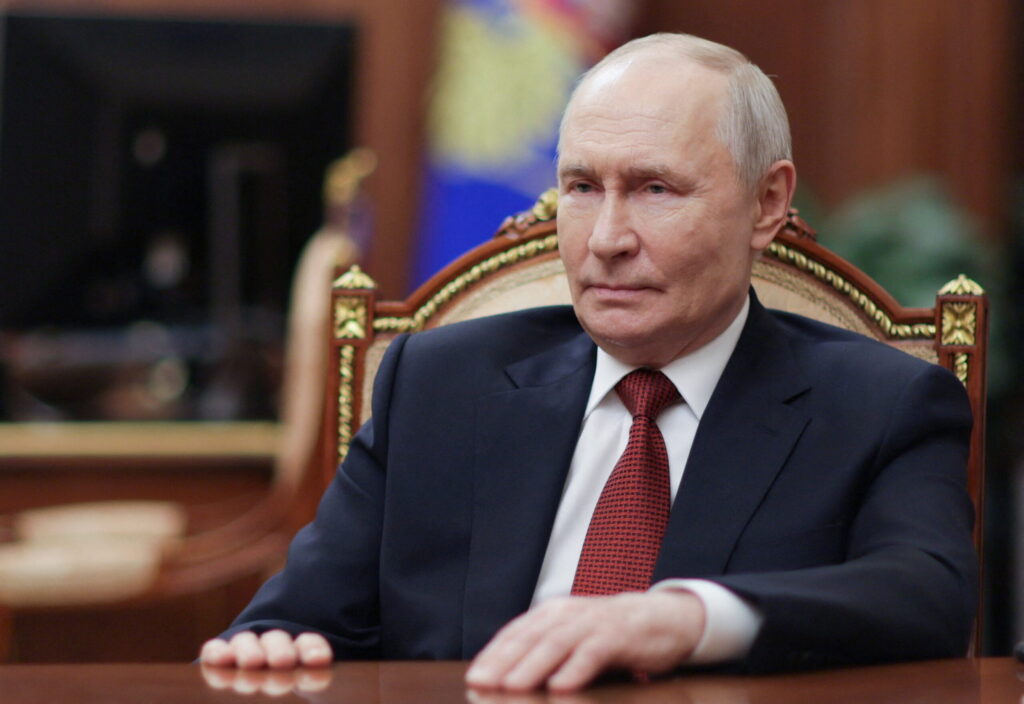
Russian President Vladimir Putin could potentially attack NATO within weeks, according to a series of new United States intelligence assessments. These latest reports follow a number of similar recent warnings from NATO capitals, highlighting growing concerns within the alliance that Putin may be considering a dramatic escalation as he seeks to break the strategic deadlock in his faltering Ukraine invasion.
US officials believe any Russian attack on NATO would likely be limited in scope, with the goal of undermining alliance unity and testing the resolve of individual member countries rather than threatening a major war. One widely discussed scenario would involve Russian troops launching a minor border incursion into the Baltic region. If allies then failed to respond robustly, this would make a mockery of the NATO commitment to collective security and place the future of the alliance in doubt.
The current debate over a possible Russian attack on NATO reflects the alliance’s failure to maintain credible deterrence against its far weaker adversary amid an unprecedented rise in tensions over the invasion of Ukraine. On paper, at least, this makes little sense. After all, the power of the NATO alliance completely dwarfs Russia’s much smaller military and economic potential. In practice, however, it is increasingly apparent that Putin has managed to seize the initiative in this unequal confrontation by exploiting the West’s crippling fear of escalation.
Ever since the onset of Russia’s full-scale invasion in 2022, the Kremlin has sought to intimidate Kyiv’s NATO allies in order to deter support for Ukraine. Tactics have included thinly veiled nuclear threats, encroachments into NATO territory, and a wide range of sabotage operations. These efforts have intensified during the past year, with Russian drones regularly violating NATO airspace in Poland, Romania, and beyond. In late July, a Russian cruise missile struck deep inside Polish territory, around one hundred kilometers from the border with Ukraine.
The latest step up the escalation ladder came in early August with the discovery of an armed drone at Germany’s Leipzig Airport, which serves as an important transport hub for Ukraine and the NATO alliance. The explosives-laden drone was assessed by US officials as belonging to a Russian intelligence service. It was found close to a Ukrainian cargo plane used in the delivery of military supplies. German Interior Minister Alexander Dobrindt said the incident represented a “new level of danger.”
Russia’s escalating acts of aggression against NATO have sparked widespread alarm and generated considerable international headlines but have not yet led to any significant countermeasures from the alliance itself. On the contrary, many countries have consciously sought to downplay airspace breaches and other security threats, portraying them as isolated incidents or accidents rather than as evidence of a coordinated Russian campaign. This obvious reluctance to impose additional costs on the Kremlin will only embolden Putin and fuel Russian perceptions of Western frailty.
Stay updated
As the world watches the Russian invasion of Ukraine unfold, UkraineAlert delivers the best Atlantic Council expert insight and analysis on Ukraine twice a week directly to your inbox.
The West’s collective failure to project strength in its relationship with Russia is not new. Throughout Putin’s reign, Western leaders have often condemned Russia’s increasingly assertive foreign policy but have repeatedly stopped short of decisive action. This dangerous disconnect has convinced many in Moscow that the democratic world is all bark and no bite, setting the stage for a pattern of increasingly aggressive Russian behavior that has plunged Europe into the continent’s biggest war since World War II.
It is easy to understand why Russian officials might have difficulty taking Western rhetoric seriously. Western leaders denounced Russia’s 2008 invasion of Georgia, but many of the loudest critics were soon advocating for a return to business as usual with the Kremlin. When Russia seized Ukraine’s Crimean peninsula six years later, the West once again expressed outrage but chose not to punish Putin in any meaningful way.
This feeble response to the occupation of Crimea was interpreted in Moscow as an invitation to expand the invasion into mainland Ukraine. Within weeks, Kremlin forces were seizing towns in eastern Ukraine’s Donbas region and attempting to spark separatist uprisings throughout much of the country. On this occasion, the chorus of condemnation from Western capitals rang particularly hollow as it was accompanied by multiple European countries lining up to deepen their dependence on cheap Russian energy exports.
Eurasia Center events

Given the West’s long record of mixed messaging and outright appeasement, it is no surprise that Putin was confident of a similarly underwhelming international reaction when he took the fateful decision to launch the full-scale invasion of February 2022. So far, his faith in Western weakness has been partially vindicated.
Over the past four years, Western support for Kyiv has exceeded Moscow’s low expectations, but the emphasis has been on ensuring Ukraine’s survival rather than arming the country to actually win. Military aid has been subject to frequent delays and restrictions, with certain weapons categories remaining entirely off limits amid a debilitating desire to avoid anything that might provoke Putin. This approach has succeeded in preventing an outright Russian victory, but it has also prolonged the war while persuading Putin that his intimidation tactics are effective.
With little prospect of a decisive Russian breakthrough on the battlefield, the Kremlin dictator is now seeking to achieve the goals of his invasion by bombing Ukraine’s civilian population into submission. In parallel, he hopes to convince Ukraine’s European partners to abandon Kyiv via a campaign of hybrid aggression that stops just short of conventional warfare.
Some remain unconvinced by recent claims that Russia may soon attack NATO, with skeptics arguing that Putin cannot beat Ukraine and would be crazy to take on the world’s most formidable military alliance. This is true enough, but represents a complete misreading of Russia’s intentions. While Putin is well aware that going to war against NATO would be suicidal, the experience of the past two decades has convinced him that the alliance is too divided to act decisively and will ultimately offer concessions rather than confront the Kremlin. His aim, therefore, is to discredit NATO rather than defeat it.
In order to counter the looming Russian threat, NATO must speak to Putin in the language of strength, which remains the only language he truly respects and understands. This will not be simple, but it could prevent a further descent toward potential disaster. For two decades, successive Western leaders have embraced policies of appeasement in a bid to avoid provoking Putin. It should now be abundantly clear that nothing is more likely to provoke Putin than Western weakness.
Peter Dickinson is editor of the Atlantic Council’s UkraineAlert service.
Further reading
The views expressed in UkraineAlert are solely those of the authors and do not necessarily reflect the views of the Atlantic Council, its staff, or its supporters.

The Eurasia Center’s mission is to enhance transatlantic cooperation in promoting stability, democratic values, and prosperity in Eurasia, from Eastern Europe and Turkey in the West to the Caucasus, Russia, and Central Asia in the East.
Follow us on social media
and support our work
Image: Russian President Vladimir Putin gives an interview to journalist Pavel Zarubin in Moscow, Russia, June 28, 2026. (Sputnik/Gavriil Grigorov/Pool via REUTERS)
