

Most people think NotebookLM is just for summarizing research papers or turning meeting notes into study guides. And sure, Google’s AI-powered research assistant does that exceptionally well. It can process PDFs, Google Docs, web URLs, and slides, then generate everything from briefing documents to podcast-style Audio Overviews. But here’s what nobody talks about: NotebookLM becomes genuinely transformative when you stop using it conventionally and start feeding it the messy, personal chaos of everyday life.
The weirder my use cases got, the more helpful NotebookLM became. At one point it basically helped me negotiate with myself—and won. What started as an experiment in unconventional productivity turned into a realization that this tool works best when you use it for problems Google never intended it to solve.
Processing emotional chaos into clarity
My journal became my unofficial therapist’s notes

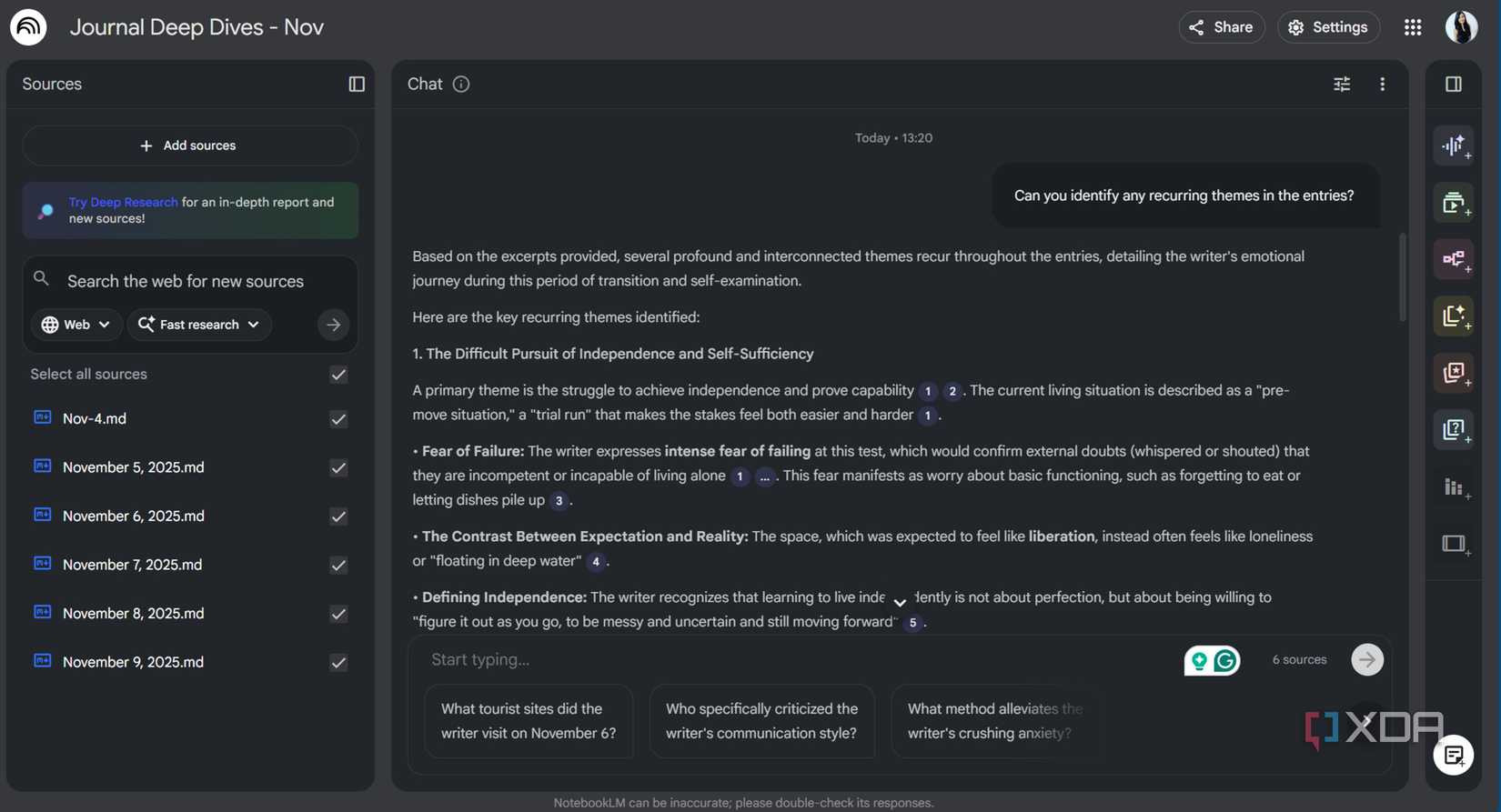
I’ve kept sporadic journals for years, but they were always emotional dumps—stream-of-consciousness rants that felt good to write but impossible to learn from later. Then I discovered NotebookLM could read those entries like a therapist reviewing session notes.
I uploaded journal entries as plain text files into a single notebook. Then I asked NotebookLM to identify recurring themes in my anxiety triggers. Within seconds, it generated a breakdown showing that 80% of my stress spirals happened on Sunday evenings and were almost always related to feeling unprepared for the week ahead. That pattern was invisible to me while writing, but NotebookLM spotted it immediately.
The real power move? I now use NotebookLM’s Audio Overview feature to listen to synthesized “conversations” between two AI hosts discussing patterns in my emotional state. It’s like having two therapists debrief about me, except they’re pulling exclusively from my own documented experiences. This turns introspection from an exhausting mental exercise into something I can absorb passively while doing dishes.
Turning text message novels into TL;DRs
Group chats don’t have to be homework anymore

If you’re in any group chat with more than four people, you’ve experienced the dread of opening your phone to 247 unread messages. Catching up feels like a part-time job. NotebookLM fixed this for me in the most absurd way possible.
I started copying entire group chat threads and pasting them into NotebookLM as plain text sources. Then I’d ask it to extract the actual actionable information: “Who’s hosting? What time? Do I need to bring anything?” What makes this especially effective is NotebookLM’s ability to cite exactly where it found each piece of information, so I can jump back to the original message if something seems off.
You can even use this for work Slack threads that spiral into dozens of messages while you’re in meetings. NotebookLM can distill “we’re changing the deadline to Friday, using the new template, and Karen will send the updated deck” from a 40-message thread about deadlines, templates, and who has access to what folder.

NotebookLM turned years of my texts into a hilarious podcast, and the results were wild
No better way to relive all your memories.
Scripting difficult conversations before they happen
Rehearsing confrontation without the confrontation
I started using NotebookLM to help me prepare for uncomfortable conversations by actually generating potential dialogue scripts based on how I wanted the conversation to go.
I uploaded screenshots of previous text exchanges with a difficult family member, along with a Google Doc where I’d written out my ideal outcomes. I asked NotebookLM to generate three different versions of how I could bring up a sensitive topic—one direct, one gentle, one humorous. It pulled language patterns from our previous exchanges to make the scripts sound natural.
The real magic happened when I asked it to anticipate likely responses based on this person’s communication style in our past messages. NotebookLM essentially became a rehearsal partner, letting me practice navigating potential reactions before the actual conversation happened.
Did I follow the scripts exactly? No. But having them removed the anxiety of “not knowing what to say,” which is usually what makes difficult conversations spiral. I went in prepared with language that felt authentic but was strategically designed to avoid typical conflict triggers.
Creating personal learning content from accumulated bookmarks
My “read later” folder actually got read (sort of)

I had many bookmarked articles sitting in my browser’s “Read Later” folder which was a digital graveyard of good intentions. Actually reading them would take weeks. NotebookLM let me cheat the system.
I fed NotebookLM URLs from my oldest bookmarks across topics I claimed to care about: productivity systems, AI developments, and obscure history. Then I generated an Audio Overview. Suddenly, two AI hosts were having a 15-minute conversation synthesizing the key insights across all 30 articles, making connections between them I would never have noticed reading them individually.
This isn’t deep reading. I’m not pretending it replaces actually engaging with long-form content. But it triages what deserves my full attention. After listening, I knew which three articles were worth actually reading and which 27 were saying variations of the same thing.
The feature that makes this work is NotebookLM’s ability to process web URLs directly as sources without downloading or copy-pasting content. Just drop in links, generate an overview, and let it synthesize across everything.
Why these weird uses work better than the obvious ones
NotebookLM’s real strength isn’t in the features Google highlights
It’s in the tool’s ability to process unstructured human mess and find signal in the noise. Where NotebookLM becomes genuinely useful is in those moments where you need to make sense of something that doesn’t fit neatly into “work” or “school” categories.
The Audio Overview feature deserves special mention. It’s absurdly effective for consuming synthesized insights when reading feels like too much work. And because NotebookLM generates content grounded in your sources with citations, you’re not just getting generic AI responses but also perspectives built specifically from your documented reality.
I’m not claiming that NotebookLM will replace actual therapy, deep reading, or learning how to have difficult conversations. But it can lower the activation energy for all of those things—turning tasks that feel overwhelming into something manageable enough to actually start.
