

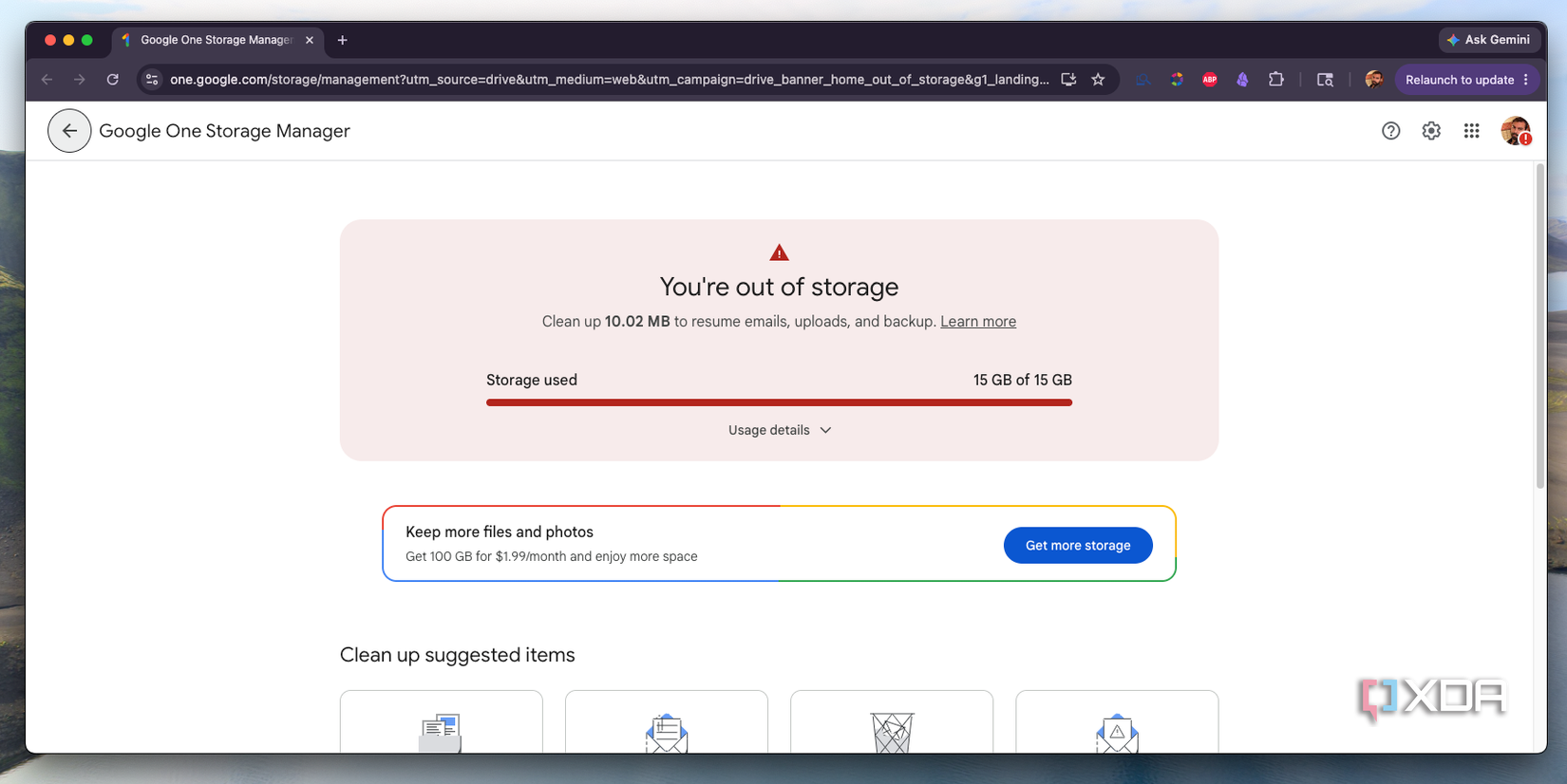
Google has provided users with a huge amount of free storage for a long time, but that gravy train has come to an end. You can still get the storage, but now there’s another requirement: your phone number. New accounts will get only 5GB of cloud storage, compared to the 15GB they previously received. If you want the full amount, you’ll need to hand over your digits. While that might not sound like a big deal, there are significant downsides to being required to give your number, particularly from a privacy perspective.
The phone number requirement means less storage across accounts
5GB doesn’t go far

There is technically no limit to the number of Google accounts you can have, and previously, each account provided 15GB of storage. Unless you have multiple phone numbers, you can’t just create more accounts for more storage; each new account will be limited to just 5GB of storage total. Thankfully, existing accounts are unaffected.
Since storage is shared across all Google services, including Gmail, Google Drive, and Google Photos, 5GB doesn’t go far. Even 15GB is a rather limited amount if you’re a heavy email user. For example, I receive a lot of PR emails, often loaded with images. My Gmail is constantly on the brink of being full, despite routine clean-ups.
On the one hand, I understand. Google is trying to limit how much people can abuse the free storage given to new users. On the other hand, 15GB isn’t much, especially these days.

9 apps that keep me bound to Google’s ecosystem
I won’t be able to leave the Google ecosystem anytime soon because I rely too much on these apps
Phone numbers are frequently leaked in data breaches
A compromised phone number is a bigger risk than a leaked email

Data breaches are far too common these days, even among tech giants like Google. In 2025 alone, millions of accounts were compromised across several leaks, and again in early 2026. A leaked email address here and there isn’t that big of a deal, but phone numbers are a different story. Not only is my phone number linked to numerous multi-factor authentication protocols, but it’s also tied to other personal accounts. It’s a much greater security risk than a leaked email.
If my phone number becomes compromised (not just leaked), it’s much more difficult to replace. I’ve had the same number for twenty years, and I have no desire at all to get a new one and update the dozens of accounts it is linked to.
My phone number is another data point for advertisers
I already receive enough spam texts
Google already scans data stored on its servers for advertising and AI training. It’s an unfortunate fact of life I have come to accept (although it did lead me to de-Google quite a few of my daily services). Throwing phone numbers into the mix is yet another way for Google to collect information that will inevitably be used by advertisers. This isn’t an unfounded concern, either; until 2017, Google scanned Gmail content, and it has various programs that detect spam and illegal content. The company already collects enough information to verify the need for additional storage. Phone numbers aren’t necessary.
Google is right — phone verification makes account abuse more difficult
Phone verification serves a legitimate purpose

Google told Android Authority, “We’re testing a new storage policy for new accounts created in select regions that will help us continue to provide a high-quality storage service to our users, while encouraging users to improve their account security and data recovery.” Without a system of checks and balances, users could create multiple accounts and utilize the storage on all of them. That’s still possible, though a user would now need to create three accounts to match the amount of cloud storage previously available on a single account.
Phone verification isn’t unheard of, either. Tons of services require it, social media included. You also don’t have to provide your phone number at account creation, either. You can create an account, get 5GB of storage, and upgrade to 15GB by providing your number later.

6 reasons you should ditch Google Docs, and what you should use instead
Ditch the generic word processor for a more secure, feature-rich experience.
The storage incentive doesn’t justify the privacy cost

These days, online services provide an increasingly frequent conundrum. If I want verification, I have to provide personal information I might not want to give. From my perspective, there is no reason Google needs my phone number, especially when the trade-off is just 10GB of storage. That’s hardly anything, especially given how poorly optimized most file types are these days. There are other verification options available that would pose less of a privacy and security risk. In addition, this policy makes it difficult for users without phone numbers. There are younger users who still need email accounts, and even if they aren’t using cloud storage, Gmail can quickly hit 5GB on its own.
Google is too much a part of modern life, and that gives it unnecessary power
These days, it’s hard to find anything that isn’t linked to Google. If you have a YouTube account — as most of us do — it’s tied to your Google account. Then there’s Gmail, Google Teams, and a slew of other platforms that connect through Gmail. It’s unreasonable for Google to ask for phone numbers for verification, because there’s little in the way of alternatives other than paid ones.
