

Projections of fire emissions by the CESM-RESFire model
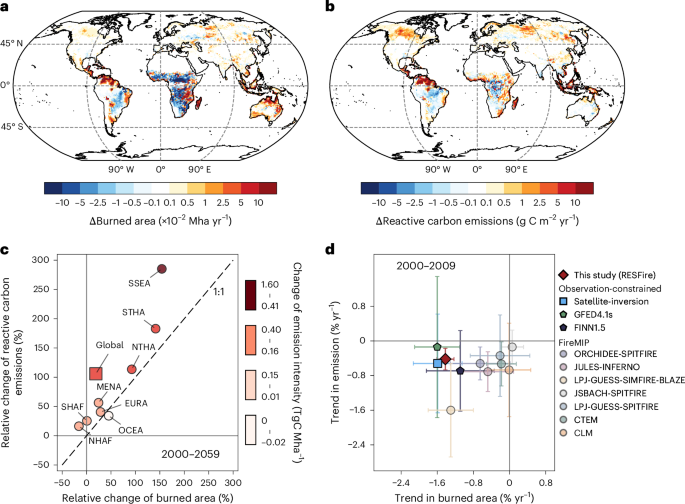
We use fire-emitted RS estimates from the RESFire model17,18, integrated in the CESM, to investigate the chemical and climatic impacts of these fire emissions. Simulations are conducted for the 2000s and the 2050s under the Representative Concentration Pathway 4.5 (RCP4.5) scenario, representing an intermediate climate pathway. The fire model is two-way coupled with the land (CLM) and atmosphere (CAM) modules of the CESM, forced by prescribed sea surface temperature and greenhouse gas concentrations (see Supplementary Table 6 for detailed configurations of present-day and future simulations). This coupling enables dynamic simulation of climate–ecosystem–fire interactions, capturing how future climate change affects vegetation growth, fuel availability and fire weather conditions. RESFire offers process-based simulations of fire ignition, spread and impacts, accounting for region-specific effects of anthropogenic activity and lightning on fire occurrence. The model quantifies fire-generated emissions of about 20 RS from fires, including NOx, HONO, CO, alkanes, alkenes, aromatics, lumped furans and oxidated VOCs (Supplementary Table 2), based on vegetation-type-dependent emission factors (Supplementary Table 4).
The climate–fire–ecosystem interactions are not accounted for in the existing Intergovernmental Panel on Climate Change Sixth Assessment Report (IPCC AR6) projections, which predict a decline in global fire activity primarily due to human influences28,29. Recent studies have started to integrate climate feedback into fire projections29,30,31, but few have provided results for RS emissions. The RESFire model17,18 estimates RS emissions with dynamic fire and ecosystem modelling, enabling the assessment of fire–chemistry–methane feedback.
The RESFire model has been systematically evaluated against observations for its ability to simulate wildfires17. The evaluation is conducted for a range of metrics including fire intensity (that is, burned areas, fire emissions and fire radiative power) and ecosystem responses (that is, plant mortality and ecosystem resilience), using the International Land Model Benchmarking system32. RESFire shows substantially improved modelling scores across these metrics, compared with the default CESM fire scheme (see Zou et al.17 for detailed evaluation results). In particular, the RESFire simulation for the 2000s aligns well with observation-constrained trends in global burned areas and fire emissions (Fig. 1d). Notably, it captures the sharper decline in global burned areas relative to fire emissions during the 2000s6,8,9 (Fig. 1d), an observed feature not replicated by FireMIP models (Fig. 1d and Supplementary Table 3). Previous studies have shown that FireMIP models fail to accurately capture the observed declining trend in the burned areas in recent decades6,8. By contrast, the RESFire model effectively replicates observed decreases in burned areas across Africa6,8 and increases in tropical South America over the past two decades6,7,31 (Supplementary Table 3), demonstrating the model’s adeptness in capturing the variations influenced by both human activities (decreases in African fires) and climatic factors (increases in tropical forest fires).
The RESFire model has previously been applied in studies of wildfire-related PM2.5 (particulate matter less than 2.5 μm in diameter) over the eastern USA by 205033 and fire-favourable weather in the western USA linked to decline in Arctic sea ice34.
Estimate global atmospheric oxidation responses to increasing fire emissions
We evaluate the response of global atmospheric oxidation to the changes in fire emissions in the first half of the twenty-first century predicted by CESM-RESFire, using the GEOS-Chem chemical transport model (v12.9.3). The GEOS-Chem simulations are performed at a horizontal resolution of 4° × 5° with 47 vertical levels. The model simulates tropospheric ozone−NOx−VOC−aerosol chemistry, which involves around 200 species and 800 reactions35.
To isolate the chemical impact of fire emissions, we hold the emissions from non-fire sources and meteorological conditions fixed at the 2000s levels. Anthropogenic emissions are from the global Community Emissions Data System emission inventory36 with aircraft emissions from the Aviation Emissions Inventory Code37 inventory. Biogenic VOC emissions are from MEGAN38, soil NOx emissions are from Hudman et al.39 and lightning NOx emissions are from Murray et al.40. Non-fire sources contribute 263.0 Tg C yr−1 of CO, 87.4 Tg C yr−1 of VOC and 31.7 Tg N yr−1 of NOx emissions. Meteorological data are from the MERRA-2 reanalysis41.
We implement a few updates to RESFire and GEOS-Chem to reflect advances in fire chemistry modelling (see Supplementary Text 3 for details). We include emissions of nitrous acid (HONO) and lumped furan, which have been identified as crucial contributors to chemical reactivity in fire plumes23,24,42,43. Furan oxidation is implemented following Carter et al.44. To account for in-plume transformation not resolved by coarse-resolution models, we implement a parameterization of fire NOx emissions45 that accounts for their rapid transformation to peroxyacetyl nitrate (PAN) and nitric acid (HNO3). These updates generally have minor impacts on the response of global OH concentrations to enhanced wildfire emissions (see Supplementary Text 3 for further discussion).
Global atmospheric oxidation responds quasi-linearly to fire emissions (Supplementary Text 2 and Supplementary Fig. 7). However, the sensitivity of this linear response depends on the representation of atmospheric photochemistry in the model, which can vary greatly across models46,47. To capture this uncertainty in model chemical mechanisms, in addition to GEOS-Chem simulations, we also use chemical sensitivities derived from other chemical transport models to estimate the response of methane loss frequency to changes in fire emissions. These model sensitivities are taken from two model intercomparison projects: the Hemispheric Transport of Air Pollution (HTAP) multimodel intercomparison48,49 and tropospheric oxidant model comparison50,51 (OxComp), including four models (that is, FRSGGUCI-v01, GISS-PUCCINI-modelE, MOZARTGFDL-v2 and TM5-JRC-cy2-ipcc-v1) from HTAP and nine models (that is, IASB, KNMI, MOZ1, MOZ2, MPIC, UCI, UIO, UKMO and ULAQ) from OxComp. We consider the contribution of NOx, CO and reactive VOC emissions to changes in methane loss frequency and use the ensemble average sensitivities for our calculation. This method has been applied previously to study the response of atmospheric oxidation to perturbation in precursors48,51,52. Supplementary Table 5 tabulates the values of model sensitivities and computation results. All these models agree on the direction of methane loss frequency to changes in NOx, CO and VOC emissions. Accounting for this model uncertainty, our estimate of the fire-induced total methane loss frequency reduction ranges from 2.4% to 2.7% between the 2000s and the 2050s (Fig. 2 and Supplementary Table 5).
Quantify the feedback on the global methane budget
The equilibrium global methane burden (B, in Tg) can be described as
where \(E\) denotes the global methane emissions (Tg CH4 yr−1), and k represents the total loss frequency of methane against all sinks (yr−1)53,54. If E changes by \(\Delta E\) and k changes by \(\Delta k\) from the 2000s to the 2050s, then the changes in the equilibrium global methane burden between the 2000s and the 2050s can be expressed as
$$\Delta B=\frac{\Delta E}{{k}_{0}}-\frac{{E}_{0}\Delta k}{{{k}_{0}}^{2}}=\frac{\Delta E}{{k}_{0}}-{B}_{0}\frac{\Delta k}{{k}_{0}},$$
(2)
where \({k}_{0}\) is the baseline total methane loss frequency (0.11 [0.10–0.12] yr−1)28 and \({B}_{0}\) is the baseline global methane burden, derived from the 2000s National Oceanic and Atmospheric Administration surface concentration observations (4,890 Tg CH4 = 1,778.3 ppb × 2.75 Tg CH4 ppb−1). The first term on the right-hand side of equation (2) represents the emission-driven change in the global methane burden and the second term the sink-driven change.
For the sink-driven change, our evaluation accounts for only changes in tropospheric OH concentrations. The relative changes in total methane loss frequency is derived from the GEOS-Chem simulation described above, which yields \(\frac{\Delta k}{{k}_{0}}\) = −2.4%. To assess the uncertainty in model structures and chemical mechanisms, we use model sensitivities from HTAP and OxComp model ensembles (Supplementary Table 5) to compute \(\frac{\Delta k}{{k}_{0}}\) based on the linear decomposition method (Supplementary Equation 1 and Supplementary Text 2). This yields alternative estimates of \(\frac{\Delta k}{{k}_{0}}\) = −2.6% for HTAP and −2.7% for OxComp, respectively (Supplementary Table 5). We thus use [−2.7% to −2.4%] as the uncertainty range for \(\frac{\Delta k}{{k}_{0}}\). Using \({B}_{0}\) = 4,890 Tg CH4, we estimate the atmospheric oxidation driven methane burden change between the 2000s and the 2050s to be 125 [118–132] Tg CH4.
For the emission-driven change, the CESM-RESFire model projects a 19 Tg CH4 yr−1 increase in direct methane emissions from wildfires between the 2000s and the 2050s (Supplementary Table 2). We adopt an uncertainty of 50% given a lack of published estimates to quantify uncertainties, yielding \(\Delta E\) = 19 [10–29] Tg CH4 yr−1. With \({k}_{0}\) = 0.11 [0.10–0.12] yr−1, this translates to an emission-driven methane burden change of 177 [94–268] Tg CH4.
Taken together, our estimate for the fire-induced change in the global methane burden between the 2000s and the 2050s (\(\Delta B\)) is 302 [218–393] Tg CH4.
The impact of wetland feedback on the methane budget is also computed with equation (2) but with \(\frac{\Delta k}{{k}_{0}}=0\) (no chemical feedback from RS) and \(\Delta E\) = 46 [30–56] Tg CH4 yr−1 derived from a series of global vegetation simulations driven by an ensemble of climate projections under RCP4.5 scenario from the CMIP520,21.
In addition, the change in methane sinks due to increasing forest fires (\(\Delta L\), in Tg CH4 yr−1) are estimated as
$$\Delta L={L}_{0}\times \frac{\Delta k}{{k}_{0}},$$
(3)
where \({L}_{0}={B}_{0}{k}_{0}\) = 538 [489–587] Tg CH4 yr−1 is the baseline methane sink. \(\Delta L\) therefore is 14 [12–15] Tg CH4 yr−1.
The uncertainties of \(\Delta B\), \(\Delta L\) and the subsequent \(\Delta \text{RF}\) are derived from Monte Carlo simulations. We perform 100,000 simulations, uniformly sampling the parameters involved within their estimated uncertainty ranges. The central estimate is reported as the mean of the resulting distribution, and the uncertainty is expressed as the 95% confidence interval.
Radiative forcing calculation
We estimate the radiative forcing (W m−2) due to changes in global methane burden using the following equation:
$$\Delta {\text{RF}}_{{\mathrm{CH}}_{4}}={\beta }_{{\mathrm{CH}}_{4}}\times \frac{{\Delta B}_{{\mathrm{CH}}_{4}}}{{\delta }_{{\mathrm{CH}}_{4}}},$$
(4)
where \({\beta }_{{{\rm{CH}}}_{4}}\) represents radiative efficiency of methane (0.000388 W m−2 ppb−1)28, \({\Delta B}_{{\mathrm{CH}}_{4}}\) (Tg CH4) is the change in equilibrium global methane burden computed following equation (2), and \({\delta }_{{{\rm{CH}}}_{4}}\) is the conversion factor55 of 2.75 Tg CH4 ppb−1, used to convert methane burdens to methane concentrations. Using \({\Delta B}_{{\mathrm{CH}}_{4}}\) derived above, we estimate the radiative forcing (\(\Delta {\text{RF}}_{{\mathrm{CH}}_{4}}\)) due to increased wildfires to be 0.04 [0.03–0.05] W m−2.
Similarly, the radiative forcing due to fire CO2 emissions is calculated as
$$\Delta {\text{RF}}_{{\mathrm{CO}}_{2}}={\beta }_{{\mathrm{CO}}_{2}}\times \frac{{\Delta B}_{{\mathrm{CO}}_{2}}}{{\delta }_{{\mathrm{CO}}_{2}}},$$
(5)
where \({\beta }_{{{\rm{CO}}}_{2}}\) represents radiative efficiency of CO2 (1.33 × 10⁻⁵ W m−2 ppb−1)28, and \({\delta }_{{\mathrm{CO}}_{2}}\) is the conversion factor between CO2 burdens and CO2 concentrations (2.12 Pg C ppm−1)55. The fire-driven CO2 burden change, \({\Delta B}_{{{\rm{CO}}}_{2}}\), is equal to the integral of fire CO2 emissions over the first half of the twenty-first century, assuming a linear increase in fire CO2 emissions (Supplementary Text 1). Fire CO2 emissions in the 2000s and the 2050s are given by the RESFire model (Supplementary Table 2). Therefore, \({\Delta B}_{{{\rm{CO}}}_{2}}\) is estimated to be 111,889 Tg CO2, with a 50% uncertainty, yielding \({\Delta B}_{{{\rm{CO}}}_{2}}\) = 111,889 [55,945–167,834] Tg CO2. Consequently, the radiative forcing (\(\Delta {\text{RF}}_{{\mathrm{CO}}_{2}}\)) due to increased wildfires is estimated to be 0.19 [0.15–0.23] W m−2.
