
LIVE NEWS
  • CEO of Minnesota-based company shares her experience applying for a tariff refund : NPR
  • ‘They have been exposed’: The Iran war upends Gulf states’ security and business model
  • Washington-backed rare earth group to buy Brazilian miner for $2.8bn
  • US Army turns to Ukraine-tested drones to counter Iranian UAV threat
  • Increasing heat can boost malnutrition among children
  • More than 200 rescued from IS-linked group in DR Congo
  • What Happens to Bitcoin if the TradFi rally breaks? Wall Street keeps printing record highs but consumer confidence just hit rock bottom
  • Why the Axios attack proves AI is mandatory for supply chain security
Prime Reports
  • Home
  • Popular Now
  • Crypto
  • Cybersecurity
  • Economy
  • Geopolitics
  • Global Markets
  • Politics
  • See More
    • Artificial Intelligence
    • Climate Risks
    • Defense
    • Healthcare Innovation
    • Science
    • Technology
    • World
Prime Reports
  • Home
  • Popular Now
  • Crypto
  • Cybersecurity
  • Economy
  • Geopolitics
  • Global Markets
  • Politics
  • Artificial Intelligence
  • Climate Risks
  • Defense
  • Healthcare Innovation
  • Science
  • Technology
  • World
Home»Science»Closing your eyes to hear better might be a big mistake
Science

Closing your eyes to hear better might be a big mistake

primereportsBy primereportsMarch 20, 2026No Comments3 Mins Read
Share Facebook Twitter Pinterest LinkedIn Tumblr Reddit Telegram Email
Closing your eyes to hear better might be a big mistake
Share
Facebook Twitter LinkedIn Pinterest Email


When people try to focus on a faint sound, many instinctively shut their eyes. The common belief is that removing visual distractions allows the brain to concentrate more fully on hearing, boosting sensitivity. However, this approach does not always work, especially in environments filled with background noise.

A study published in JASA, on behalf of the Acoustical Society of America by AIP Publishing, set out to test whether closing the eyes truly improves hearing under noisy conditions. Researchers from Shanghai Jiao Tong University examined how visual input affects the ability to detect sounds.

Experiment Testing Hearing in Noise

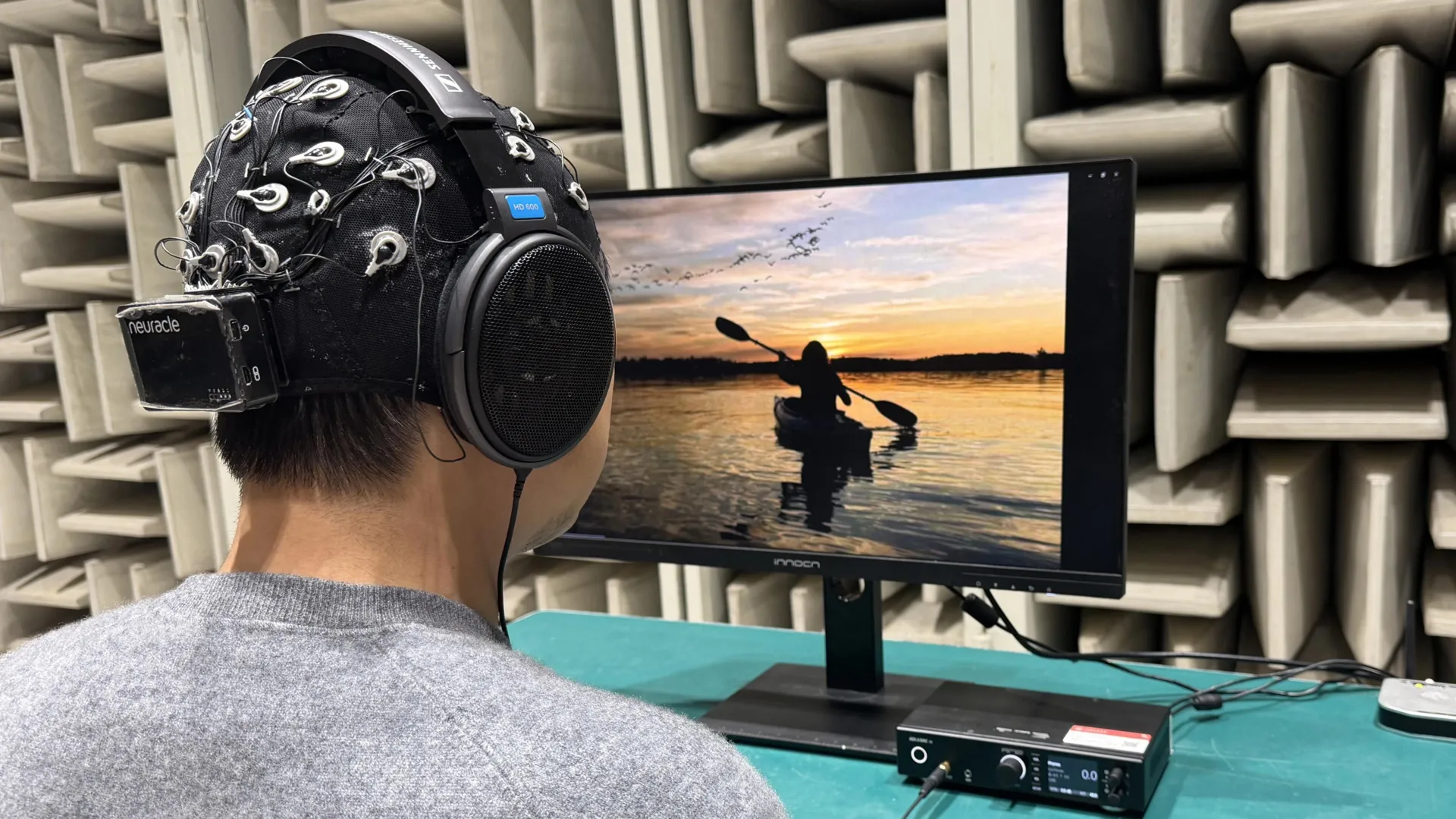
Participants in the study listened to a range of sounds through headphones while background noise played at the same time. Their task was to adjust the volume until each sound was just barely audible over the noise.

The experiment included several visual conditions. First, participants completed the task with their eyes closed. They then repeated it with their eyes open while looking at a blank screen, followed by viewing a still image related to the sound, and finally watching a video that matched what they were hearing.

Closing Eyes vs Visual Cues

The results went against a widely held assumption. “We found that, contrary to popular belief, closing one’s eyes actually impairs the ability to detect these sounds,” said author Yu Huang. “Conversely, seeing a dynamic video corresponding to the sound significantly improves hearing sensitivity.”

Rather than helping, closing the eyes made it harder to pick out faint sounds in noisy settings, while relevant visual input provided a clear advantage.

Brain Activity and Over-Filtering

To understand why this happens, the researchers used electroencephalography (EEG) to track brain activity during the tests. They found that closing the eyes shifts the brain into a state known as neural criticality, which increases how strongly it filters incoming information.

This heightened filtering does not just reduce background noise. It can also suppress the target sounds participants are trying to hear.

“In a noisy soundscape, the brain needs to actively separate the signal from the background,” said Huang. “We found that the internal focus promoted by eye closure actually works against you in this context, leading to over-filtering, whereas visual engagement helps anchor the auditory system to the external world.”

When Closing Your Eyes Still Helps

The researchers noted that the effect appears specific to noisy environments. In quieter conditions, closing the eyes may still improve the ability to detect subtle sounds.

However, since everyday life often involves significant background noise, keeping your eyes open may be the more effective strategy in many situations.

Future Research on Vision and Hearing

The team plans to continue studying how sight and sound interact. One key question is whether the benefit comes simply from having visual input or from seeing something that matches the sound.

“Specifically, we want to test incongruent pairings — for example, what happens if you hear a drum but see a bird?” said Huang. “Does the visual boost come from simply having the eyes open and processing more visual information, or does the brain require the visual and audio information to match perfectly? Understanding this distinction will help us separate the general effects of attention from the specific benefits of multisensory integration.”

Share. Facebook Twitter Pinterest LinkedIn Tumblr Email
Previous ArticleUganda reintroduces rhinos in protected area where they have been extinct since 1983
Next Article Without planning, consultation or legitimacy, the US needs a lot of luck in Iran
primereports
  • Website

Related Posts

Science

Increasing heat can boost malnutrition among children

April 20, 2026
Science

After 200 years scientists finally crack the “dolomite problem”

April 20, 2026
Science

Watch SpaceX launch advanced GPS satellite for US Space Force early on April 20

April 19, 2026
Add A Comment
Leave A Reply Cancel Reply

Top Posts

Global Resources Outlook 2024 | UNEP

December 6, 20258 Views

The D Brief: DHS shutdown likely; US troops leave al-Tanf; CNO’s plea to industry; Crowded robot-boat market; And a bit more.

February 14, 20264 Views

German Chancellor Merz faces difficult mission to Israel – DW – 12/06/2025

December 6, 20254 Views
Stay In Touch
  • Facebook
  • YouTube
  • TikTok
  • WhatsApp
  • Twitter
  • Instagram
Latest Reviews

Subscribe to Updates

Get the latest tech news from FooBar about tech, design and biz.

PrimeReports.org
Independent global news, analysis & insights.

PrimeReports.org brings you in-depth coverage of geopolitics, markets, technology and risk – with context that helps you understand what really matters.

Editorially independent · Opinions are those of the authors and not investment advice.
Facebook X (Twitter) LinkedIn YouTube
Key Sections
  • World
  • Geopolitics
  • Popular Now
  • Artificial Intelligence
  • Cybersecurity
  • Crypto
All Categories
  • Artificial Intelligence
  • Climate Risks
  • Crypto
  • Cybersecurity
  • Defense
  • Economy
  • Geopolitics
  • Global Markets
  • Healthcare Innovation
  • Politics
  • Popular Now
  • Science
  • Technology
  • World
  • About Us
  • Contact Us
  • Privacy Policy
  • Terms & Conditions
  • Disclaimer
  • Cookie Policy
  • DMCA / Copyright Notice
  • Editorial Policy

Sign up for Prime Reports Briefing – essential stories and analysis in your inbox.

By subscribing you agree to our Privacy Policy. You can opt out anytime.
Latest Stories
  • CEO of Minnesota-based company shares her experience applying for a tariff refund : NPR
  • ‘They have been exposed’: The Iran war upends Gulf states’ security and business model
  • Washington-backed rare earth group to buy Brazilian miner for $2.8bn
© 2026 PrimeReports.org. All rights reserved.
Privacy Terms Contact

Type above and press Enter to search. Press Esc to cancel.