

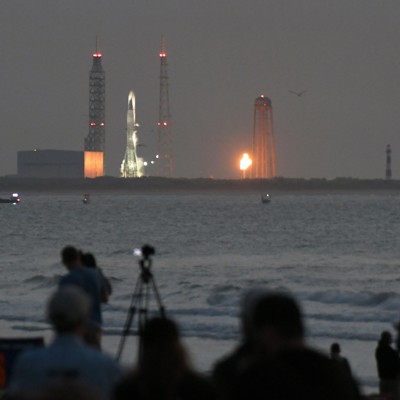
Hours after a Blue Origin rocket blew up on a Florida launch pad last month, a SpaceX rocket lofted a military payload from a nearby site—neatly illustrating concerns about whether the commercial launch industry can actually add providers quickly enough to match the Pentagon’s accelerating demands.
The incident should be “a moment to step back and reassess the fragility of our space launch infrastructure” and how little competition exists for the nation’s military launch missions, said Todd Harrison, the American Enterprise Institute’s defense space expert.
Just two companies are certified to launch the nearly 100 National Security Space launch missions the Pentagon has budgeted for in the next five years: SpaceX and United Launch Alliance.
Several companies are working to introduce new heavy-lift rockets, which handle payloads between 22 and 55 tons. But the ill-fated Blue Origin test failed to move the New Glenn rocket closer to qualification and ULA’s Vulcan heavy rocket is still sidelined amid a probe into a solid rocket booster anomaly. That leaves Elon Musk’s SpaceX with a heavy-lift monopoly, at least for now.
That’s not where service leaders, who plan a steep increase in launches, want to be.
Just before Blue Origin’s May 28 mishap, service officials awarded a task order to the Jeff Bezos-owned company for a National Reconnaissance Office mission by late 2027 or early 2028. Soon afterward, they reiterated their plans to count on the company.
“The U.S. Space Force (USSF) and NRO remain committed partners with Blue Origin and will work with them on the New Glenn vehicle anomaly experienced during its integrated vehicle hot fire test yesterday evening,” Space Systems Command said in a May 29 press release.
AEI’s Harrison suggested the incident was a reminder not to count too heavily on plans.
“I think it hurts some of that optimism that the Space Force may have had about getting a third provider, but I think, in a practical sense, it’s not as if there are near-term missions that we’re depending on New Glenn,” he said. “I think it’s just taking some shine off the rosy projections for the future, that there are going to be more hiccups like this along the way.”
‘We are the primary launch provider’
Congress is also concerned about the lack of launch providers.
The House Armed Service Committee’s initial draft of the 2027 National Defense Authorization Act asks the Air Force Secretary to brief lawmakers on how the Space Force is “investing in capability and capacity” to increase the service’s launch cadence. It also asks for ideas to “accelerate development and reduce barriers to participation by nontraditional defense contractors” to meet the growing mission demand. That report is due by March 2027.
“The committee has a continued interest in maintaining and growing competition across the space enterprise, to include launch,” one HASC staffer said.
In the meantime, SpaceX dominates the market.
“We are the primary launch provider for the U.S. government,” the private company wrote last month in its S-1 filing, part of the paperwork for its highly anticipated initial public offering.
SpaceX rockets launched 11 of last year’s 12 national-security launches, and holds the contracts for five of seven high-profile launch missions in the current fiscal year. SpaceX also launches its own satellites for the Starlink communications constellation, which has become crucial for military operations.
SpaceX has a huge lead against companies trying to take on future national security space missions, said Victoria Samson, the Secure World’s Foundation’s chief director of space security and stability.
“It does speak to how complicated these issues are, how far SpaceX is ahead of its competitors, and the, I would say, unlikelihood of any real competitor to SpaceX in the near future,” Samson said.
But SpaceX’s IPO filing also revealed weaknesses. Its launch business lost roughly $657 million last year. Despite a huge push to field orbital data centers in space, its AI segment lost $6.3 billion. The only profitable segment of the company was Starlink, with $4.4 billion in income.
And several national-security analysts noted that SpaceX is less than fully focused on military launches.
Byron Callan, a managing director at research firm Capital Alpha Partners, said in a note about SpaceX’s prospectus that “does not suggest that SpaceX is being positioned as a major defense contractor” and instead is more aligned with other technology sectors.
Harrison said that SpaceX’s other ambitions could pull focus away from its launch business.
“SpaceX today enjoys a near monopoly on military and national security space launch, and that’s a vulnerability, because we’re talking about a company that has evolved its focus over time from being a space launch company to being a SATCOM company to being an AI data center and space company,” he said. “Launch is an increasingly small part of the SpaceX portfolio.”
More missions, more launchpads
It’s unclear just how long it will take Blue Origin to recover from the explosion, which damaged its only launch pad.
Blue Origin CEO Dave Limp said this week on X that the company plans to have another New Glenn rocket in the skies by “the end of this year.” But SpaceX needed more than a year to repair its own launch pad after a 2016 Falcon 9 explosion.
Kiko Donchev, SpaceX’s vice president of launch, didn’t comment on Blue Origin’s timeline, but described in a post on X how extensive the investigation and cleanup process is.“In the initial days and weeks, you’re using a scalpel, not a bulldozer,” Donchev said, “Cleanup has to be done with a sense of urgency, but extreme precision. It’s literally launch pad surgery.”
The company reportedly has plans to build a second launchpad at the Space Force base and another site is in the works at Vandenberg Space Force Base in California, officials said in April.
Still, the mishap underscores how the paucity of launch pads is a bottleneck for the Space Force’s plans.This year, the service plans to launch more than 200 rockets from the Cape and Vandenberg. In the next decade, that could increase to more than 3,000 launches per year, according to the service’s ambitious “Objective Force 2040” document.
That same document also warns that increased reliance on those two bases “creates enduring vulnerability to natural hazards, operational disruption, and degraded performance during periods of peak demand.”
Last month, the Commercial Space Federation, an industry group, sounded an alarm about the increased tempo of launch missions on traditional sites.
“U.S. orbital launch demand has surpassed 180 launches per year, straining infrastructure that
must be developed years in advance of its need,” the report said, adding that the Defense Department, NASA, local governments, and private companies should “coordinate infrastructure upgrade investments” to improve launch facilities amid growing tempo.
Service leaders told Defense One in April that they’re looking at expanding launch capabilities to other sites and to more providers.
Harrison said the Blue Origin mishap also shows why the government can’t leave the expansion of launch infrastructure to for-profit companies.
“You need to invest in some excess capacity, so that you have it when you need it. It could be a rocket failure that takes out a pad, it could be a hurricane, it could be an earthquake, fire, a wildfire,” Harrison said. “But if you want to have a robust launch enterprise, then you’ve got to build in some redundancy and some resilience that the commercial sector, which is trying to maximize profits, would not necessarily do on its own.”
