

The municipal actors of building modernization
The administrative actors who participated in our co-productive processes work on different organizational levels and in different units of their respective municipal administrations. We encouraged the (political) heads of administration (including mayors), but also operational staff with responsibility for building modernization to participate. This process returned a diverse and illustrative group of administrative actors involved in building modernization. In the following section, we address research question 1 and its sub-questions by elaborating on the actors’ roles and positions within the municipal structures.
Publicly elected mayors serve as the heads of the municipal administration. In Hessen, they are directly elected, but have no formal training requirement, so comprise a fairly diverse group in terms of professional backgrounds and experience43. Municipal administrations in Hessen typically contain various departments such as finance, estates and buildings, tourism, culture, and more, to fulfill their multifaceted tasks. Staff members from 6 of the 12 participating municipalities were employed in a dedicated building department, albeit with varying designations and scopes of responsibility. Three out of the six administrative actors were department heads. Four served as “climate managers” in their respective municipalities, three of whom held temporary positions based on a federal funding program. Climate managers represent a distinct administrative innovation in Germany in order to work across administrative silos and coordinate climate action across the municipality44,45. One climate manager held a permanent position with joint funding from several small municipalities. These municipalities had developed an inter-municipal climate action concept and agreed on joint funding for a climate action manager46. One mayor participated in project workshops only by himself, while two others attended some meetings in conjunction with staff from their administration. Five municipalities occasionally sent more than one representative to project workshops, suggesting a higher level of personnel capacity to engage. Four administrative actors in our workshops had previous experience in the private sector, while the others had longer histories of working in public administration. Based on our work with the municipalities, the actors involved in municipal building modernization can be grouped into the following categories, addressing sub-question (1c): Which more general actor types can be identified from the empirical material?
Mayors and other high-level administrators: Mayors in Hessen have broad responsibilities in structuring and running day-to-day administrative operations. They must implement the decisions of their municipal council. To do so, they are primus-inter-pares members of an executive municipal board (“Magistrat”), whose composition typically reflects the power balance of the council. The mayor and the executive board/administration also have the right to initiative by putting forward proposals and potential courses of action to the municipal council. With smaller matters, the executive board also typically holds direct decision-making powers. The council grants and limits these powers, especially with a view to spending, by setting upper financial limits for executive decisions.
In the area of building modernization, mayors and other high-level administrators thus decide how to organize the relevant tasks in the administration, and they also influence the extent to which modernization processes reflect a political and administrative priority. In so doing, they balance the need for building modernization with other administrative demands and necessities. We found that high-level backing for building modernization activities matters immensely for lower-level staff, because it drives available financial and personnel resources, but also the leeway and trust to implement innovative approaches and to tackle challenging and at times expensive modernization projects. The mayor of Weilrod personally took part in the workshops, underscoring the importance of municipal building modernization for a municipality that manages a particularly large building stock47. The mayors of Fischbachtal48 and Ober-Ramstadt49 participated in selected workshops, accompanied by municipal staff members.
Jack-of-all-trades: Generalists with broad administrative responsibilities but without specific building-related expertise. These individuals typically have general administrative training and potentially wield influence, particularly if they hold leadership positions in the administration. However, they often lack direct building-related expertise, generating dependency on external advisors for more technical aspects. These actors are typically found in smaller municipalities with less differentiated administrations, such as the municipality of Fischbachtal, the smallest among our 12 participating municipalities. The administration of Fischbachtal has a grand total of ten employees. The responsibilities of the building and property management department include processing building permits; general property management and property and building maintenance; maintenance and operation of supply networks, as well as urban planning. The tasks also include citizen and customer service. At the time of this writing, these tasks were handled by approximately 1.5 full-time equivalents. The responsible employees received general administrative training48. In Fischbachtal, everyday operations and urgent maintenance tasks consume a significant portion of the available time, so that very limited capacity remains for fundamental or strategic planning for building modernization. The lack of in-house building-related expertise necessitates the engagement of external consultants for project planning and aspects of implementation48.
Climate Managers: Climate managers reflect an administrative innovation, which started spreading more rapidly across Germany from 2008, when the federal government instituted a dedicated funding program. Climate managers are often generalists, with backgrounds in geography, urban planning, political science, and/or technical aspects44. Their responsibilities typically span different administrative areas and often also include strategic communication and coordination tasks, which may include building modernization. Their effectiveness hinges on their ability to persuade colleagues, to network, and to gain personal standing within the administration. There are no formal training requirements for climate managers, and the contours of the profession were still being defined at the time of this writing. They are often recent university graduates and may hold temporary positions tethered to external funding. This means that their standing within municipal administration can vary, depending on their personality, training, and the openness of their colleagues to engage. In smaller towns, climate managers are often part-time or responsible for multiple municipalities simultaneously.
Occasionally, climate managers are employed through inter-municipal cooperation agreements. Their precise formal institutional location within the administration varies: Climate managers often hold cross-cutting positions that only report to the mayor, working across municipal departments; in other cases, they may be part of a department or unit, such as buildings or environment. Overall, existing research shows that the presence of climate managers leads to more municipal climate action45. In our project, the municipalities of Allendorf (Lumda)50, Alsfeld51, Bad Hersfeld52, and Kaufungen53 had climate managers with significant responsibilities for building modernization.
Building Specialists: Building specialists comprise trained professionals with backgrounds in architecture, engineering, or related fields. They possess significant building-related expertise, affording them greater independence from external experts when compared with generalists. In larger administrations, they may specialize and potentially also work as trained energy advisors. However, building specialists may have limited knowledge of administrative and political processes, which can pose barriers and can lead to frustration. We observed this actor group in larger municipalities with more differentiated administrations, including Bad Soden am Taunus, a municipality in the vicinity of the City of Frankfurt54. The Buildings and Properties department in the Building and Development division of Bad Soden am Taunus is responsible for the majority of municipal properties, except properties owned by the drinking water supply company. The department is responsible for the modernization and new construction of buildings, renting and leasing, maintenance and servicing, as well as the organization of building-related energy supply, including purchasing and billing. The department consists of 15 employees, some part-time, at the time of this writing. Six of them are formally trained architects, including the head of the department and a climate coordinator. The team also includes two clerks and one person responsible for building maintenance. Another staff member deals with room reservations, with one more responsible for billing and four for cleaning. In sum, it is evident in this example that there is a distinct division of tasks among the individual employees54. The municipalities of Bad Hersfeld52, Alheim55, Herborn56, and Ober-Ramstadt49 also have relatively differentiated administrative structures to manage municipal buildings.
Hybrid types: We also found some hybrid types, which combine aspects of the types explained above. In Allendorf (Eder), the climate manager is also a trained building specialist and energy adviser with extensive administrative experience, therefore combining different types of backgrounds and advantages46. Therefore, the formal position or job title does not necessarily indicate the precise range of responsibility and the type of training.
Based on our observations and numerous direct interactions with administrators, we found that structural variables (town size, settlement structure type, and incorporated districts) influence the nature of administrative positions. Very small municipalities tend to have more generalist administrative units for the building sector and therefore rely more on external expertise—which may also be in shorter supply in smaller places—than their bigger counterparts. The larger the municipality, the greater the specialization for building modernization within its administration.
The challenges of small municipalities in building modernization
Identifying the challenges of building modernization in small municipalities involved a two-step, co-productive and participatory approach. In the first workshop, we engaged with the participants in a more general brainstorming session of their challenges. In a second workshop, we asked the municipalities to sort their challenges into a policy-instrument related scheme, drawing on Christopher Hood’s famous work41,42. We translated Hood’s NATO-classification of policy instruments into terms that resonate with practitioners in building modernization, referring to “information and advice” (for nodality), “rules and regulations” (for authority), “subsidies and finance” (for treasure), and “participation in networks and exchange” as well as “adjustments in administrative structures” (both for organization). Furthermore, following practitioner demand, we added a “miscellaneous/other” category in the process to capture any remaining challenges, notably those arising from specific construction or modernization projects. Strikingly, many municipalities reported similar challenges, suggesting that certain issues were common across most or all participants. Below, we describe the challenges by category, addressing our research question (2): What are the main challenges that municipal actors face in modernizing their buildings?
Information and consultation: Frequently changing laws and requirements demand significant time and resources to stay up to date. This challenge is particularly acute for small municipalities, which may only have a few employees with general administrative training. Because of complex grant funding mechanisms from higher government levels and the obligation to involve energy efficiency experts, small municipalities typically depend on external support. Participants noted that due to a shortage of Energy Efficiency Experts (EEE), consulting services to gain the necessary information and advice often had limited capacities, leading to significant delays. Additionally, some participants struggled to find independent and effective consultants, who are not equally available everywhere, with particular challenges in rural settings.
Other difficulties in this category emerged from missing or hard-to-access building documentation. Construction plans of old buildings are often not (yet) digitalized and subsequent changes were not always properly documented, or in one case lost altogether because of flooding in document storage facilities. Such gaps become a particular challenge when EEEs need accurate information for their assessment, which small municipalities cannot always provide easily. In addition, undocumented and/or previously unknown changes to building structures can lead to significant surprises and delays during modernization. Based on the workshop-based exchange, one staff member communicated a need for funding support to survey the state of the municipal buildings in order to plug existing gaps before embarking on the next steps.
Regulation & legal requirements: In line with or surpassing (inter)national requirements, the participating municipalities have climate neutrality targets, with some aiming for 2035 and others for 2045 (the latter as part of signing up as a Klima-Kommune and in synch with the existing Hessian target). However, there is an overall lack of planning and intermediate targets for achieving climate neutrality—including for built structures. One workshop participant insisted: “The goal is to make the municipal buildings climate neutral by 2045, but there is a lack of ideas, concepts, and visions on how this goal can be concretely achieved and what the next steps should be.” The pathway to climate neutrality at the municipal level, therefore, often remains unclear due to a lack of corresponding decisions from municipal councils and/or insufficient financial resources. Climate-related building construction guidelines, such as those found in large Hessian cities like Darmstadt57 or Frankfurt am Main58, typically remain unavailable in smaller municipalities. In the absence of a clear regulatory and legal framework for climate neutrality at the local level, administrative practitioners often struggle to prioritize building modernization measures, both generally but also with a view to the order in which they may want to re-work their municipal buildings.
Funding programs and financing: Obtaining grant funding from higher governance levels for building modernization typically involves complex and time-consuming proposal-writing and associated administrative processes, which require upfront resource investment and experience. Small municipalities with few employees, who are not highly specialized (e.g., see type jack-of-all-trades above), often lack experience in funding acquisition and frequently depend on external consultants to handle applications. The broad range of available funding opportunities from the German federal government and from the federal state level is often confusing and requires significant time and effort to navigate.
Specific funding requirements and frequent changes in funding conditions aggravate the uncertainty and difficulty in securing financial support. The participants described the multitude of ever-changing funding possibilities as a “complex funding landscape” or even a “grant jungle.” The grants often only support direct investments, but not the costs for additional staff for project development. And when grant programs do provide resources for additional municipal personnel, such as the funding of climate managers from the German “National Climate Action Initiative” (NKI), these grants usually only last for a limited time (around 2–3 years). Once the funding ends, keeping the staff and continuing their work generates a lagged financial burden.
This state of affairs directly relates to another, frequently highlighted municipal challenge: financial constraints. Limited financial resources and tight local budgets frequently force municipalities to prioritize immediate building maintenance over long-term energy efficiency, climate adaptation, and other modernization measures, affecting their ability to implement comprehensive approaches, which building specialists typically recommend. Due to the annual budgeting logic, few municipalities have comprehensive and durable financial frameworks for long-term modernization planning. Some municipalities reported a significant drop in business tax revenues, leading to the suspension of planned modernization. When municipalities with severe financial constraints cannot afford a contribution to activate grant-based funding (usually between 10 and 50%), a vicious cycle of low resources continues.
Furthermore, grant funding requirements and administrative budgetary processes are often out of synch. One municipality described how it faced serious delays because it could not start the process of tendering before the corresponding grant agreement had arrived. Another municipality reported undergoing a 14-month review process in order to secure funding for updating its climate action concept. Once grant funding became available, a lengthy tendering process for defined tasks led to additional delays in the implementation phase, generating issues with the annual budgeting logic of both the grant funders and the municipality.
Participation in (municipal) networks: Many municipalities participate in mutual support networks, which foster exchange on various topics, such as the Hessian “Klima-Kommunen” (climate municipalities), a voluntary network of municipalities with the aim to promote climate action26. There are also other easily accessible exchange opportunities, such as an email list for Hessian climate managers. But given the bottom-up organization of the email list, the members are responsible for maintaining the contacts, as well as removing invalid e-mail addresses and adding new members—this was perceived as a challenge by some practitioners.
Districts, cities, and municipalities have also been using more formal types of cooperation, while retaining their independence and local identity. The Hessian state government supports municipal cooperation through funding and advice from a dedicated support center. However, coordinating and networking various actors among different municipalities is time-consuming and requires extensive communication. For example, the Hessian municipalities Bad Camberg, Brechen, Hünfelden, Selters (Taunus), and Weilrod established an inter-municipal working group in 2019 to develop a concept for a joint fire department center. In 2023, they then founded an operating company and were then aiming for funding support from the federal State of Hessen47.
Administrative structures: Almost all of the municipalities highlighted a notable shortage of administrative and specialized staff for building modernization. Staff shortages can, in turn, cause difficulties to cover responsibilities of colleagues who retire or who are on extended leave (e.g., parental or medical leave). This is especially acute in smaller municipalities, where few people are involved in the same field of work, making it difficult to cover for one another. And even when financial support from funding programs can be secured, lacking administrative capacity can hamper implementation, causing projects to stall. The municipalities frequently mentioned delays due to such administrative difficulties, and we also observed these first-hand, as practitioners with responsibility for participation in our project had to interrupt their engagement for months due to changes in their personal circumstances, such as for example parental leave. A lack of backup meant that the work could not continue as originally planned. In times of (local) crisis, municipalities tend to turn to their mandatory tasks, which typically do not include climate action and building modernization59.
The generally considerable daily administrative load and operational tasks often leave little time for comprehensive strategic thinking and planning with a view to building modernization. This particularly affects complex, long-term modernization projects, where many aspects need to be considered, for example, which steps to take and in which order, which stakeholders to involve, how to finance measures, and many more. Furthermore, the process of researching sources of financial support often involves many departments in a decentralized way, adding an additional need for coordination and potentially causing delays.
Cumbersome internal hierarchical structures and staggered approval processes can delay decision-making even more, given that administrative staff may have limited access to (political) management levels. As a consequence, good cooperation between administrators and politicians is an essential condition for successful implementation, but mistrust between administrators and their political counterparts can delay or even block action. One participant used the following proverb to describe their challenges: “A prophet is without honor in his own country.” Such mistrust may develop on the basis of different operational logics and priorities. In addition, building modernization project responsibilities are not always clearly delineated within municipal administrations, making it rather difficult to hold specific individuals or departments accountable.
Finally, administrative reforms (during the 1970s in West Germany and from the 1990s onwards in small towns in East Germany)59 intended the stepwise incorporation of formerly independent surrounding villages, and as a result, small municipalities grew60. With the incorporation of the surrounding villages, the number of public buildings belonging to a single municipality expanded, including multiple town halls, fire stations, and community centers. The preservation of these public buildings is costly, but may have political significance. As one mayor explained: “Demolition is not an option. If the community center is demolished, I will no longer be elected there.”
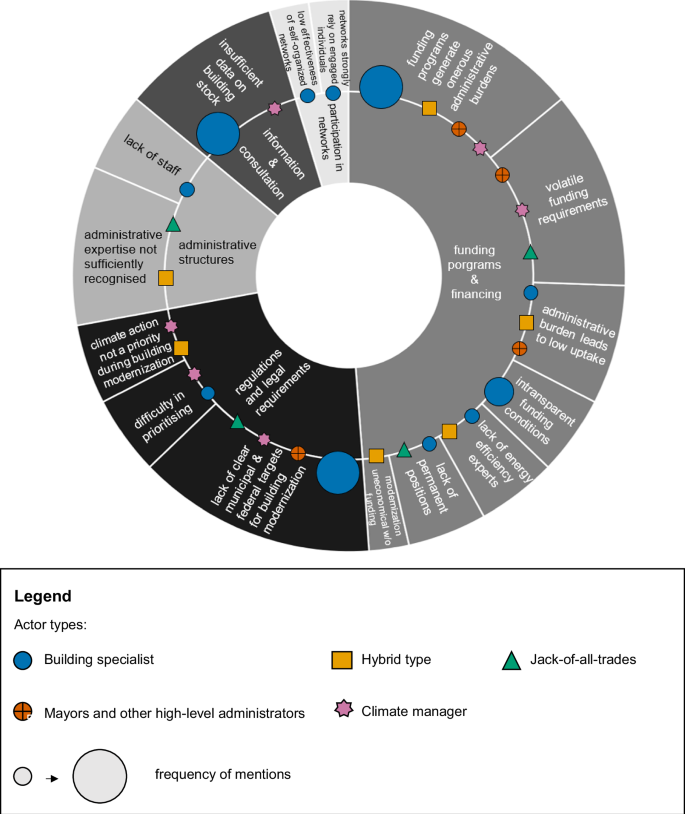
Taken together, our work and exchanges with the municipal administrators demonstrate that, beyond the well-known challenges of resource and personnel shortages in municipalities, a range of additional conditions make building modernization particularly challenging. These range from difficulties to find and use information to the complex coordination processes to acquire resources and manage projects. Such challenges tend to be particularly acute when building modernization is not a clear politico-administrative priority, which often results in minimal maintenance activities rather than more comprehensive building modernization, which would be needed with a view to functional needs and climate targets. As Fig. 1 highlights, each actor type contributed challenges from their perspective—some unique, while others were widely shared by others—illustrating the hurdles municipal actors need to overcome in order to advance building modernization (sub-question 2a).

While challenges related to funding programs and financing account for half of the issues mentioned, there is also a substantial focus on other themes, such as administrative burdens or intransparent funding conditions. Certain challenges, notably insufficient data on the building stock and difficulties in prioritizing, were only mentioned by building specialists and climate managers, while mayors focused on challenges with funding programs, as well as lacking municipal and federal targets for municipal building modernization.
