

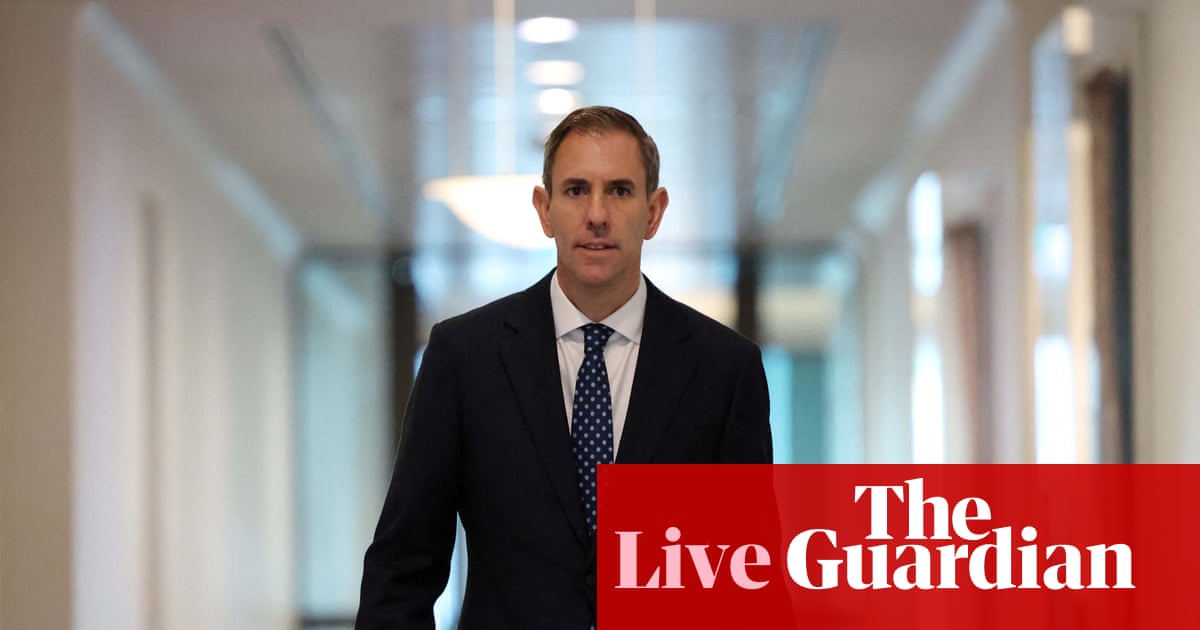
Henry VIII powers on tax bill a ‘secret back door’, say Greens
You say godlike powers, I say Henry VIII powers, either way, the Greens and the Coalition have a problem with the discretionary powers that would allow the treasurer to make rule changes to CGT and negative gearing after the legislation passes.
As we’ve heard many times from the government now, they say it’s all standard practice, but the Greens are sceptical.
Greens senator David Shoebridge says the legislation needs “a really bloody close look”, as the party considers its position.
The term politically is Henry VIII powers, the ability to rewrite laws that have been passed by parliament … That didn’t go well for parliament at the time.
I can’t see how the government can say, well look these laws are really important, we’ve got to pass all these laws, but we want a sort of secret back door to write them off whenever we want, that’s what this bit of legislation says.

Key events
NDIS inquiry receives more than 4,000 submissions
The inquiry examining the government’s bill to overhaul the NDIS has received more than 4,000 submissions, says shadow NDIS minister, Melissa McIntosh.
She says the overwhelming volume of submissions reflects “the high level of anxiety that many Australians who rely upon the NDIS [are] feeling”.
Just over 300 of those submissions have so far been published on the inquiry’s website.
Influential thinktank the Grattan Institute has said in its submission that the overhaul is “blunt and inequitable” and “underpinned by dubious logic”. Read more on that from my colleague, Sarah Basford Canales, here:
McIntosh says:
Minister Butler talks a big game about consulting with the disability community, but Labor has gone about this in the wrong way – they’ve introduced the legislation first and are only now consulting with the community.
We have to strike the right balance between reducing growth in the scheme and ensuring that people with significant and permanent disabilities can access the support they need.
Three days of public hearings are scheduled for next week with the committee due to report back on 16 June.

Patrick Commins
Economy ‘solid’ in early 2026 ahead of Iran war impact, Treasury secretary says
The Treasury secretary, Jenny Wilkinson, has described the economy’s performance over the first three months of 2026 as “solid”.
Appearing at Senate estimates this morning, Wilkinson in her opening statement said the 0.3% real GDP growth rate in the March quarter – and 2.5% through the year – “aligns broadly with our expectations” as laid out in the budget.
Treasury still believed unemployment would peak at current levels of 4.5% and that inflation would ease into 2027. But much depends on what happens in the Middle East, Wilkinson said.
The impacts of the closure of the strait of Hormuz has been cushioned to some extent by a drawdown of global inventories. But there are limits on the extent to which stocks can continue to be drawn down before operational stress levels increase.
This also creates the risk of higher prices in the future if the current continues, even if it doesn’t escalate.
Six childcare centres shut, 99 hit with notices to improve standards under reforms
Six childcare centres facing disciplinary action by the government for not meeting minimum standards have shut, while 99 services have been issued notices to improve since the government passed new safety legislation in December.
Guardian Australia understands the five centres had failed to meet standards within the deadline set by government, but had not yet had their childcare subsidy funding suspended.
Ninety-nine childcare services have been issued notices since new standards were legislated, with 44 now meeting them. The government says those services had persistently failed to improve prior to intervention.
Ninety-two per cent of services are now meeting or exceeding the standards.
The education minister, Jason Clare, says the percentage of childcare centres meeting quality benchmarks “is now at the highest level ever”.
I have been very blunt – not enough had been done by governments – state or federal, Labor or Liberal.
But a lot has happened in the last 12 months and we’re seeing quality and safety across the sector improving.
Under the new reforms, 90% of the childcare workforce has now undertaken mandatory safety training while state and territory regulator inspections have increased 7.15% compared with the previous year, with 6,147 visits in the first quarter of 2026.
Minister defends controversial aged care assessment tool after review ordered
The government has been in hot water over an aged care assessment tool that determines financial support for elderly Australians and has no human override.
The aged care minister, Sam Rae, has continued to defend the process, and said the tool assesses data that is provided by a human who has done an assessment with an elderly person, and then a second human reviews the decision made by that automated algorithm (but critically, that second person can’t change the outcome).
In April, the health department revealed that it had received 834 requests for a review of tool’s assessments since it launched in November.
On RN Breakfast earlier this morning Rae said:
So the human being does the assessment, they’re a highly trained assessor. After that happens, the data goes into the integrated assessment tool. There’s then a second human being, that’s the assessor delegate, who then reviews the data against the notes that have been taken through the assessment process, makes sure that the input data is right.
Host Sally Sara asks him several times to confirm that the second person can’t override the outcome, but Rae won’t say the words.
She asks what the financial benefit has been of making a key part of this process automated. He replies:
This has not been based on any financial savings. This is based on getting the best outcomes … This is getting much better outcomes than the old system. We’re getting fairer outcomes for older people.
Yesterday the government said it had decided to review the integrated assessment tool.
Henry VIII powers on tax bill a ‘secret back door’, say Greens
You say godlike powers, I say Henry VIII powers, either way, the Greens and the Coalition have a problem with the discretionary powers that would allow the treasurer to make rule changes to CGT and negative gearing after the legislation passes.
As we’ve heard many times from the government now, they say it’s all standard practice, but the Greens are sceptical.
Greens senator David Shoebridge says the legislation needs “a really bloody close look”, as the party considers its position.
The term politically is Henry VIII powers, the ability to rewrite laws that have been passed by parliament … That didn’t go well for parliament at the time.
I can’t see how the government can say, well look these laws are really important, we’ve got to pass all these laws, but we want a sort of secret back door to write them off whenever we want, that’s what this bit of legislation says.
Patrick Commins
More than 50,000 permanent residents accessed 5% first home buyer deposit scheme
About 51,000 permanent residents have benefited from the government’s 5% first home buyer guarantee scheme, Housing Australia officials revealed at a Senate estimates hearing last night.
The opposition leader, Angus Taylor, has said he would restrict the program to citizens.
The 5% deposit scheme has been hugely popular with buyers struggling to build a deposit to get into our overpriced property market. Cotality has estimated it takes a typical couple 12 years to save a standard 20% home deposit.
The scheme allows eligible first home buyers to buy with 5%, and in some cases 2%, with taxpayers acting as the guarantor for the remaining 15-18%.
Housing Australia officials said there have been more than 310,000 first-home guarantees since the scheme was launched under the former Coalition government in 2019. A more expanded scheme under Labor has turbocharged demand, with 251,000 of those guarantees since 2022.
Experts say the popularity of the scheme has added to price pressures in entry-level properties.

Josh Taylor
Meta criticises news media bargaining incentive as ‘poorly designed’ and ‘grossly unfair’
Meta has said the federal government’s proposed news media bargaining incentive as a “discriminatory tax” that is “poorly designed” and “grossly unfair”.
The incentive is designed to force Meta, Google and TikTok to make commercial deals with Australian media outlets or they will be forced to pay a dedicated 2.25% levy on local revenues.
Meta published its formal submission to the draft legislation on Thursday morning, and said it would insulate publishers from competitive pressures by guaranteeing revenue. The company again argued that news organisations share their content on Meta platforms for free because they get commercial benefits.
Meta said the news bargaining incentive is:
A discriminatory, retroactive tax targeting a handful of foreign companies while competitors offering comparable services face no equivalent obligation.
Meta claimed it “plainly violates” the US and Australia free trade agreement.
The company said it wasn’t a plan to save journalism but “a tax on innovation dressed up as media policy” and Meta said it is “vehemently opposed” to the legislation.
Meta said most people now come to its platforms for “creator-driven video content” and it’s not the role of digital platforms to pay to rescue public interest journalism.
Hockey endorses plan for three used submarines
Hockey, who last month at the national press club said he had some concerns around Australia receiving three Virginia class submarines, says that the change to buying three second-hand, instead of two used and one new, has allayed some of his fears.
He says that the deal has played out almost exactly as he had predicted under the Trump administration (remembering that the Aukus deal was originally signed under the Democratic Biden administration).
I was repeatedly asked about how Donald Trump would react to the Aukus deal. And I said at the time, he’ll confirm the deal, but say don’t give him the new ones. Now, that’s played out exactly as I predicted. And look, from a military perspective, I think it works well that we have a single platform.
Hockey adds that whether new or used, the Virginia class submarines are “a massive improvement on the Collins class subs”.
Joe Hockey says he’s ‘argued personally’ with Trump over tariffs
There were no surprises for Joe Hockey, the former Liberal treasurer and ambassador to the United States, when the Trump administration yesterday slapped on a new round of tariffs on 54 nations including Australia.
Speaking to the ABC’s RN Breakfast this morning, Hockey said he’d argued personally with Trump over tariffs, but the US president is “not for moving”.
Hockey would know, having served as ambassador from 2016 to 2020, during the first Trump administration.
He says that the US is “running out of money and they need to get it from somewhere”, and Trump believes that somewhere is foreigners paying tariffs (but in fact its American consumers that get hit with the higher prices).
The president of the United States is absolutely convinced that tariffs are great. I’ve argued personally with him on the issue, and he’s just not for moving. He just can’t see the inflationary impact and the negative impact on American consumers. And it just goes to show how the world’s on its head when a leftwing Labour prime minister is trying to convince a rightwing Republican president that free trade is actually the right way to go.
‘We’ll fight against these rotten tariffs’: Angus Taylor
The opposition leader, Angus Taylor, has also joined the fight against the Trump administration’s latest round of tariffs announced yesterday.
He’s doing a doorstop in Canberra, and says the US shouldn’t put tariffs on a friend like Australia, and promises to fight against them.
Not being in government might mean it’s a little tricky for the opposition leader to engage in diplomatic battle against the administration, but at least it’s a bipartisan stance.
Taylor says:
They’re a great friend, and they shouldn’t do it to a friend. We’ve fought with them in every war, every major war. They shouldn’t be imposing tariffs. It’s not what we want to see, and we’ll fight against these rotten tariffs.
‘Nothing good faith’ about tax negotiations, says Paterson
Liberal frontbencher James Paterson has slammed “godlike” discretionary powers in the government’s tax legislation and said the treasurer can’t be trusted to make changes to the reforms once they’ve passed.
Jim Chalmers earlier called the characterisation of the powers being godlike as a “beat-up” and said it was standard practice for several tranches of legislation to make and then refine the rules.
Speaking to Sky News, Paterson says it’s not standard practice when “fundamental questions still can’t be answered about how [the rules are] going to apply”.
[There’s] certainly nothing good faith about the way in which the government has gone about this. As the prime minister admitted himself, he lied to the Australian people on 50 occasions about CGT, negative gearing and trusts.
So, these are not people to trust with godlike powers to make changes at the stroke of a pen after legislation has passed. They should actually get the legislation right.
Tariffs unwarranted and unjustified, says Chalmers
Chalmers also gives a strong rebuke of the Trump administration’s 12.5% tariffs for countries allegedly importing goods made by slave labour, announced yesterday. The administration named 54 countries including Australia.
The treasurer says Australia has world-leading legislation to combat modern slavery, and says the government will “continue to take every opportunity” to fight the levy.
These tariffs are unwarranted, they’re unjustified, and they’re inconsistent with our free trade agreement with the US, and we’ve made that case repeatedly.
So, we will continue to take every opportunity that we can to stand up for Australian exporters and to stand up for the workers and businesses in those industries.
