

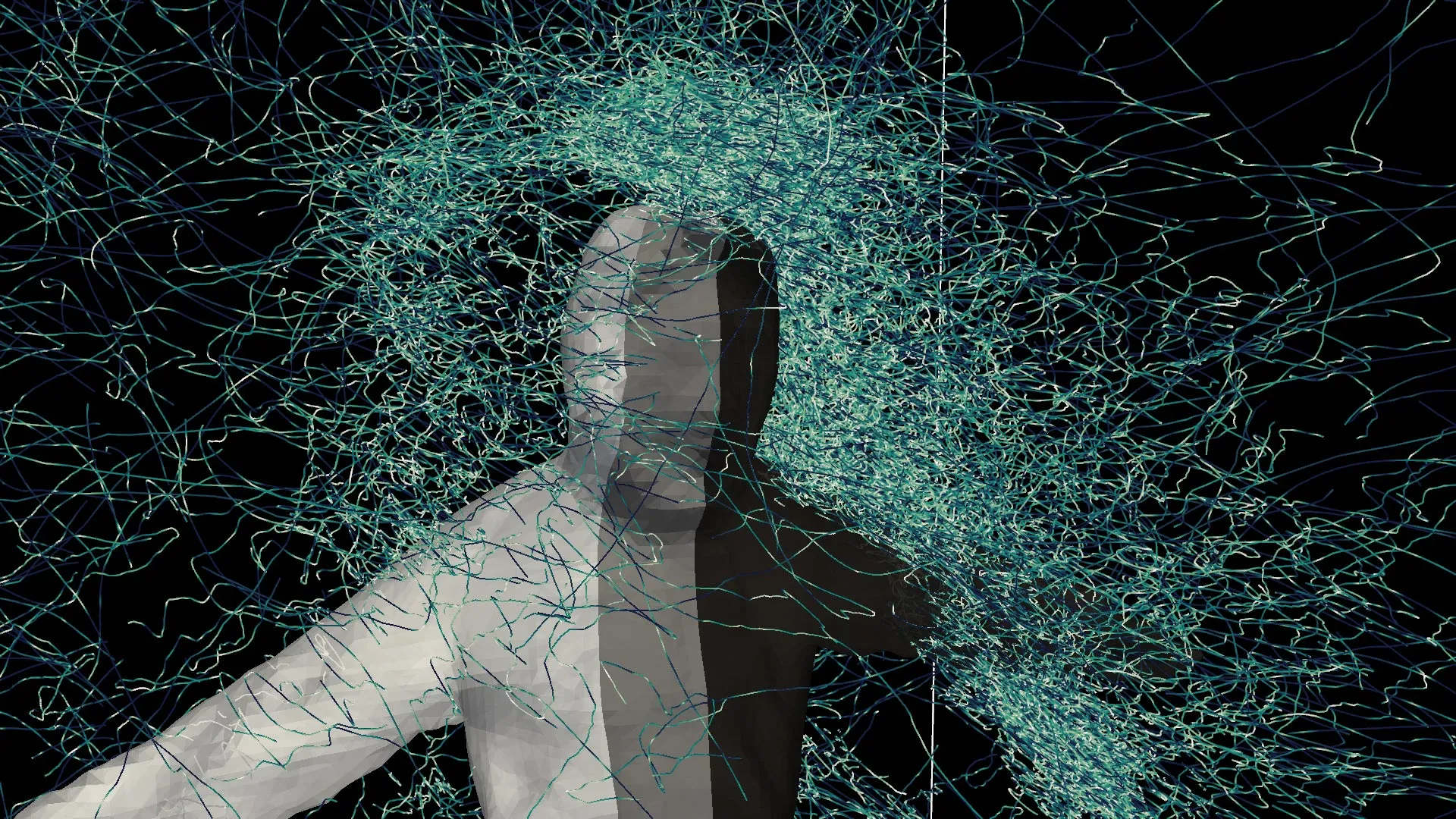
After closely tracking hundreds of mosquitoes swarming around a human subject and analyzing 20 million data points, researchers from Georgia Tech and the Massachusetts Institute of Technology developed a mathematical model that predicts how female mosquitoes fly toward people to feed.
This research offers the first detailed visualization of mosquito flight behavior and provides measurable data that could improve trapping and control methods. Beyond being irritating, mosquitoes spread dangerous diseases such as malaria, yellow fever, and Zika, which together cause more than 700,000 deaths each year.
The team also launched an interactive public website that lets users explore mosquito movement and behavior.
Tracking Mosquito Flight With 3D Imaging
To understand how mosquitoes navigate, scientists used 3D infrared cameras to observe how the insects moved around objects using visual signals and carbon dioxide. They then introduced a person into a controlled chamber, changed his clothing colors, and recorded how mosquitoes flew around him.
The findings, published in Science Advances, focused on female Aedes aegypti mosquitoes (also called yellow fever mosquitoes), a species common in the southeastern United States, California, and many regions worldwide.
Mosquitoes Follow Signals, Not Each Other
The data suggests mosquitoes do not gather because they follow one another. Instead, each insect responds independently to environmental cues, yet they end up clustering in the same place at the same time.
“It’s like a crowded bar,” said David Hu, a professor in Georgia Tech’s George W. Woodruff School of Mechanical Engineering and the School of Biological Sciences. “Customers aren’t there because they followed each other into the bar. They’re attracted by the same cues: drinks, music, and the atmosphere. The same is true of mosquitoes. Rather than following the leader, the insect follows the signals and happens to arrive at the same spot as the others. They’re good copies of each other.”
The Powerful Combination of Visual Cues and CO2
The researchers ran three experiments that adjusted visual targets and carbon dioxide levels. In the first test, a black sphere drew mosquitoes in, but only when they were already flying toward it. After reaching the object, they usually did not stay and quickly moved on.
When the team replaced the black object with a white one and added carbon dioxide, mosquitoes were able to locate the source, but only at close range. Hu observed the insects pausing briefly, almost as if doing a “double take,” before gathering nearby.
When both a black object and CO2 were present together, the effect was strongest. Mosquitoes swarmed the area, lingered, and attempted to feed.
“Previous studies had shown that visual cues and carbon dioxide attract mosquitoes. But we didn’t know how they put those cues together to determine where to fly,” said Christopher Zuo, who conducted the study as a Georgia Tech master’s student. “They’re like little robots. We just had to figure out their rules.”
Human Tests Reveal Where Mosquitoes Target
After identifying the importance of still visual cues, Zuo tested the behavior on himself. He entered a chamber wearing different outfits, including all black, all white, and mixed clothing.
Standing with his arms extended, he allowed dozens of mosquitoes to fly around him while cameras recorded their paths. The data was later analyzed at MIT to determine the most likely rules guiding their movement.
The mosquitoes behaved as if Zuo were simply another object. The largest clusters formed around his head and shoulders, which are the areas the species most commonly targets.
Luo wore a long-sleeved sweatshirt, pants, and head covering in the chamber. He said he wasn’t bitten very often.
Interactive Model Shows Mosquito Behavior
The team’s interactive model and website illustrate how mosquitoes change direction, accelerate, and slow down based on visual signals and CO2. Users can switch between different conditions, including color, carbon dioxide, both, or neither, and observe how up to 20 mosquitoes respond. The platform also allows users to upload custom images as targets.
New Insights Could Improve Mosquito Control
The researchers believe their findings could lead to more effective pest control strategies.
“One tactic is using suction traps that rely on steady cues, such as continuous CO2 release or constant light sources, to attract mosquitoes,” Zuo said. “Our study suggests using them intermittently, then activating suction at intervals, might be better. That’s because mosquitoes don’t tend to stick around their target when both clues aren’t used at the same time.”
Zuo and Hu collaborated with mechanical engineering Ph.D. candidate Soohwan Kim. Additional co-authors include MIT’s Chenyi Fei and Alexander Cohen, along with Ring Carde of the University of California at Riverside.
