

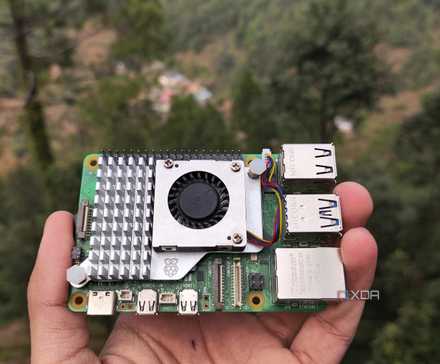
For a long time, I treated my Raspberry Pi setup like the ideal home lab foundation. One board handled DNS, another ran a few Docker containers, and a third picked up whatever task I didn’t want to disturb elsewhere. I devoted a fourth to Jellyfin media streaming. It felt tidy in theory, and there was definitely some charm in seeing several tiny machines humming along together. But after living with that setup for a while, I started noticing that the cluster was giving me more overhead than payoff.
My Raspberry Pi cluster looked clever, but the mini PC works better, uses less power in the real world, and asks a lot less from me to keep it running.
What finally pushed me over the edge wasn’t performance alone. It was the combination of power bricks, microSD anxiety, case clutter, cable sprawl, and the constant need to remember which Pi was doing what. Replacing that whole arrangement with a single low-power mini PC felt almost too simple at first. Then I looked at the power draw, stability, and ease of management, and it became obvious that I’d been hanging on to the Pi cluster mostly because I liked the idea of it.

Cheap mini PCs are the death knell for Raspberry Pis
With x86 mini PCs becoming more budget-friendly, I find it hard to recommend Raspberry Pi SBCs
Consolidation made my home lab much easier to live with
One quiet box replaced several tiny infrastructure headaches
The biggest difference wasn’t raw speed, though there was plenty of that. It was the sudden disappearance of little annoyances that had built up over time and become normal to me. Instead of juggling multiple operating system installs, separate update cycles, and a pile of accessories, I had one machine to manage. That changed the mood of my home lab more than I expected, because it stopped feeling like a collection of compromises stitched together.
A Raspberry Pi cluster sounds efficient until you start adding up everything around it. Each board needs storage, power, networking, cooling if you push it hard, and some kind of physical organization unless you enjoy tracing cables like you’re defusing a bomb. Even when each piece is inexpensive on its own, the total setup gets messy fast. A mini PC cuts through that by putting the CPU, storage, RAM, and power handling into a single, compact box built for this kind of always-on work.
That also made troubleshooting dramatically less annoying. When something went sideways on the Pi cluster, the first question was always which node was having the problem and whether the issue was hardware, storage, power, or the service itself. On the mini PC, that chain of guesswork mostly vanished. I could centralize services, monitor them in one place, and stop wasting time on maintenance that doesn’t teach you anything new and just eats up an evening.
The performance gap was bigger than I expected
Even light services felt smoother once I moved everything

I didn’t need a monster system to replace my Pi cluster. I just needed something with a decent x86 processor, proper NVMe storage, and enough RAM that I could stop planning around scarcity. That turned out to be the sweet spot where everything got easier at once. Containers launched faster, dashboards loaded instantly, and I no longer had to think twice before adding another service just because it might tip one board over the edge.
The storage jump alone changed the experience. Moving from a stack of microSD cards and USB drives to an internal NVMe drive made the whole setup feel more serious and much less fragile. Backups were faster, updates were less stressful, and I spent far less time wondering whether odd behavior was really a software issue or just storage acting flaky again. Raspberry Pi boards can absolutely do real work, but they often ask you to be patient with limitations that a mini PC simply ignores.
Then there’s virtualization, which is where the mini PC really started to run away with the comparison. On the Pi cluster, separating workloads usually meant physically separating them across boards, which sounds elegant until one system is underused and another is gasping. On a mini PC, I can carve things up however I want using VMs or containers and reassign resources without moving hardware. That flexibility made the whole lab feel less like a puzzle and more like a tool I could actually shape around my needs.
Raspberry Pi clusters still make sense in some situations
Small distributed projects can still favor separate single-board computers
To be fair, I don’t think Raspberry Pi clusters are pointless. They’re great for learning distributed systems, experimenting with orchestration, and building setups where separate physical nodes are part of the goal rather than an inconvenience. If your priority is education, tinkering, or just the fun of building a tiny cluster, the Pi route still has real value. There’s also something genuinely satisfying about making modest hardware do bigger things through clever design.
They can also make sense when jobs are naturally split across locations or roles. Maybe you want one Pi by the router, another attached to a printer, and a third dedicated to a display or sensor project somewhere else in the house. In that case, the cluster is less about centralized computing and more about purpose-built endpoints that happen to share a theme. A single mini PC can’t replace that kind of physical distribution, because it solves a different problem.
Cost is the other obvious argument, at least on paper. If you already own multiple Raspberry Pi boards and the accessories to run them, consolidating onto a mini PC may not feel urgent. Reusing what you have is sensible, and not every home lab needs a fresh hardware pivot just because something newer is more convenient. For certain lightweight services, the Pi cluster can still get the job done without much complaint, especially if you’ve already smoothed out the rough edges.
For an always-on home lab, one system wins anyway
Lower friction matters more than theoretical hardware flexibility

That said, the more practical my home lab became, the weaker the cluster argument felt. I wasn’t using it to learn Kubernetes or prove a point about distributed workloads. I was using it to run real services I wanted available all the time, without babysitting them. Once that became the priority, the mini PC’s advantages stopped being abstract and started affecting my day-to-day experience in ways the Pi cluster just couldn’t match.
The power story also landed harder than I expected. A lot of people assume that several Raspberry Pi boards must use less electricity than a mini PC. However, that equation gets fuzzy once you include USB storage, powered hubs, active cooling, and the inefficiency of multiple separate power adapters. My mini PC replaced all of that with a cleaner, more efficient system, and the total draw ended up lower than that of the cluster it took over. That was the moment the whole swap stopped being about convenience and started looking like the smarter long-term setup.
Four Raspberry Pi 4 boards can look efficient until you add up the real load. At roughly 7.6W under load per Pi 4, a four-node cluster lands around 30.4W before you factor in extra storage, cooling, network gear, or the inefficiency of multiple power adapters. By contrast, my GEEKOM Air12 Lite uses Intel’s 6W TDP N100 and has been reported at roughly 5.7W to 6.5W idle, 9W to 15W in lighter daily use, and about 20W under heavier CPU load, which makes it easy to see how one mini PC can undercut a Pi cluster’s total draw in real-world use. That’s the part that surprised me most: the supposedly bigger machine ended up being the simpler and more efficient one.
Most importantly, I trust it more. That doesn’t mean Raspberry Pi hardware is unreliable by default. In my experience, though, a mini PC gives you fewer weird edge cases and fewer points of failure in an always-on environment. Fewer cables, fewer boot media, fewer individual devices, and fewer fragile workarounds add up to a system that feels calmer. And once a home lab feels calm, you get to spend more time enjoying the services it runs rather than constantly maintaining the pile of machines beneath it.
Why this shift changed how I build home labs now
At this point, I don’t really see myself going back to a Raspberry Pi cluster for core home lab services. I still like Raspberry Pi boards, and I still think they’re excellent for appliance-style jobs, experiments, and one-off projects. But when I want dependable infrastructure, a single mini PC makes more sense for how I actually use my gear. It’s cleaner, faster, simpler to back up, and easier to expand without turning my shelf into a tangle of compromises.
The funny part is that the mini PC didn’t make my setup feel bigger or more complicated. It made it feel smaller, because so much of the clutter vanished the second I consolidated everything into one capable box. That’s what sold me in the end. My Raspberry Pi cluster looked clever, but the mini PC works better, uses less power in real-world use, and asks a lot less of me to keep it running.
