

Medical care isn’t just tests and procedures. It’s discussing diagnoses, chatting about health behaviors and conducting psychotherapy. Legally, speech related to medical care has been considered conduct, so it’s subject to state laws that regulate the practice of medicine.
But on March 31, the U.S. Supreme Court decided that some speech related to medical care is different. In ruling on Chiles v. Salazar, an 8 to 1 majority wrote that talk therapy is speech, not conduct. Therefore, regulation of a therapist’s speech could run afoul of the First Amendment, which protects free speech. Specifically, the case looks at whether talk-based “conversion therapy” for minors can be prohibited. This practice, which seeks to change sexual orientation or gender identity, is not backed by evidence.
Setting talk therapy up as separate from other medical conduct could have wide-ranging ramifications for patients, therapists and other medical providers. Until now, the legal framework has been that “medical care delivered through speech was not the kind of speech that’s protected under the First Amendment,” says health law professor Jennifer Bard at the University of Cincinnati. So it’s a big change, she says, to say that talk therapy, which requires a license, is now a practice that the state has less authority to regulate.
And it’s not clear from the majority’s opinion where they draw the line on which speech is solely speech, not medical conduct, and therefore subject to First Amendment protections. “If I tell you to eat steak and that cholesterol is fake,” says public health law professor Michael Ulrich of Boston University, “is that pure speech or is that still somehow going to be framed as medical treatment?”
Supreme Court Justice Ketanji Brown Jackson put it this way in her dissent from the majority opinion: “Before now, licensed medical professionals had to adhere to standards when treating patients: They could neither do nor say whatever they want…. Today, the Court turns its back on that tradition. And, to be completely frank, no one knows what will happen now. This decision might make speech-only therapies and other medical treatments involving practitioner speech effectively unregulatable.”
Here’s a rundown of Chiles v. Salazar, how the decision affects LGBTQ minors and what the case could mean for medical care delivered with speech.
What is this case about?
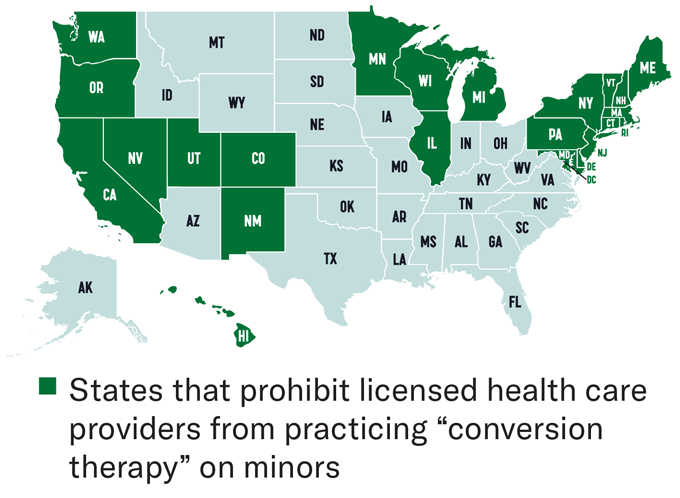
The case centers on a Colorado law that bans state-licensed therapists from using therapy that seeks to change the gender identity or sexual orientation of minors. Colorado is among the 23 states and the District of Columbia that prohibit so-called “conversion therapy” for minors. This practice “is extremely harmful,” Ulrich says. “There’s no benefit, there’s only risk.” Conversion efforts have been denounced by numerous major medical associations.
State of ‘Conversion Therapy’ Laws
Twenty-three states and the District of Columbia have statutes that prohibit “conversion therapy” for minors as of March 30, according to the Movement Advancement Project nonprofit think tank based in Boulder, Colo. The U.S. Supreme Court just ruled that Colorado’s ban impinges on a therapist’s free speech. Michigan is facing a separate challenge to its law, which is currently paused as per the United States District Court for the Western District of Michigan.

The case was brought by Kaley Chiles, a licensed therapist in Colorado. She claimed that the state’s law is a restriction on her viewpoint, because she believes that she can use talk therapy with clients to change their gender identity or sexual orientation.
In its ruling on the case, the 10th Circuit Court of Appeals disagreed. By regulating which treatments the therapist “may perform as a licensed professional counselor, Colorado is not restricting [her] freedom of expression.” The statute regulates professional conduct that “incidentally involves speech,” the appeals court said. That’s because “an aspect of the counseling conduct, by its nature, necessarily involves speech.”
But a majority on the Supreme Court were not swayed by the 10th Circuit ruling. The justices held that Colorado’s law does discriminate on the basis of viewpoint. Because the law allows the expression and practice of gender-affirming care, it dictates which views Chiles may or may not discuss. The majority wrote that the law “does not regulate conduct in a way that only ‘incidentally burden[s] speech’.” The opinion continues, “All [the therapist] does is speak, and speech is all Colorado seeks to regulate.”
Justice Jackson countered that the ability of the government to regulate professions includes instances when the practice of a profession entails speech. The therapist “is not speaking in the ether; she is providing therapy to minors as a licensed health care professional. The Tenth Circuit was correct to observe that ‘[t]here is a long-established history of states regulating the healthcare professions.’ And, until today, the First Amendment has not blocked their way.”
What does the ruling mean for LGBTQ youth?
Conversion efforts attempt to make transgender people cisgender or sexual minority people heterosexual via a variety of methods, including physical punishment or talk-based therapy. Research has found that conversion efforts are tied to a higher risk of depression, anxiety and suicidality. For example, exposure to gender identity conversion practices, especially as a child, is associated with an increased risk of attempting suicide. Meanwhile, state bans of “conversion therapy” are linked to reduced rates of considering suicide among high school students.
Major medical organizations including the the American Academy of Pediatrics, the American Medical Association and the American Academy of Child & Adolescent Psychiatry oppose “conversion therapy,” finding, as the latter organization put it, that such efforts lack scientific credibility and cause harm.
As the American Psychological Association wrote in its amicus brief for the case, the APA and other health organizations “have established empirically supported practice guidelines that encourage clinicians to use gender-affirming practices when addressing gender identity issues.” Gender-affirming care for youth is “developmentally appropriate care that is oriented towards understanding and appreciating [one’s] gender experience,” the brief argues. Furthermore, conversion efforts “are dangerous, unethical, ineffective, and have been repeatedly discredited.”
The ruling doesn’t immediately overturn all laws that prohibit “conversion therapy.” The Supreme Court sent the ruling back to the 10th Circuit, instructing them to reassess Colorado’s law with a higher level of scrutiny, called strict scrutiny, since it involves a free speech infringement. “That is the most stringent form of judicial review,” Ulrich says.
It’s not completely off the table that the law could survive this review, but it will be very difficult. “That will be the question, does it pass under the higher standard? Probably not,” Bard says, because it would be almost impossible to find a justification to restrict therapists’ viewpoint, considering the Court’s stance.
The ruling also opens the door to legal challenges to other jurisdictions’ laws prohibiting the practice. Those laws, like Colorado’s, now face a higher level of scrutiny. It doesn’t mean there can’t be laws that ban the practice of talk-based “conversion therapy,” but they would need to somehow be crafted in such a way that they don’t infringe on therapists’ First Amendment rights.
In a March 31 news release, the American Psychological Association noted that while “traditional malpractice claims for patients who have been harmed by talk therapy remain unaffected by the Court’s ruling,” the opinion “risks leaving patients without meaningful preventive legal protection, shifting recourse to after the harm has already occurred.”
What does the ruling mean for medical care delivered with speech?
That’s going to take time to find out, as it’s not apparent what other kinds of speech in the realm of medical care might also be subject to a higher standard of review in crafting regulation. The ruling is likely to tee off more cases that challenge licensing standards or the regulation of speech in other medical care.
Although the majority opinion recategorized talk therapy as speech and not conduct, it did not provide guidance for “what other kinds of laws or actions are now going to be different for health care delivered through speech,” Bard says. One thing that is concerning, she says, is that “this takes away a state’s ability to identify [and regulate] a form of therapy as harmful and ineffective.”
It also could make it harder for patients to trust that therapists are following a standard of care. “You’re basically saying this license that you have from the state is really kind of meaningless,” Ulrich says, that the state “can’t hold you to a standard of care necessarily.” It could make it harder for therapists to be seen as offering “care that is evidence-based,” he says. “That’s a real problem, I think, for therapists who have spent a lot of time and effort over decades to convey to policy makers, to the public, that this is an actual form of health care.”
In her dissent, Justice Jackson deplored the confusion the ruling leaves as to whether states can still regulate medical care involving practitioner speech. “We are on a slippery slope now: For the first time, the Supreme Court has interpreted the First Amendment to bless a risk of therapeutic harm to children by limiting the State’s ability to regulate medical providers who treat patients with speech.”
Chiles v. Salazar is of a piece with two other cases targeting health care, Ulrich says: Dobbs v. Jackson Women’s Health Organization, which overturned the right to an abortion, and United States v. Skrmetti, which upheld a Tennessee law that goes against medical consensus in banning gender-affirming treatment for minors. “This is the court weighing in on when, why and how politicians can say, ‘Here’s the kind of heath care you can give and here’s the kind of health care that you can’t give,’” Ulrich says. “I think that there should be, frankly, a lot more alarm.”
