

On March 27, an Iranian missile scored a high-value hit on Prince Sultan Air Base in Saudi Arabia, reducing an Air Force E-3 (AWACS) command center aircraft worth up to $500 million to splinters and shards.
While the strike underscored Iran’s capabilities, it also reignited a longstanding conversation about the need for the U.S. to protect its aircraft and other high-value equipment with underground bunkers and hardened shelters — an area in which analysts say adversaries like China have invested far more extensively.
“People are asking the valid question: What on earth was this half-billion dollar airplane doing sitting right out in the open, where commercial satellite imagery can see exactly where it was and target a weapon onto that, which apparently they did,” said Tom Shugart, a retired Navy submarine officer and adjunct senior fellow at the Center for a New American Security’s Defense Program. “I think there’s really good questions being asked about, what are we doing here? And the bigger question is, why wasn’t it already done?”
As missiles continue to hit U.S. bases in the Middle East, the Pentagon is moving to ramp up investment in base hardening. As reported by The War Zone, which has been writing about gaps in infrastructure hardening and aircraft protection for years, March saw the publication of multiple contracting solicitations seeking near-term and long-term solutions, including a Space Force call for “prefabricated transportable bunkers” and a seven-year task order for infrastructure work at Al Udeid Air Base in Qatar.
Defense Secretary Pete Hegseth has called for “more and more bunkers,” saying during a trip to the Middle East that their rapid fielding was a “theater priority,” as also reported by TWZ.
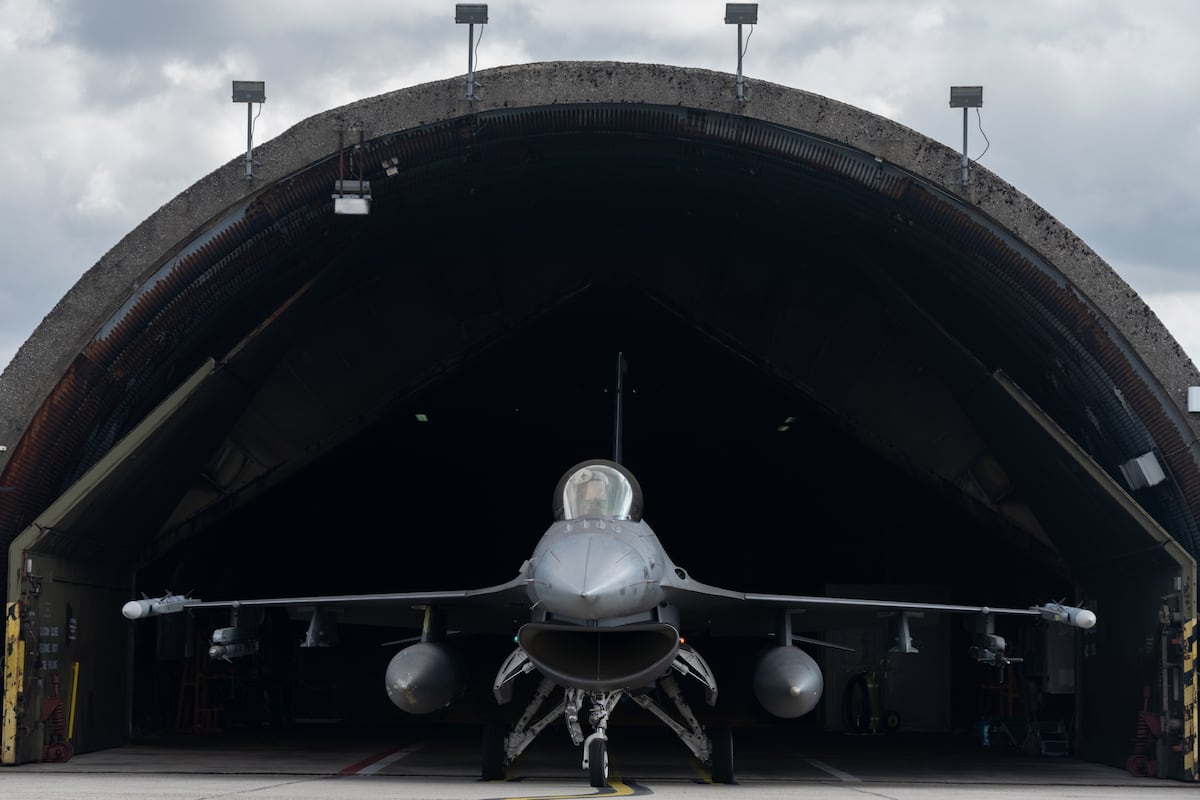
While the emphasis thus far has been on bunkers, Shugart said the protection gap can be seen more clearly in hardened aircraft shelters, which are visible and countable via commercial imagery. A paper, “Concrete Sky,” that he coauthored last year with Timothy Walton of the Hudson Institute found that in the Indo-Pacific, China had more than doubled its number of hardened aircraft shelters between 2010 and 2020, reaching a total of about 800, while the U.S. and its allies had built just two in the same timeframe.
The paper particularly highlights as “foolish” the decision not to build hardened aircraft shelters for the coming fleet of B-21 bombers — describing the shelters as a $30 million investment to protect aircraft worth $600 million apiece.
In recent years, the Army Corps of Engineers has worked to make modest improvements to existing bunkers. Military Times reported in 2024 on reinforcement work including better blast doors intended to protect troops inside from traumatic brain injuries caused by overpressure.
But calls to protect aircraft have been dampened in the past by concerns from leaders about the value of doing so. Shugart noted that Gen. Kenneth Wilsbach, then commander of Pacific Air Forces and now chief of staff of the Air Force, said in 2023 that he wasn’t “a big fan of hardening infrastructure.”
“You saw what we did to the Iraqi Air Force and their hardened aircraft shelters,” he said, referring to U.S. strikes during the Gulf War. “They’re not so hard when you put a 2,000-pound bomb right through the roof.”
If that was true at the time, Shugart said, it might not be as true anymore.
While one missile with submunitions may be able to wipe out multiple aircraft on the ground, it would take one missile to destroy a single hardened aircraft shelter, he said. In that scenario, he estimates the missile would cost $20 million; the shelter, $5 million.
“At that point, you’re at least on the right side of the cost curve,” he said.
Moreover, he added, the Air Force’s own think tanks have also pushed for better air base protection. A paper published in 2024 by J. Michael Dahm, a fellow at the Air Force’s Mitchell Institute for Aerospace Studies, posited that air base defenses had “atrophied” over the last three decades and budgeting for resilient basing had actually declined.
“To date, neither Congress nor the Department of Defense (DOD) have adequately funded air base defense requirements. Without an immediate reversal of this trend, the Air Force may be unable to generate operationally relevant combat airpower in a near peer conflict, which would likely have devastating impacts on joint and combined campaigns,” Dahm wrote. “Inadequate air base defense also strains alliances, incentivizes potential aggressors, and may ultimately result in a strategic loss that has existential consequences for the United States and its allies.”
The Air Force does have a five-year contract for new Expedient Small Asset Protection shelters as part of its Agile Combat Employment strategy — “hangars in a box” for small aircraft or vehicles. It’s not clear, though, how many have been purchased and deployed since the first one was unveiled at Andersen Air Force Base, Guam, in 2023.
Walton, at the Hudson Institute, said past assumptions about hardened shelter space constraints — that they’re mainly for fighters and wouldn’t fit a large plane like the AWACS to begin with — may not hold true. He pointed to the large shelters at Andersen that have been constructed for typhoon protection, saying that could be a starting point design for sheltering the biggest and most costly warfighting assets.
“This would give you an ability to put it in the large aircraft shelter, close the doors and have it not be vulnerable to drones or submission or weapons that are coming up top,” he said. “It could still be probably penetrated by certain classes of unitary warheads, but it helps.”
Both Walton and Shugart emphasized that the threat to U.S. aircraft on the tarmac shouldn’t be considered limited to the Indo-Pacific or the Middle East. With the rise of unmanned aircraft crossing onto military installations, the threat is domestic, too, they said.
“There’s been a slate over the past years of incursions of U.S. airfields and other critical infrastructure, even within the contiguous United States; incursions by drones,” Walton said. “And it exposes how vulnerable U.S. aircraft are to attack at airfields.”
Another Hudson Institute analysis called for 12 small hardened aircraft shelters and three large ones per airfield in the Pacific, where it focused, estimating between $9 billion and $10.5 billion to shore up resilient structures and passive defenses.
