

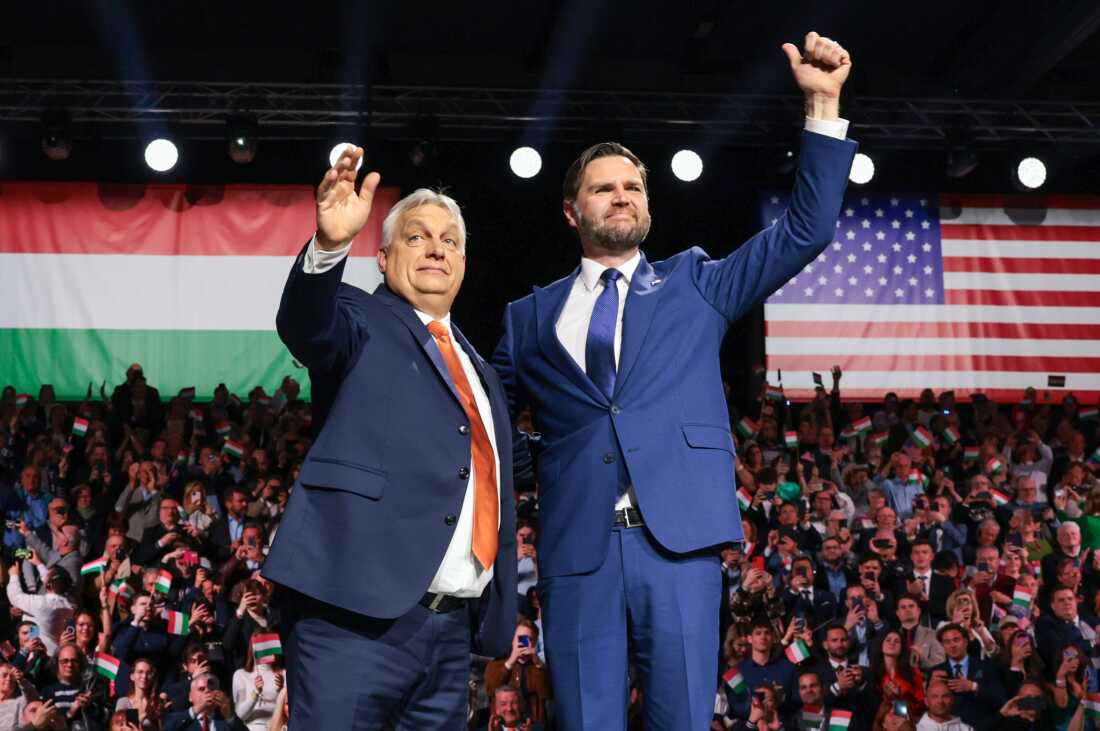

Vice President Vance meets with Hungarian Prime Minister Viktor Orbán on April 7, 2026, in Budapest, Hungary.
Pool/Getty Images/Getty Images Europe
hide caption
toggle caption
Pool/Getty Images/Getty Images Europe
BUDAPEST – Hungary’s election on Sunday, April 12, is about more than who governs a country of almost 10 million. It is a test of a political model: one known as “illiberal democracy,” one that has reshaped not only Hungary’s institutions, but influences conservative movements far beyond its borders. In the final days of the campaign, U.S. Vice President Vance traveled to Hungary in a show of support, underscoring Orbán’s close ties to President Trump and his growing influence within parts of the American right.
But after 16 years in power, Orbán faces one of his most serious challenges yet. And the outcome could reverberate across Europe and the United States.
1. Orbán has transformed Hungary’s political system
After a first term between 1998 and 2002 during which he was seen as a center-right, pro-European leader, Orbán and his party, Fidesz, returned to power in 2010. They rewrote the constitution, reshaped the judiciary and consolidated control over key state institutions.
Independent monitors say those changes have weakened democratic checks. Freedom House, a U.S.-based non-governmental organization that since 1941 has studied human rights and democracy around the world, now classifies Hungary as only “partly free.” The V-Dem Institute, an independent research organization based in Sweden, describes it as an “electoral autocracy.”
For his part, Orbán has variously described his country’s political system as an “illiberal state” based on “national foundations” or a “Christian democracy.”
2. Power now extends into media, business and academia
Critics say the government’s influence reaches far beyond politics and law-making.
Much of Hungary’s media landscape is now aligned with the government, with the public broadcaster shut down, and private networks in the hands of business networks close to Fidesz.
Higher education has also been a flashpoint. The Central European University, funded by Hungarian-American philanthropist George Soros, was effectively pushed out of Budapest. In 2017, the Orban government passed a law known as “Lex CEU” targeting it: the legislation required the respected institution to open a campus in the U.S. or be shut down. Instead, at great expense, it moved to Vienna. Its former president, Michael Ignatieff, has described Hungary as a “training ground” for a broader illiberal political movement.
3. Elections still matter — but the system favors the incumbent
Hungary continues to hold regular elections, and opposition parties campaign freely. But analysts say the playing field is uneven.
Changes to electoral rules, increasing executive branch control over the judiciary, media dominance and the use of state resources give the ruling party structural advantages. That means challengers must win decisively to overcome them.
4. A new challenger has shaken up the race
The emergence of Péter Magyar at the head of the relatively new Tisza party has upended the political landscape.

Péter Magyar on the campaign trail in 2026. A former insider turned challenger, he poses the strongest test yet to Viktor Orbán’s long rule—and to Hungary’s “illiberal democracy.”
Attila KISBENEDEK/AFP via Getty Images
hide caption
toggle caption
Attila KISBENEDEK/AFP via Getty Images
A former member of Orban’s Fidesz, Magyar broke away in 2024 in dramatic fashion: after a man accused of involvement in a child abuse scandal was given a presidential pardon, he began attacking the government for corruption, and turned his personal rupture into a political movement. Since then, he and Tisza have tapped into voters’ frustration over corruption and economic stagnation, drawing large crowds across the country.
He promises to crack down on corruption, to get the EU’s public prosecutor to examine alleged misuse of EU funds sent to Hungary, to restore rule-of-law standards in order to unlock frozen billions in European transfers, and to align more with EU and other Western institutions while reducing dependence on Russian energy.
“We don’t want to live in fear anymore,” Magyar has told supporters at rallies. “This country belongs to all of us, not just those in power.”
After more than a decade of Orbán’s rule, voter fatigue — and economic pressure — could prove decisive.
5. The stakes extend far beyond Hungary
Hungary is a member of both the European Union and NATO, but Orbán has often clashed with Western allies over rule-of-law concerns and relations with Russia.
Think tanks such as the German Marshall Fund argue Hungary has become a key test case for democratic backsliding within the West.
At the same time, Orbán has positioned himself as a model for nationalist movements abroad.
The result of this election will help answer a broader question: whether that model remains durable — or whether voters are ready to turn in a different direction.
